

Evolution
100 Years After The Scopes Trial: The Court Case That Shook America
Discover the story of the 1925 Scopes Trial, the famous courtroom battle over evolution, faith, and education that captured the attention of America.
- Yehosef Yaavetz
- | Updated
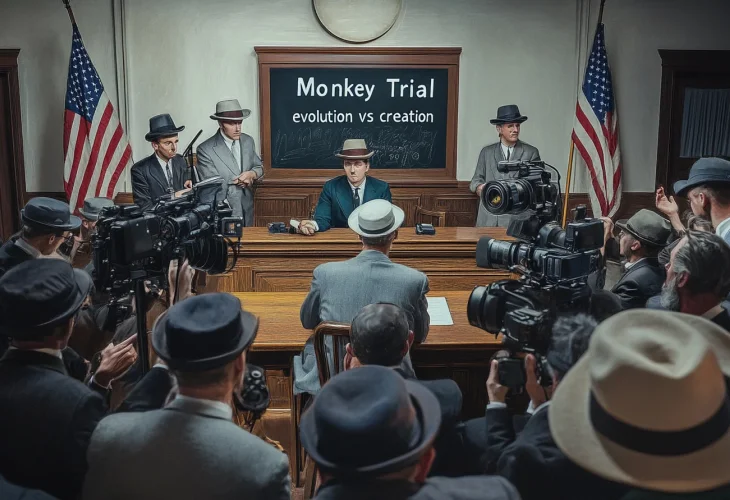
A carnival-like atmosphere took over the town of Dayton, Tennessee. Thousands of people filled the streets. Lemonade stands appeared in local parks, trained monkeys performed in public squares, hundreds of reporters flooded the area, and camera flashes lit up the scene.
Yet despite all the excitement, everyone’s attention was focused on one place: the courthouse.
Inside, a unique and historic trial was unfolding before Judge John T. Raulston.
The year was 1925, exactly 100 years ago. The defendant was John Scopes, a teacher at the local high school. His alleged crime was teaching students that human beings had descended from apes. At the time, Tennessee law prohibited public school teachers from teaching the theory of evolution.
Scopes was arrested for violating the law and later released on bail by a prominent journalist. As news spread across the country, Americans eagerly awaited the dramatic courtroom battle.
A Clash of Famous Figures
One of the most prominent members of the prosecution team was William Jennings Bryan. Bryan had been the Democratic Party’s candidate for president of the United States, served as secretary of state under President Woodrow Wilson, and was also an experienced attorney.
Leading the defense was Clarence Darrow, a famous lawyer known for his sharp wit and outspoken atheism.
As is customary in the United States, twelve jurors sat alongside the judge. Their role would be to determine whether Scopes was guilty or not guilty.
Turning Faith Into a Public Spectacle
The defense sought to turn not only the law itself, but also religious belief in general, into a public spectacle.
During the proceedings, Darrow questioned Bryan about matters of faith. One of his most famous questions concerned the biblical story of Jonah. Darrow asked whether Bryan believed that Jonah had been swallowed by a fish. Bryan answered yes, because that is what is described in the Holy Scriptures.
Darrow then challenged him further: if the Scriptures had said that Jonah swallowed the fish, would he believe that as well?
Bryan responded that the Holy Scriptures do not contain nonsense and that the question itself was inappropriate.
Yet, as is often the case, ridicule can be more powerful in shaping public opinion than serious argument. The defense hoped to create the impression that religious believers were irrational people who could not distinguish truth from fantasy.
The Question About Joshua
Another issue Darrow raised concerned Joshua son of Nun.
According to the biblical account, Joshua caused the sun to stand still. Darrow argued that if the earth’s rotation had suddenly stopped, it would have produced a catastrophic disaster.
Bryan admitted that he had never considered the question, and once again many observers viewed the believer as having been embarrassed.
In reality, the question is not necessarily difficult to answer. The process could have occurred gradually rather than instantly. In such a case, there would not necessarily have been a sudden catastrophe. The essential point of the biblical account is that sunset did not occur at its usual time.
What Was the Trial Really About?
Judge Raulston eventually ruled that the entire debate about faith and Scripture was irrelevant to the case itself.
The discussion was halted and removed from the official record.
The judge emphasized that the issue before the court was simple: Tennessee law prohibited the teaching of evolution in public schools. If Scopes had taught evolution, then he had violated the law. The defense could not place the Holy Scriptures themselves on trial.
The Verdict
The highly publicized trial lasted eight days.
When the proceedings concluded, the jury reached a unanimous verdict: John Scopes was guilty. He had violated Tennessee law and was ordered to pay a fine of one hundred dollars, an amount roughly equivalent to $1,700 today.
The Appeal and Its Outcome
The defense did not accept defeat and appealed the verdict.
Their arguments reflected a more liberal legal approach. Among other claims, they argued that a law banning the teaching of evolution contradicted constitutional principles that encouraged the advancement of literature and science.
The appeal did not succeed.
However, the fine itself was canceled for a technical reason. Under Tennessee law, the jury was supposed to determine the amount of the fine, but Judge Raulston had done so instead.
Although the case could have been reopened and the fine imposed again, the judges recommended ending the matter. Scopes had already lost his teaching position, and there was little desire to transform the courthouse into a public spectacle for a second time.
A Lasting Cultural Impact
Although the legal battle came to an end, the public debate was only beginning.
Newspapers across America threw themselves into the controversy, often criticizing whichever side most differed from their own worldview. Cartoonists produced famous illustrations inspired by the trial, and in later years a film known as The Monkey Trial was created.
To this day, the case remains one of the most famous episodes in the ongoing debate between faith and heresy. More than a century later, people continue to discuss its significance and legacy.
The original Tennessee courthouse has since been preserved as a protected historic site. A commemorative sign stands outside the building, recording the events that took place there in July 1925:
"Here, from July 10 to 21, 1925, John Thomas Scopes, a high school teacher in a county school, was tried for teaching that man had descended from a lower order of animals, in violation of a state law then in effect. William Jennings Bryan assisted the prosecution; Clarence Darrow, Arthur Garfield Hays, and Dudley Field Malone were on the defense side. Scopes was convicted."

