

History and Archaeology
He Escaped the Soviet Union by Jumping Into the Pacific Ocean
In 1974, Soviet scientist Slava Kurilov jumped from a cruise ship into the Pacific Ocean and spent three days at sea in a daring bid for freedom.
- Yehosef Yavetz
- | Updated
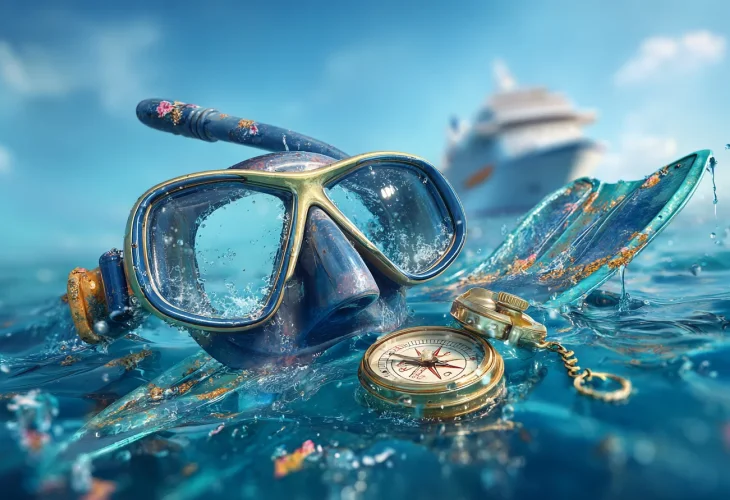
On the night of December 13, 1974, Slava Kurilov stood on the deck of a Soviet cruise ship fittingly named Soviet Union. The vessel was sailing through the Pacific Ocean near the Philippine islands.
Behind him was a regime that would not allow him to leave its borders. Ahead of him stretched a vast, dark ocean with no land in sight.
He had no boat, no map, no rescue team, and no way to call for help. All he had was a diving mask, a snorkel, a pair of fins, years of training, and one simple realization: if he remained on the ship, he would return to the Soviet Union. If he jumped, he might die at sea. But he also might reach freedom and eventually fulfill his dream of reaching Israel.
A Risk Few Would Ever Take
Kurilov had one advantage that made his daring plan even remotely possible: he was an oceanographer and experienced diver.
Waiting for the right moment, he slipped out of sight of the crew and leaped into the rough waters of the Pacific Ocean.
The ship continued on its course, leaving behind a lone figure in the darkness.
At 38 years old, Kurilov knew the dangers better than almost anyone. He understood ocean currents, weather conditions, and the limits of the human body. Yet no amount of expertise could make such a leap safe.
He knew the currents could carry him away from land. He knew exhaustion, dehydration, exposure, and the relentless waves could claim his life long before he reached shore.
Still, he chose to jump.
For three days and two nights, Kurilov swam and drifted through the open ocean. Without food or fresh water, carrying only his fins, mask, and snorkel, he covered roughly 100 kilometers before finally reaching the area of Siargao Island in the Philippines.
A Childhood Dream of Freedom
Stanislav Vasilyevich Kurilov, known as Slava Kurilov, was born in 1936 in Ordzhonikidze in the Soviet Union, now known as Vladikavkaz. He spent much of his childhood in Semipalatinsk, Soviet Kazakhstan.
From a young age, he was fascinated by the sea. Biographical accounts describe how he learned to swim despite his parents' objections and developed a lifelong attraction to water, exploration, and open spaces.
Yet he lived in a country where freedom of movement was tightly controlled. The Soviet Union severely restricted foreign travel, often refusing permission to scientists, professionals, and ordinary citizens who wished to leave.
Kurilov studied meteorology in Leningrad and eventually became a marine scientist and oceanographer. Throughout his career, he participated in scientific expeditions, diving operations, and marine research projects. Time after time, however, his requests to travel abroad were denied.
The Cruise to Nowhere
Eventually, Kurilov discovered a unique opportunity.
A Soviet cruise ship departing from Vladivostok offered what was known as a "cruise to nowhere." The ship would travel through the Pacific Ocean and return to the Soviet Union without stopping at any foreign ports.
Because passengers were not expected to disembark, passports and visas were not required. This allowed Kurilov to board the vessel.
Before the voyage, he carefully studied the ship's route. He realized that at one point it would pass relatively close to the Philippine islands.
By ordinary standards, the distance was still enormous. But for a desperate man with exceptional swimming and diving skills, it represented a chance.
Alone in the Open Ocean
When the moment arrived, Kurilov jumped from the stern of the ship on a stormy night.
His first challenge was survival. He had to move quickly away from the ship's propellers and lights. Had the crew spotted him, they would likely have pulled him back aboard. Had he drifted into the ship itself, his escape would have ended immediately.
Once the ship disappeared into the darkness, he was completely alone.
He navigated using the stars, his knowledge of currents, and his own judgment. He conserved energy whenever possible, alternating between swimming and floating while fighting fatigue and fear.
For long stretches of time, he saw nothing but water.
The open ocean offers no shelter, no landmarks, and no margin for error. Every wave and every decision can mean the difference between life and death.
Reaching Freedom
According to Kurilov's own account, he eventually reached the Philippine coast after his exhausting journey.
Other reports, including information cited by American newspapers based on Philippine authorities, stated that local fishermen found him clinging to a drifting fishing boat near Siargao Island.
Whatever the exact details, one fact is undisputed: the escape succeeded.
Kurilov had reached territory beyond Soviet control.
Philippine authorities questioned him for several months, partly because they needed to determine whether he might be a Soviet agent or whether another explanation existed for his extraordinary arrival.
Eventually, he was permitted to leave for Canada. From there, he immigrated to Israel and began working at the Israel Oceanographic and Limnological Research Institute in Haifa.
From Soviet "Traitor" to Cold War Legend
The Soviet authorities viewed Kurilov very differently.
He was tried in absentia and sentenced to a lengthy prison term for his escape.
In the West, however, his story became one of the most remarkable escape accounts of the Cold War.
Many people fled the Soviet Union through border crossings, political defections, embassies, airplanes, and ships. But escaping by jumping into the Pacific Ocean and surviving days alone at sea was extraordinary even by the standards of Cold War history.
The Sea That Saved Him
Kurilov spent the rest of his life connected to the water he loved.
Tragically, on January 29, 1998, while performing professional diving work in the Kinneret, he became entangled in fishing nets or underwater equipment. Unable to free himself, he eventually ran out of air and drowned.
He was 61 years old.
The sea that had once carried him to freedom ultimately claimed his life. Yet his remarkable act of courage continues to inspire people around the world and remains one of the most extraordinary stories of determination and the pursuit of freedom in modern history.

