

Parashat Pinchas
The Dream Moses Never Lived to See
The deepest Jewish privilege is fulfilling the hopes of those who loved Zion but never arrived.
- Rachel Wigman
- | Updated
In the months leading up to when I made aliyah, my grandmother, may she live and be well, could not stop telling me how proud her mother would have been. Her mother, my great-grandmother, was born in a small town in Poland in the beginning of the twentieth century. She lived with the daily challenges of virulent antisemitism, and as she grew older, she embraced the dream of a Jewish homeland with a love that knew no bounds. In 1928, twenty years before the creation of the state, when she was still living in Poland, my great-grandmother was issued a certificate of recognition for her work on behalf of the Jewish National Fund. Somewhere in Israel, there is a tree that was planted in her honor.
And yet, she never made it to Israel. When she left Poland in 1929, the land of Palestine was under British rule, and immigration certificates were issued somewhat sparingly. My great-grandmother instead got a visa to the United States, settling down in Manhattan’s Lower East Side and finding a job in the garment industry. (One of my favorite stories of her is the unmitigated chutzpah she had every single week when she would leave her job on Friday with her boss telling her that if she didn’t come back the next day, she shouldn’t bother coming back on Monday. And, like clockwork, every Monday she was defiantly back in her seat, refusing to be intimidated into working on Shabbat.) My great-grandmother built a beautiful life in her adopted country, yet she never lost her love for our ancestral homeland, and she spent her entire life wishing that she could somehow come.
I think of my great-grandmother when I think about the end of Moses’ life. We are coming up now on the end of the book of Numbers, which brings us nearly to the end of the narrative portion of the Torah. (The book of Deuteronomy, which we will begin reading in two weeks’ time, is much more instructional than narrative in nature.) At this point, Moses is the last of his generation. His siblings, with whom he led the Israelites for the previous forty years, died back in the portion of Chukat. In that same chapter, Moses was informed that he, too, was to die in the desert.
Moses loved the land with all his heart and all his soul. All he wanted was to be able to enter the land. After he was told that he would die in the desert, he prayed five hundred fifteen separate prayers, begging and pleading to be allowed to enter the land. He bargained with God, asking to go in as a private citizen, willing to abdicate his position as leader just to have the privilege of entering the land. God’s response, each time, was no.
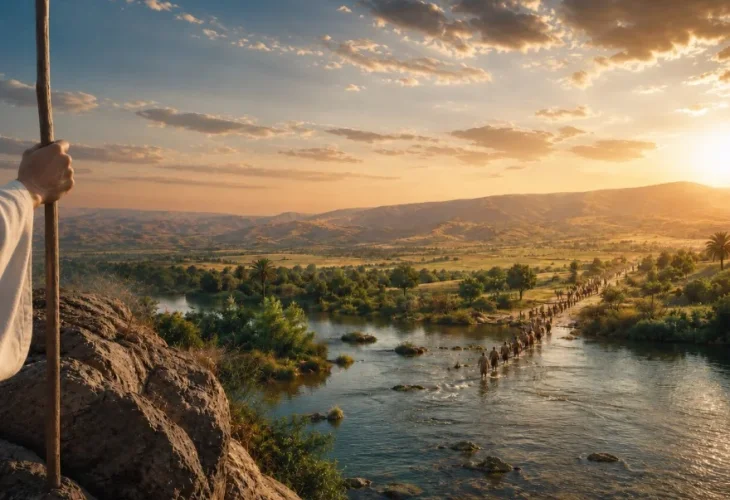
And so when we read in this week’s portion of the first time God tells Moses to go up to the top of the mountain, “And you shall see the land which I am giving to the children of Israel; and you shall see it and you shall be gathered to your nation like your brother Aaron” (Num.27:12-13), it’s a genuinely difficult read. Moses was, just prior, instructed regarding how the land will be apportioned to which families, yet for himself, he only gets to see the land from afar. As difficult as many of the narratives in the Torah are to read, this, to me, is perhaps the most heartbreaking.
Yet, Moses’ response is stunning. He does not cry, he does not get angry. He does not even think of himself in that moment. Instead, Moses turns to God and says, “May the God who knows the inner thoughts of all people appoint a man over the congregation who will lead them when they go out and when they come back, who will bring them forth and who will draw them back in. Do not let the nation of God be like sheep without a shepherd” (27:16-17). His concern is that the people should survive beyond him. Let them be led by someone who is worthy, someone who can bring them to a new reality in their new land, someone who will lead from the front, calling, “After me!”
God does answer his prayer, immediately instructing Moses to appoint Joshua as his successor and to do it in a public ceremony so that no one will contest the appointment. What is so remarkable, though, is that as much as Moses wanted to enter the land, when it came down to it, his chief concern was that the people should be okay. He wanted to know that they would be able to transition from the life of open miracles that they lived for forty years in the desert to the miracle of daily life for which they would toil in their new land. He needed to be sure that the people to whom he dedicated the last forty years of his life would survive his death.
Indeed, they did survive. They lived out his dream, conquering the land, settling it, and raising subsequent generations in God’s own homeland. And we took some bumps along the road, and it was indeed a long road home, but we are still living out his dream today.
My great-grandmother would be so proud of me if she could see me today. But what if Moses could see all of us? He was the spiritual father of the newly-born nation, and I have to believe that he would be, to use the Yiddish expression, shepping nachas like the best of the bubbies and zeidies of the Jewish world.
When we live as Jews, we are his greatest legacy. When we live as Jews in Israel, it’s only compounded. He couldn’t make it to the land, and it’s up to us to carry on in his life’s work. May we merit to continue to make him proud.

