

Wonders of Creation
Blue Holes: The Mysterious Sinkholes Hidden Beneath the Sea
Hidden beneath crystal clear waters, blue holes preserve ancient fossils, sediments, and clues that help scientists unlock Earth's history.
- Shira Dabush
- | Updated
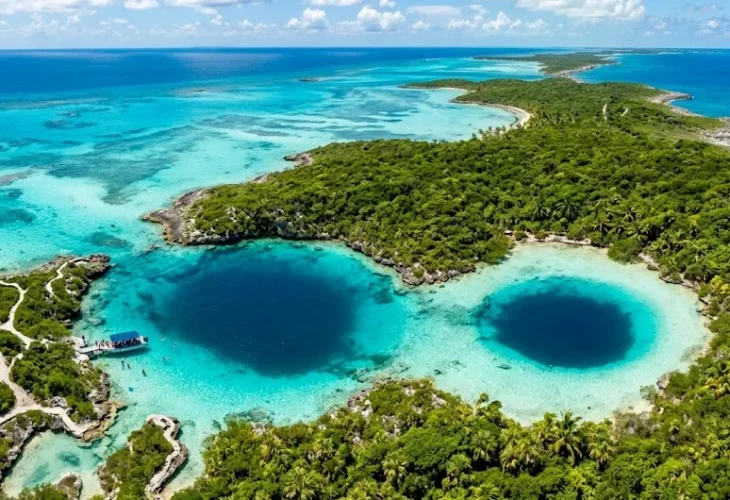
From above, blue holes appear as dark circles set against the brilliant turquoise waters of the sea. Their calm appearance, however, hides one of nature's most remarkable geological wonders.
These enormous underwater sinkholes formed thousands of years ago in limestone rock, creating deep, water filled chambers that continue to fascinate scientists, divers, and explorers alike.
How Blue Holes Were Formed
Blue holes began forming during periods when sea levels were much lower than they are today.
Over thousands of years, rainwater slowly dissolved layers of limestone, carving out vast underground cave systems.
Later, as glaciers melted and sea levels rose, seawater flooded the caves. In many places, the cave ceilings eventually collapsed, leaving behind the deep vertical openings now known as blue holes.
A Natural Wonder in the Bahamas
One of the world's greatest concentrations of blue holes is found in the Bahamas.
Because the islands are composed largely of limestone, they provide ideal conditions for these remarkable formations to develop.
Researchers have identified hundreds of blue holes throughout the archipelago. Some are found on land, while others lie beneath the ocean.
Some extend only a few dozen meters below the surface, while others reach depths of hundreds of meters. Several remain so deep that they have yet to be fully explored or measured.
A Journey Into Another World
Descending into a blue hole is unlike any ordinary dive.
Near the surface, sunlight still penetrates the water. But with increasing depth, the light fades, temperatures change, and the environment becomes dramatically different.
In some blue holes, a unique layer forms where fresh water and seawater barely mix.
Deeper still, oxygen levels become extremely low, creating an environment where very little complex life can survive.
Even so, rare microorganisms have adapted to these harsh conditions, making blue holes an important subject of scientific research.
Because of their narrow passageways, changing visibility, and extreme depth, blue holes are considered among the world's most challenging diving locations. Many require specialized equipment and extensive experience, and some can only be entered as part of carefully supervised scientific or professional diving expeditions.
Nature's Time Capsules
The same conditions that make blue holes challenging to explore also make them invaluable to science.
With very little water movement and almost no oxygen, organic material decomposes extremely slowly.
As a result, blue holes preserve ancient remains with remarkable clarity.
Researchers have discovered the remains of extinct trees, ancient pollen, geological sediments, bones of extinct animals, and even the remains of crocodiles, turtles, and bats that once lived in the region.
Unlocking Earth's History
Each layer of sediment at the bottom of a blue hole serves as a record of Earth's past.
By studying these layers, scientists can reconstruct ancient climates, track changes in sea level, identify periods of intense tropical storms, and better understand how the natural environment of the Bahamas has changed over thousands of years.
Far more than underwater caves, blue holes are extraordinary natural archives, preserving clues about the history of our planet that would otherwise have been lost to time.

