

Israel News
Israel’s Weather Service Warns: El Niño Could Bring Extreme Winter Storms
Israel’s Meteorological Service has released a new study ahead of the coming winter season, finding that “climate shifts driven by the ‘El Niño’ phenomenon create a risk of more extreme weather during the Israeli winter.” The concern: unusually heavy rainfall and a greater chance of flooding in some parts of the country.
- Shlomi Diaz
- | Updated
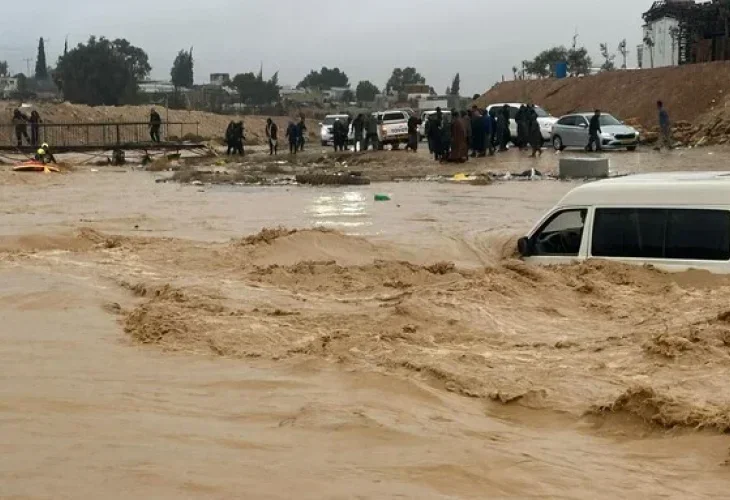 Rescue of a family trapped in their vehicle on Highway 80 (archive photo: Mousa Abu Goudeh, Israel Fire and Rescue Services)
The Israel Meteorological Service today (Thursday) published a new study that found a connection between events caused by the “El Niño” phenomenon and cases of extreme weather in Israel. According to the study, this coming winter may bring an increase in rainfall across Israel, along with a heightened risk of flooding and even a greater possibility of snow.
Following the findings, the service developed emergency scenarios that include rainfall events that could be more extreme than anything measured in Israel to date. The study, led by Dr. Amir Givati and researchers at the Meteorological Service, examined how unusual warming of Pacific Ocean waters affects winter systems in our region.
The researchers analyzed decades of weather systems and compared them with “El Niño” indicators across more than 150 years of observations, with most of the analysis based on data from roughly the past fifty years.
It should be noted that “‘El Niño’ is a natural process that occurs in the Pacific Ocean once every few years. During the phenomenon, sea surface temperatures rise beyond normal across a vast area off the coasts of Peru and Ecuador. That warming changes air currents in the atmosphere, storm tracks, and precipitation patterns around the world.”
According to the researchers, during “El Niño” years, more heat and moisture accumulate in the atmosphere. At the same time, the position of the jet stream shifts — a powerful current of winds at an altitude of about 10 kilometers that guides the path of winter systems. When that current moves southward, the likelihood increases that deep low-pressure systems will also reach Israel and bring especially active rain systems with them.
The Meteorological Service notes that in recent years, Israel has already recorded an increase of up to 40% in rainfall intensity during extreme events in parts of the coastal region. According to the forecasts, this trend is expected to continue and even intensify against the backdrop of global warming, and an extreme “El Niño” could add even more force to it.
The Meteorological Service sent a preparedness document to rescue agencies and local authorities to help them prepare in advance. One scenario describes a short event lasting two to four hours, during which as much as 300 millimeters of rain could fall over a limited area. Such an event could be accompanied by wind gusts of up to 150 kph, hail up to seven centimeters in diameter, and tens of thousands of lightning strikes. Another scenario describes a winter system lasting up to two days, in which 350 to 400 millimeters of rain could fall.
According to the Meteorological Service, such an event could cause widespread urban flooding, rivers and streams to overflow, road closures, damage to railway lines and vital infrastructure, and even disruptions to the operation of security facilities.
According to the preparedness document, the areas most vulnerable to flooding include Nahariya, the Krayot, Haifa, Netanya, Herzliya, Gush Dan, Rishon LeZion, Ness Ziona, Yavne, Ashdod, and Ashkelon. In prolonged rain events, the risk also expands to stream and river areas, including the Ayalon, Yarkon, Shikma, Lachish, Hadera, and Kishon, which could overflow and flood broad areas.
Officials at the Meteorological Service clarified, however, that “despite the troubling forecasts, the study was not intended to determine with certainty that this is what the coming winter will look like. Its purpose is to point out that the risk of extreme events rises significantly when conditions of unusual El Niño are present, and to allow the state to prepare for such scenarios.”

