

Parashat Masei
The Dead Sea and the Secret of the Land of Israel
Discover a profound insight into spiritual transformation, the purpose of the Holy Land, and what it teaches about every Jewish soul
- Rabbi Moshe Sheinfeld
- | Updated
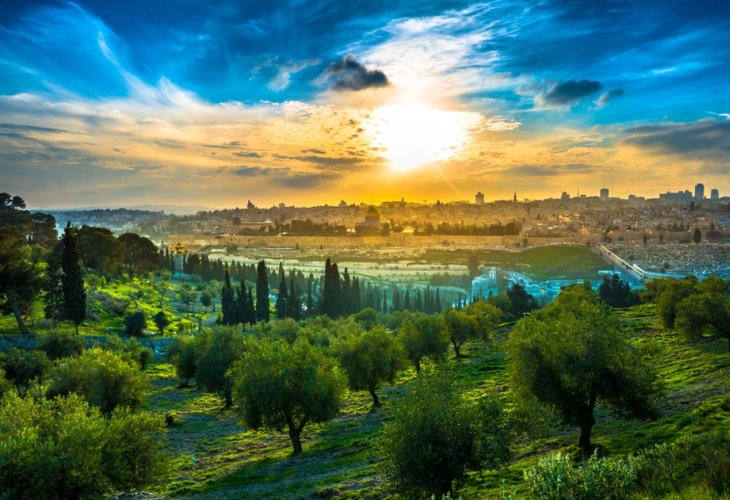 (Photo: shutterstock)
Parashat Masei contains several major themes. It recounts the journeys of the Israelites through the wilderness, presents the commandment to inherit and settle the Land of Israel, describes the borders of the land, details the division of its inheritance among the tribes, discusses the Levitical cities and the Cities of Refuge, and concludes with the request of the tribe of Manasseh that the inheritance of the daughters of Zelophehad remain within their tribe.
One particularly fascinating and relevant insight emerges from the Torah's description of the borders of the Land of Israel. Ultimately, the subject is not only the physical borders of the land, but also the spiritual boundaries of those who dwell within it.
Why Do the Borders Begin and End at the Dead Sea?
The borders of the Land of Israel are described in several places throughout the Torah and the Prophets, although with slight variations. The subject is both complex and extensive, and the classical commentators devote considerable attention to understanding it. That discussion, however, lies beyond the scope of this article.
When we examine the description of the borders in our parashah, one detail immediately stands out. The point of reference from which the Torah traces the borders, as well as both the starting and ending point of the boundary line, is the Dead Sea.
The opening verse states: "Your southern border shall extend from the Wilderness of Zin alongside Edom, and your southern boundary shall begin at the eastern end of the Dead Sea." (Numbers 34:3)
The concluding verse says: "The boundary shall descend along the Jordan, and its endpoint shall be the Dead Sea. This shall be your land with its surrounding borders." (Numbers 34:12)
From a geographical perspective, the explanation is straightforward. The Israelites were camped in the plains of Moab near the Dead Sea, making it the most practical landmark from which to describe the borders. Technically, this answer is correct.
Yet, as with every detail in the Torah, there is undoubtedly a deeper spiritual message as well.
From Paradise to Desolation
Before it became known as the Dead Sea, this region was a flourishing and fertile plain. It was home to the cities of Sodom and Gomorrah, whose fertile soil and abundant water made the area exceptionally productive.
The Torah describes it as: "Well watered everywhere... like the garden of the Lord, like the land of Egypt." (Genesis 13:10)
What transformed this prosperous region into the barren Dead Sea was not nature, but morality: "The people of Sodom were exceedingly wicked and sinful before the Lord."
Because of their corruption, God transformed the fertile land into a desolate wasteland.
The Meaning of "A Land Flowing with Milk and Honey"
This helps explain why the Torah chooses the Dead Sea as the focal point from which to define the borders of the Promised Land.
The Land of Israel is repeatedly described as "a land flowing with milk and honey."
Beyond its simple meaning of agricultural abundance, this phrase carries profound symbolism. Milk and honey are both kosher foods, even though their sources would seem, at first glance, to present a contradiction.
Normally, Jewish law follows a simple principle: that which comes from a non kosher source is itself non kosher, while that which comes from a kosher source is kosher.
For example, milk from a cow is permitted because the cow itself is a kosher animal. Milk from a camel or a lion is forbidden because those animals are not kosher.
Honey and milk appear to be remarkable exceptions.
Honey originates from bees, creatures that are themselves forbidden for consumption. Yet the honey they produce is permitted.
Similarly, according to one opinion in the Talmud, milk originates from blood, which is forbidden to consume, yet through the natural processes within the animal it is transformed into something entirely permissible.
Both foods symbolize transformation.
The Unique Power of the Land of Israel
This, perhaps, is one of the defining spiritual qualities of the Land of Israel.
The Land possesses the unique capacity to transform. It has the power to elevate impurity into purity and wickedness into righteousness.
The Torah frequently refers to the land as the Land of Canaan, even though Canaan himself was cursed: "Cursed be Canaan; a servant of servants shall he be."
Why preserve such a name?
Perhaps because one of the unique qualities of the Land of Israel is its ability to transform what is cursed into what is blessed and, tragically, when misused, even the reverse.
God embedded within this land unique spiritual qualities designed specifically for the Jewish people and the Torah.
The Land Reflects the People
This explains another remarkable verse: "A fruitful land became a salty waste because of the wickedness of its inhabitants." (Psalms 107)
The fertile land became barren because of the moral failure of those who lived there.
Yet the very same chapter later declares: "He turns the wilderness into pools of water and dry land into flowing springs." (Psalms 107:35)
The same land that became desolate can once again become a source of life.
Jerusalem itself can become either the center of global peace or, God forbid, the focal point of worldwide conflict.
By beginning and ending the borders at the Dead Sea, the Torah conveys a profound message. The defining characteristic of the Land of Israel is transformation. Nothing in this land is spiritually static. Everything can change. Its condition reflects the spiritual condition of its inhabitants.
The Land of Israel is governed by principles that transcend ordinary nature. When the Jewish people walk in God's ways, it becomes a fruitful and blessed land. When they abandon that path, it can become a barren wilderness. Likewise, the future redemption itself will arrive with sudden and dramatic transformation.
The Cities That Turn Lives Around
The theme of transformation appears again in another seemingly unrelated section of the parashah.
The Torah discusses both the Levitical cities and the Cities of Refuge. At first glance, these seem entirely different institutions. Yet they are deeply connected.
Those who accidentally caused another person's death were sent to live among the Levites, the tribe devoted to Torah and Divine service.
Why?
Because the goal was not merely punishment or exile. The goal was transformation.
Through exposure to Torah and spiritual guidance, those who had caused tragedy could themselves become elevated and renewed.
It is no coincidence that the Patriarchs are buried in Hebron, one of the Cities of Refuge, or that Joseph is buried in Shechem, another City of Refuge. The mission of the Patriarchs was to sanctify the land and reveal its power to transform darkness into light.
The Miracle of the Land
The wonder of the Land of Israel lies precisely in its Divine nature.
As the prophet Isaiah declares: "I form light and create darkness, I make peace and create adversity. I, the Lord, do all these things." (Isaiah 45:7)
When the Torah traces the borders of the land, it deliberately begins and ends with the Dead Sea, the ultimate symbol of transformation brought about by human actions.
Just as a fruitful land became a salty wasteland because of the behavior of its inhabitants, so too we pray for the fulfillment of the prophet's vision: "For the Lord shall comfort Zion; He shall comfort all her ruins. He will make her wilderness like Eden and her desert like the Garden of the Lord. Joy and gladness shall be found there, thanksgiving and the voice of song." (Isaiah 51:3)
May we also witness the fulfillment of the prophecy: "His dominion shall extend from sea to sea, and from the River to the ends of the earth." (Zechariah 9:10)
Rashi explains that this means "from one sea to the very end of the world."
Ultimately, the future of the Land of Israel, and in many ways the future of the world itself, depends on us.

