

In Search of God
Xenobots Explained: The Tiny Living Machines Made From Frog Cells
Scientists used living frog cells to create tiny organisms called xenobots. Discover how they move, heal, and why they are transforming the future of biology and engineering.
- Yehosef Yaavetz
- | Updated
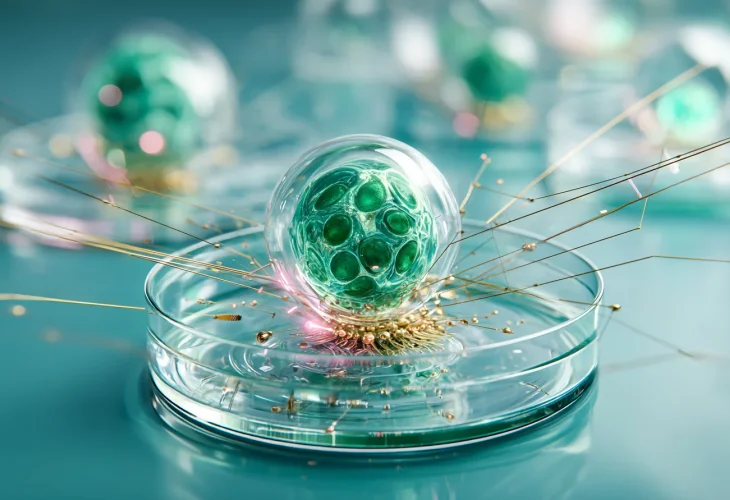
In 2020, researchers from the University of Vermont, Tufts University, and the Wyss Institute for Biologically Inspired Engineering unveiled one of the most unusual scientific creations of recent years: a tiny living organism built entirely from frog cells.
Unlike traditional robots, these microscopic creations contained no metal, plastic, computer chips, or wheels. Instead, they were made entirely of living cells taken from the African clawed frog, Xenopus laevis.
Under a microscope, they appeared as soft, living blobs measuring less than a millimeter across. Despite their tiny size, they could move, heal after being damaged, and carry out simple tasks in their surroundings.
The researchers named them xenobots, after the frog species from which the cells were taken.
Their creation opened an entirely new field of research that lies at the intersection of biology and engineering: living machines built from natural cells.
How Were Xenobots Created?
The first xenobots were not assembled the way engineers normally build robots.
Instead, researchers first used powerful computer algorithms to test thousands of possible body shapes. The computer searched for designs that would best accomplish simple tasks, such as moving, pushing tiny particles, or navigating their surroundings.
After identifying the most promising designs, scientists extracted stem cells from frog embryos and manually assembled them according to the computer's blueprint.
Some cells became structural "skin," while others were heart muscle cells whose natural contractions produced movement.
The result was something entirely new.
A xenobot has no brain, nervous system, or conventional reproductive system. Yet it is alive, capable of movement, and able to respond to changes in its environment.
The Hidden Potential Inside Every Cell
In nature, these frog cells normally work together to build the body of a tadpole.
But once removed from that environment and arranged into an entirely different structure, they did not stop functioning.
Instead, the cells continued communicating with one another, organizing themselves, and forming a new biological structure that does not exist anywhere in nature.
A xenobot is neither a miniature frog nor simply a frog organ.
It is an entirely new biological form made from natural cells arranged according to an engineered design.
From a faith perspective, the discovery highlights the remarkable sophistication embedded within every living cell. Each cell contains an extraordinary ability to communicate, organize, and work together in ways scientists are still striving to understand.
An Unexpected Discovery
In 2021, researchers made another surprising discovery.
A study published in the journal Science Robotics showed that frog skin cells alone, even without heart muscle cells, could naturally assemble into tiny spheres and begin moving.
Instead of muscle contractions, these xenobots used microscopic hair-like structures called cilia.
Inside a frog, cilia normally move fluids across tissues. In xenobots, however, they served as tiny motors, allowing the organisms to travel through their environment.
The same biological structures had taken on an entirely different function simply because the cells had been arranged differently.
Researchers viewed this as evidence that living cells possess an inherent ability to self-organize. They recognize neighboring cells, respond to physical forces, and collectively create behaviors that are far more dynamic than previously understood.
Can Xenobots Reproduce?
Later that same year, xenobots attracted worldwide attention after researchers reported a surprising form of replication.
Unlike animals, xenobots do not reproduce through ordinary biological reproduction or cell division.
Instead, while moving through a dish filled with loose frog cells, they gathered those cells into small clusters. Some of those clusters eventually developed into new xenobots capable of moving independently.
Scientists described this process as kinematic replication—replication through movement and the gathering of material rather than through conventional biological reproduction.
A later study published in the journal Proceedings of the National Academy of Sciences found that artificial intelligence could design body shapes that made this process even more efficient.
Why Build Living Machines?
Today, xenobots are primarily used as research tools.
They help scientists study how groups of cells communicate, organize themselves, and collectively build functioning biological structures.
Researchers also hope that similar technologies may one day help remove microplastics from waterways, deliver medications directly to specific locations inside the body, or perform delicate tasks beyond the capabilities of traditional machines.
For now, however, these possibilities remain theoretical and are still years away from practical medical or environmental use.
Questions for the Future
One major advantage of xenobots is that they are completely biological.
Unlike conventional robots, they eventually break down naturally without leaving behind metal, plastic, or electronic waste.
At the same time, because they are living systems, they raise important ethical questions.
Are xenobots machines or living creatures?
Who bears responsibility for their behavior?
Should scientists create entirely new biological forms using living cells?
And what might happen if future versions include engineered genes, more advanced sensory abilities, or even simple neural components?
More Than a Robot
Xenobots belong to a growing field known as biohybrid systems, which combines living biological material with engineered designs.
Scientists have already developed microscopic machines powered by bacteria, living muscle tissue, and other biological components.
Xenobots are different because their entire bodies consist of living cells. There are no motors, electronic circuits, processors, or computer programs operating inside them.
The computer's role ends once the design is complete.
From that point onward, every movement arises naturally from the cells themselves through contraction, cilia, cell-to-cell communication, and responses to the surrounding environment.
For that reason, many researchers believe the term "robot" is somewhat misleading. Rather than traditional robots, xenobots may be better understood as engineered living organisms or living machines, representing an entirely new category of biological design.

