

Parashat Masei
Why Did Hashem Wait Until Morning for the Exodus From Egypt?
Discover the deeper meaning behind the timing of the Exodus and why Hashem waited until morning for the Children of Israel to leave Egypt.
- Yonatan HaLevi
- | Updated
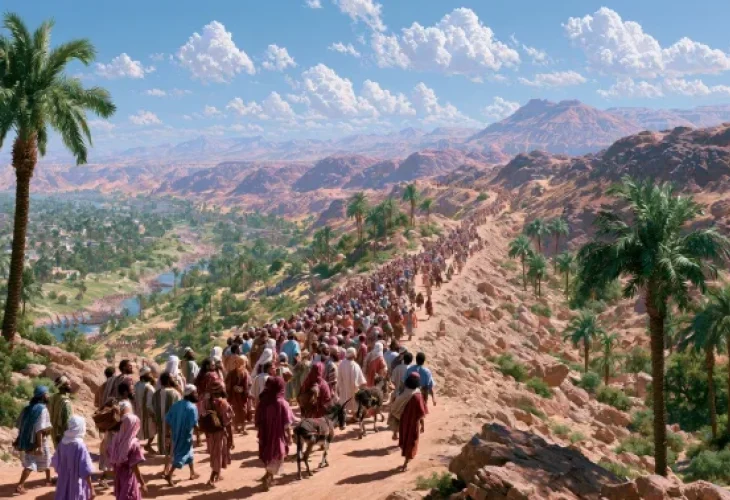
The Torah describes the Exodus from Egypt:
"They journeyed from Ramses in the first month, on the fifteenth day of the first month; on the day after the Passover offering, the Children of Israel went out triumphantly before the eyes of all Egypt. And the Egyptians were burying those whom Hashem had struck among them, every firstborn, and Hashem had carried out judgments against their gods" (Numbers 33:3–4).
At first glance, these verses seem straightforward: the Jewish people left Egypt on the morning of the 15th of Nissan, after the night of the Plague of the Firstborn. But this raises an important question. If Hashem wanted the Exodus to take place "before the eyes of all Egypt," why didn't the Children of Israel leave during the night?
After all, the Egyptians were already fully aware of what had happened. The Plague of the Firstborn had devastated every Egyptian household, and the people themselves were urgently begging the Children of Israel to leave.
Another question also emerges. Why does the Torah place these two statements side by side?
"The Egyptians were burying those whom Hashem had struck among them, every firstborn,"
followed immediately by:
"Hashem had carried out judgments against their gods."
What is the connection between the burial of the firstborn and the judgment against Egypt's idols?
A Greater Blow Was Revealed in the Morning
The Zera Shimshon, based on the teaching of Rabbeinu Bachya (Exodus 12:12), explains that the Egyptians did not fully grasp the extent of the plague during the night.
They remained inside their homes, overwhelmed by grief, fear, and confusion after the deaths of the firstborn.
Only the next morning, when they went out to bury their dead, did they discover another devastating reality. Alongside the death of the firstborn, Hashem had also brought judgment upon Egypt's idols, exposing their complete helplessness.
According to Egyptian custom, the dead were buried near places of idol worship. As the mourners arrived, they found that the very gods in whom they had trusted had been humiliated and rendered powerless.
Why the Exodus Waited Until Morning
This also explains why Hashem instructed the Children of Israel to leave Egypt during the day rather than at night.
The plague was not truly over when dawn broke. Another stage of Egypt's downfall was still unfolding as the nation witnessed the disgrace of its gods.
At that moment, the Egyptians remained completely broken, fearful, and humbled before Hashem's power.
This gives deeper meaning to the verse:
"On the day after the Passover offering, the Children of Israel went out... before the eyes of all Egypt."
Hashem delayed the Exodus until morning so the Egyptians would witness it at the precise moment they were burying their firstborn and realizing that the idols they had relied upon were utterly powerless.
The humiliation was complete. As the Egyptians stood mourning their dead and watching their faith collapse, they also watched the Children of Israel leave Egypt openly and triumphantly under Hashem's protection.
Why the Torah Connects These Events
This also explains why the Torah mentions these events together.
It first describes the departure of the Children of Israel and then immediately tells us that the Egyptians were burying their firstborn while Hashem executed judgment upon their gods.
The two events were inseparable.
The Exodus was delayed until morning so that Egypt would experience the full impact of Hashem's judgment all at once. Not only had their firstborn died, but the gods they believed would protect them had also been exposed as powerless.
Only then, before the eyes of a defeated Egypt, did the Children of Israel leave as a free nation, demonstrating that there is no power in the world besides Hashem.
(Based on Zera Shimshon, Parshat Masei, section 1.)

