

Magazine
From Israeli Music Star to a Life of Torah: Tomer Matana's Powerful Journey of Faith
Singer and producer Tomer Matana shares how childhood memories, family tradition, and a gradual return to Judaism transformed both his life and his music
- Avner Shaki
- | Updated
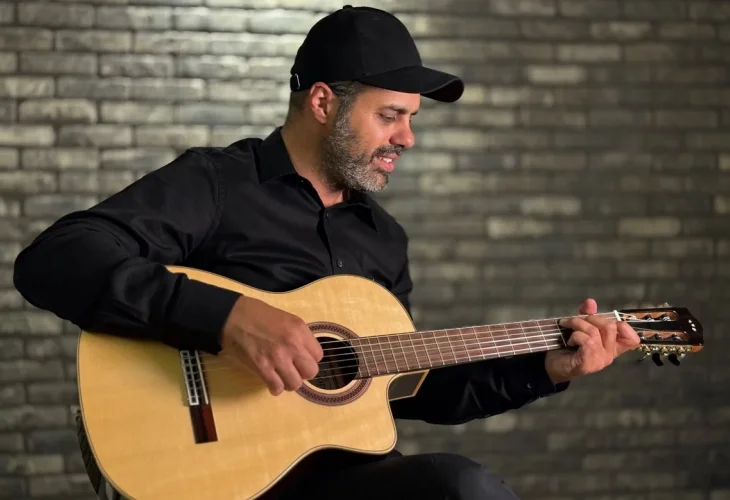 Tomer Matna (Photo: Yarin Shayman and Adal Harizman)
When musician Tomer Matana reflects on his life, he begins not with the recording studio or the concert stage, but with the traditions he inherited at home. Looking back, he believes those early memories planted the seeds that would one day lead him on a remarkable spiritual journey.
"I was born into a secular family," he says, "but we still observed certain traditions. My father is of Yemenite heritage, while my mother comes from Iraqi and Aleppan roots, so I grew up surrounded by customs from several Jewish communities. My maternal grandfather, Majdi Yitzhak Basson, was both a celebrated Iraqi singer and a Mossad agent. He had fascinating friends, including the legendary Israeli spy Eli Cohen and the grandfather of singer Dudu Tassa, who was also a well known Iraqi vocalist."
His father's parents, by contrast, were religious. "I used to go with my father and grandfather to synagogue on the holidays. Looking back, I realize that's where the foundations of my faith were laid."
Music quickly became another defining part of his childhood. "When I was ten, my parents bought me a keyboard. I taught myself to play, and by the age of fourteen I was already performing in clubs. I mainly accompanied a duo that sang classic Israeli songs, while I performed Mizrahi music by artists like Zohar Argov, Ishay Levi, and Tzlilei HaKerem. It has always bothered me that songs by artists like Arik Einstein or Yehudit Ravitz are simply called 'Israeli music,' while Mizrahi music is placed in a separate category. Unfortunately, that's still how many people think."
The Grandmother Who Shaped His Faith
His Yemenite grandmother left an especially deep impression on him. "She was very elderly and spoke almost entirely in Yemenite Arabic. We were incredibly close. She came from a distinguished rabbinic family. Her father had served as the head of the rabbinical court in one of Yemen's major cities. At the time I knew very little about Judaism beyond basic tradition, but one thing stayed with me forever. Before I ate anything in her home, she insisted that I make a blessing. I'd put on a kippah before entering, she would slowly recite the blessing, and I would repeat every word after her."
When his grandmother passed when he was eighteen, those memories became even more meaningful. "After she died, everything I had seen in her home gave me an unshakable belief in God. She became so emotional every time she heard me recite a blessing. Back then I thought she was crying because she worried about my spiritual state. Today I understand that she was crying out of joy. I feel so small compared to people who lived every moment with the awareness of 'I have placed God before me always.' I try, in my own way, to live with that same consciousness."
Building a Career in the Music Industry
Now married, and the father of six, Matana lives in Rosh HaAyin, where he continues to work as a singer, songwriter, producer, and arranger.
"The performances were going well, and after high school I joined the IDF Education Corps Band as a singer. After my military service, I began recording original material while continuing to perform. As my career progressed, I had the privilege of working with many of Israel's leading artists, including Amir Benayoun, Margalit Tzanani, Bar Tzabari, Ben El Tavori, Omer Adam, Ishay Levi, Shiri Maimon, Shir Levi, and Moshik Afia. A significant part of my work was alongside producer Nadav Bitton, and we were blessed with great success."
His debut single, Mevin Hafuch, became a major radio hit and was featured extensively on Galgalatz. "I appeared frequently on television after the song took off and eventually signed with Helicon Records. We worked on an album together, but in the end it was shelved, and we parted ways. Since then, I've continued independently, focusing mainly on producing and arranging music for other artists and providing a full range of studio services, including mixing and mastering. Professionally, I devoted myself almost entirely to production, and after that album I released only two songs of my own. Recently, though, I've returned to my own music in a much more significant way."
Returning to Center Stage
The turning point came through longtime friend and radio personality Moshiko Stern. While preparing a special program about Idan Raichel, Matana created a new arrangement and cover of Raichel's song What a Beautiful Day.
"Idan loved it and invited me to perform it with him. After the concert, Moshiko told me, 'You can't spend your whole life behind the scenes. The world needs to hear your music too.' He pushed me to write again and guided me artistically."
Soon afterward, Matana, Stern, and songwriter Avi Ohayon began writing Fly Higher, which became the title track of his upcoming album.
"While we were working, Moshe Peretz walked into the room and joined the creative process. That's how the song was born. I also produced it musically, and that gave me the desire to keep writing."
At around the same time, he began attending Torah classes taught by Rabbi Kovalsky, where many musicians and entertainers participate.
"I reconnected with old friends from the industry, met new people, and found fresh inspiration. It gave me the momentum to continue developing my own material."
"The Best Is Still Ahead"
His latest release, The Best Is Still Ahead, reflects both his personal and spiritual journey.
"It's a very personal, optimistic song. It speaks about those moments when we lose our way, even when everything seems fine, and how sometimes a kind word or the presence of someone close is enough to lift us back up. The lyrics include details from my own life: tzitzit beneath my clothes, a journey to Meron, tears that open the heart, and a righteous Yemenite sage reminding us that everything is temporary, but the light is still ahead."
The Journey Back to Judaism
More significant than his musical comeback, however, was another transformation.
"The greatest change in my life was becoming religious. I always respected Judaism and tried to live according to many of its values, but eventually I realized my world felt shallow. I was investing too much energy in things that didn't really matter."
About fifteen years ago, he attended a Torah class with several artists. "It awakened a deep desire to learn."
Later, a Chabad friend invited him to another class taught by Rabbi Yossi Ginzburg in Ramat Aviv. "It spoke directly to my soul. He also took me to the mikveh. I didn't even know what a mikveh was. Those experiences opened an entirely new spiritual world."
His journey was gradual.
"At first I was embarrassed by my observance. I kept a kippah in my pocket, quickly put it on to recite a blessing, and then immediately hid it again. Later, when I started wearing tzitzit, I tucked them carefully into my trousers and constantly checked that the fringes weren't showing. I wasn't yet observing Shabbat, but I slowly took on more mitzvot, moving at a pace that felt right for me."
Bringing His Family Along
The transition was not always easy for his family.
"I was already married, and my wife wasn't interested in becoming religious. Thankfully, I approached the process with patience. She didn't embrace it at first, but she didn't oppose it either. Eventually, she attended a women's Torah seminary to better understand what was drawing me in, and there she discovered the beauty of Torah herself."
There were practical challenges as well.
"My family had a traditional background, but my wife's Ashkenazi family had almost none. They would gather on Shabbat, but we couldn't join them or eat the food they prepared. Thankfully, raising our children was much easier. Our oldest son was still in daycare when we began keeping Shabbat, so we were blessed to give all six of our children a religious education from the very beginning."
Following the Path of His Ancestors
Asked where he feels most at home within the religious world, Matana answers without hesitation.
"I try to follow the traditions of my ancestors and observe the customs of Yemenite Jewry. That's what feels most authentic to me and gives shape to my religious life. Generally speaking, I identify with the Haredi community, but I'm certainly not opposed to the State of Israel or the army. Living in the Land of Israel and having the privilege to observe Torah and mitzvot here is an incredible blessing. Every Jew should appreciate the soldiers who make extraordinary sacrifices and risk their lives for the Jewish people. That should be self evident."
How Faith Changed His Music
His return to Torah has also transformed his music.
"My songs now have much greater depth, values, and meaning. Naturally, I no longer sing romantic love songs. More importantly, faith has given me peace. When things don't go as I hoped, it's much easier to accept because I truly believe that God is doing what is best for me, even when I can't see it."
There are practical limitations.
"I can't perform in certain venues anymore, and I won't perform at mixed dancing events. But honestly, I no longer see those things as hardships. They belonged to the old Tomer."
He smiles. "Accepting the yoke of Torah and mitzvot has filled my life with light. The deeper I grow in my faith, the more clearly I see God's blessing in everything I do."

