

Raising Children
Don't Label a Child: The Powerful Lesson for Every Parent and Educator
A moving encounter between a rabbi and an at risk teenager reveals why labels can wound a soul, and how seeing a person's true Divine essence can inspire hope, healing, and transformation
- Rabbi Dan Tiomkin
- | Updated
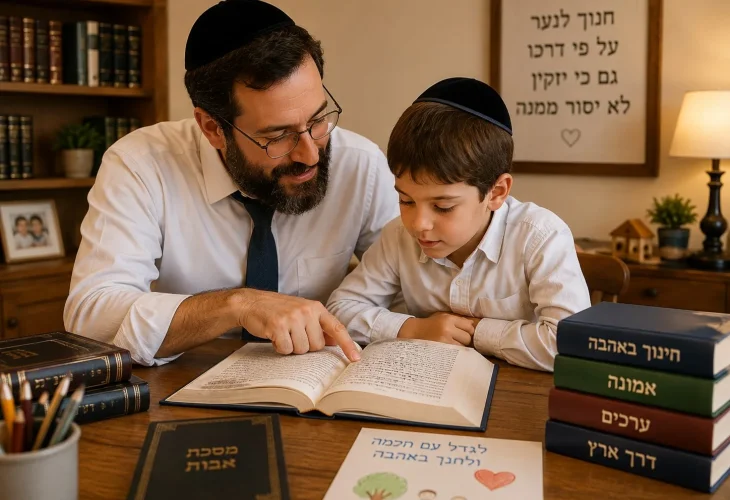
A rabbi once began giving a weekly Torah class at a residential program for at risk teenage boys. He spoke with warmth and sincerity, meeting the boys where they were. His lessons focused on the human soul, life's purpose and meaning, how deeply God loves each of us, and how every action we take has an impact on the world.
Many of the boys attended faithfully and were inspired by his words. But one teenager, Dudu, refused to come under any circumstances.
One day, the rabbi met him in the hallway and asked kindly, "Why don't you come to my classes?"
Dudu replied, "You don't really want a 'Shababnik' like me sitting in your class."
The rabbi smiled and answered, "Listen, you don't have to come. These classes are optional, not mandatory, and you have every right to decide for yourself. But I do have one piece of advice for you: never define yourself by your actions."
He continued, "Labels like 'Shababnik,' 'leftist,' 'secular,' 'atheist,' and so on are never truly accurate. Those labels don't define who we are. They only describe what we do or what we currently believe. They say nothing about our essence.
"I'm not asking what you've done, what you ate yesterday, or who you've been spending time with. That's not what matters to me. What matters is who you truly are. And in your deepest essence, you are a Divine soul, hewn from beneath God's Throne of Glory. You are a prince, a child of the King, fashioned from precious stones. That is who you really are."
The Problem with Labels
Many of the names we give to at-risk youth completely miss this point.
Terms like "dropouts," "damaged," "Shababniks," "fringe youth," "at risk youth," or the especially pessimistic "disconnected youth" place a permanent label on people based on their current behavior or circumstances.
These labels can be deeply unfair.
Calling someone a "dropout" suggests that, like a fallen leaf, they can never return. What an injustice to apply such a label to a precious soul. Calling someone "damaged" might be appropriate when talking about spoiled food, but not about a Divine soul.
Who are we to judge another person?
As our Sages taught: "Do not judge your fellow until you have reached his place."
Our role is not to define people by their present condition. Instead, we are called to become agents of hope, planting seeds of faith, encouragement, and closeness in the hearts of those around us.
Seeing Beyond the Surface
To do that, we must learn to see with a different lens. Not a lens that focuses only on outward behavior, but one that also recognizes the Divine light within every soul.
That is the true reality.
Every Jew is "truly a part of God above." A person may be living inside broken circumstances, but the soul itself remains pure. No matter how distant someone appears, they can always return. A life can change in a single moment.
Speak to the Soul, Not the Label
We must be so careful with our words.
We should avoid harmful labels, even when the young people themselves are not present to hear them. Words have power. The way we speak about others shapes the way we see them, and often the way they eventually see themselves.
If we choose instead to focus on the sweetness and holiness of their souls, despite the walls they have built through pain and hardship, and if we define them according to that inner holiness, we can help accelerate the healing process.
With patience, compassion, and a generous eye, we can nurture hope instead of reinforcing despair.
Above all, we must be careful never to replace a person's true identity with a label that distances, rejects, or diminishes who they really are.

