

World News
Hasan Piker Tells College Democrats to Reject Lawmakers Who Fund Israel
Far-left streamer addressed hundreds of young Democratic organizers at a Washington convention sponsored in part by J Street U
 Screenshot/X
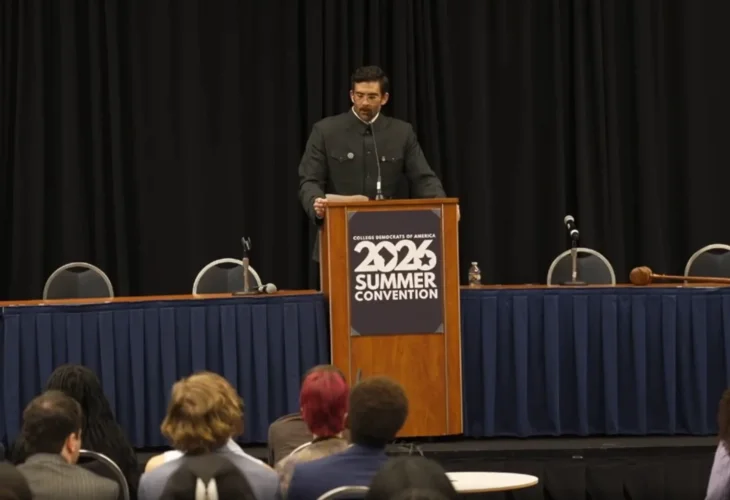
Far-left political streamer Hasan Piker told young Democratic activists that the party no longer needs lawmakers who support funding for Israel during an appearance at the College Democrats of America convention in Washington.
“No more to the Democrats who collaborate with the fascists, who will fund ICE, who will fund Israel. We don’t need those Democrats anymore,” Piker told the audience Saturday evening.
The College Democrats of America is the official collegiate arm of the Democratic National Committee, and more than 500 student organizers were expected at the convention. The gathering was designed to train students in campaign strategy, communications, fundraising, field operations, digital organizing and coalition-building.
Piker’s message went beyond opposition to Israeli policy. He condemned Democrats who “compromise,” “conciliate” and “betray us,” presenting support for Israel as one of the positions that should place politicians outside the movement he wants young activists to build.
Piker is one of the most prominent far-left political voices among younger Americans. His online commentary frequently portrays American politics as controlled by wealthy interests and presents Israel as part of a wider system of oppression.
His supporters argue that he reaches young voters who distrust traditional media and established political institutions. His critics say his growing access to Democratic candidates and organizations is helping normalize increasingly extreme rhetoric about Israel.
That concern is heightened by the purpose of the College Democrats organization. Its members are trained to participate in voter outreach, political communications, fundraising and campaign work, placing them inside the Democratic Party’s future organizing structure.
The ideas promoted in those spaces can later influence which candidates activists support, which policies they prioritize and which positions become unacceptable within the party. Progressive politicians such as Rep. Alexandria Ocasio-Cortez and Zohran Mamdani have already demonstrated the political power of combining economic frustration, social-media communication and opposition to the established party leadership.
Piker has faced repeated accusations of antisemitism over previous remarks concerning Israel, Hamas, Orthodox Jews and the September 11 attacks. He has rejected that description and identifies himself as anti-Zionist.
Despite the controversy, he has continued receiving invitations from prominent political, academic and cultural organizations, including the Yale Political Union and The New Yorker’s annual festival.
His appearance also drew criticism from within Democratic and progressive circles. Gun-control activist Shannon Watts called the invitation a “terrible decision” and said Piker had nothing constructive to contribute. Other figures associated with the College Democrats also publicly objected.
J Street U, the student arm of the self-described pro-Israel organization J Street, sponsored the convention. J Street President Jeremy Ben-Ami said the organization had no role in choosing the speakers.
“We had no role in the selection of speakers and we’re sure there will be speakers — including Hasan Piker — with whom we disagree,” Ben-Ami said.
He nevertheless said J Street U was “proud” to sponsor and participate in the event, arguing that pro-Israel advocates should remain present in political spaces where they face opposition.
“Being in venues like this is even more important when there are participants with whom we disagree,” he said. “Failing to show up would be an abdication of our responsibility to make the case for our pro-Israel views.”
The convention also featured progressive activists, Democratic Socialists of America-backed candidates and sitting Democratic lawmakers. Piker’s invitation placed his message before students being trained to organize campaigns, mobilize voters and help determine the Democratic Party’s future priorities.

