

Personal Stories
The Extraordinary Power of Birkat Kohanim
Inspiring stories, the Zohar's profound teaching on the Priestly Blessing, and the remarkable synagogue whose daily Birkat Kohanim was said to have protected it during World War II
- Yonatan HaLevi
- | Updated
 (Photo: Illustration)
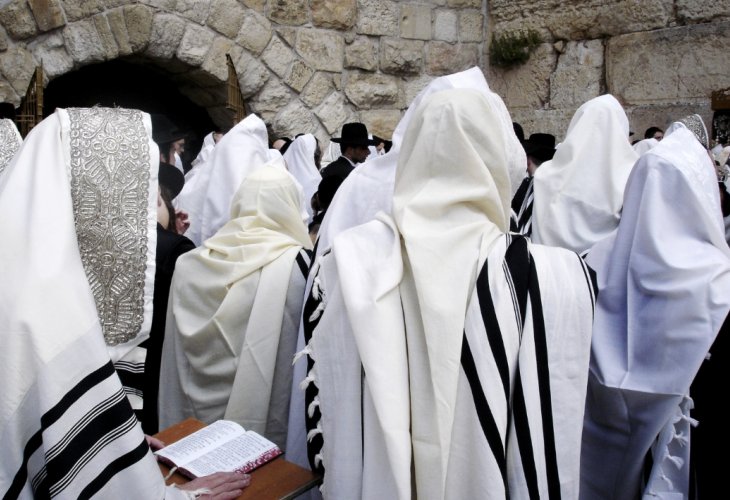
The great Torah scholars Rabbi Moshe Aharon Stern, the mashgiach of the Kamenitz Yeshiva, and Rabbi Moshe Yosef Miletzky, Av Beit Din of Jerusalem, cherished the Priestly Blessing with extraordinary devotion. They would travel from one synagogue to another simply to hear Birkat Kohanim, eager to receive its remarkable blessing again and again. If there were no kohanim in the minyan where they were praying, they would even make the journey to distant neighborhoods rather than miss the opportunity to hear the blessing.
The book Otzroteihem Amaleh records the testimony of Rabbi Yechiel Michel Stern, who recalled that when he was a young boy, he stayed awake all night on Shavuot studying Torah. After the morning prayers, he was exhausted and eager to return home to sleep. His father, however, had another idea.
"Today," his father said, "the Ger Chassidim are marking the yahrzeit of the Imrei Emes. There are surely hundreds of kohanim there. Let us go and hear Birkat Kohanim, because among so many kohanim there are undoubtedly some of distinguished lineage."
When the boy tried to excuse himself because of his fatigue, his father responded passionately:
"Imagine someone came to you right now and offered to take you to receive a blessing from the Vilna Gaon himself. Would you tell him you were too tired? Of course not! You would run for miles to receive such a blessing. And here, the Holy One, blessed be He, personally promises in the Torah, 'And I will bless them,' yet you are complaining that you are tired?"
A Moment of Divine Favor
The holy Zohar (Naso 147a) teaches: "When the kohen raises his hands to bless the people, they should stand in awe and reverence, knowing that this is a moment of Divine favor throughout all the worlds. During that time, both the heavenly and earthly realms receive blessing, judgment has no power over them, and peace fills all the worlds, as it is written, 'And may He grant you peace.' Therefore, one should be careful not to forfeit the blessings available during this auspicious time."
The Synagogue That Survived the Holocaust
Rabbi Eliezer Turk relates that he once heard a remarkable story from a distinguished Torah scholar and educator who had visited Sofia, the capital of Bulgaria, several years earlier.
While there, he met an elderly Jewish man in his nineties who served as the longtime chief gabbai of the city's historic synagogue. The synagogue is considered one of the most magnificent Jewish houses of worship in the world. Its architecture is breathtaking, with elaborate embroidery, marble floors, intricate carvings, majestic chandeliers, elegant furnishings, and stained-glass windows that preserve the grandeur of centuries past.
Sadly, Sofia's Jewish population has dwindled dramatically in recent decades. As a result, this magnificent synagogue now stands largely empty throughout the year, functioning more as a historic Jewish landmark visited by tourists than as a thriving house of prayer.
During the tour, the elderly gabbai pointed to a large hole in the ceiling.
"During World War II," he explained, "the Nazi murderers destroyed virtually every synagogue and Torah center in the region. This synagogue was the only one left standing. Although it suffered some damage, as you can see from the hole in the ceiling, it continued to serve as an important place of worship for many years."
The Two Merits That Protected It
The gabbai then shared a tradition that had been passed down through generations.
"For many years," he said, "people repeated what one of the great Torah sages taught — that this synagogue survived while all the others were destroyed because of two practices that were observed here with exceptional care."
"The first was the mitzvah of 'You shall revere My sanctuary.' Throughout the years, people were meticulous never to engage in ordinary conversation inside the synagogue."
"The second was that Birkat Kohanim was recited here every single day, without exception."
According to that Torah giant, these two merits protected the synagogue and spared it from the terrible destruction and Divine wrath that swept across the world during those dark years.

