

World News
Britain Has a New Prime Minister: Andy Burnham Officially Takes Office
Andy Burnham was sworn in as Britain’s prime minister after Keir Starmer stepped down amid an internal Labour revolt. Burnham is promising a new economic direction and signaling a tougher line toward Israel.
- Yuval Aviv
- | Updated
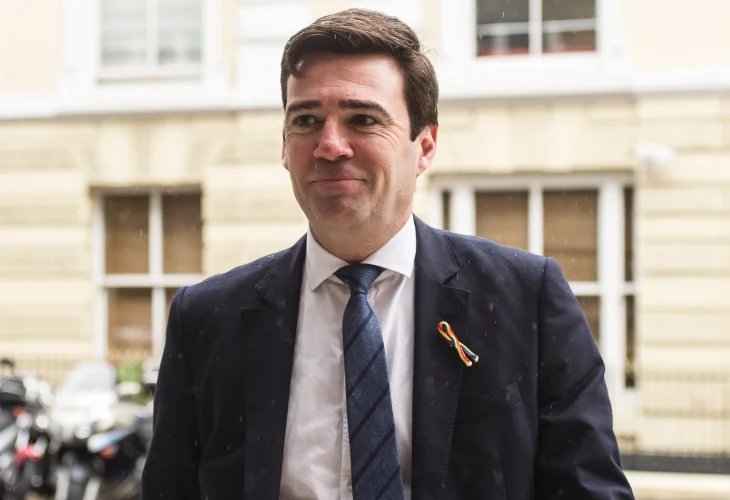 Burnham (Credit: shutterstock)
Andy Burnham officially entered office today (Monday) as prime minister of Britain, after receiving the mandate to form a government from King Charles at Buckingham Palace. His appointment comes בעקבות the departure of Keir Starmer, who resigned after the revolt against him within the Labour Party. Burnham thus becomes Britain’s seventh prime minister in a decade.
The transfer of power began with Starmer’s farewell speech outside the prime minister’s residence at 10 Downing Street: "It has been the honor of my life to serve you and this great country as prime minister, and I am confident that Britain today is stronger and fairer than it was two years ago." He wished his successor "the very best of luck" and added: "I leave in good spirits, I leave with a smile, and I leave proud of everything we achieved. Thank you very much."
Shortly afterward, Burnham arrived at Buckingham Palace, where he met with King Charles and received the official appointment from him. At the end of the meeting, Burnham is expected to head to Downing 10, deliver his first speech as the new prime minister, and later today present his government. According to assessments, the new cabinet will include major changes at the top, especially in the Treasury, Foreign Office, and Home Office. Shabana Mahmood, who currently serves as home secretary, is expected to be appointed chancellor.
Burnham has already made clear that he intends to focus his term on rebuilding the British economy. In an interview with "The Times," he pledged "to do things differently" and to lead Britain toward "a new kind of economy." In his first speech, he is expected to present steps aimed at giving the public "breathing room against the cost of living," and to make clear that Britain is at a moment that requires "honesty and soul-searching," according to British media reports.
On the international stage, the expectation is that Burnham will continue a line similar to Starmer’s in relation to Israel, and may even intensify the steps taken against it. During Starmer’s tenure, Britain leveled sharp criticism at Israel and even imposed sanctions on it, and Burnham is expected to consider additional measures.
In an interview with "The Guardian," he apologized earlier this month for the Labour Party’s initial response to Israel’s military operation in Gaza. In his words, "We need to do more to increase the pressure on the Israeli government... we have taken some important steps, but if we are honest, Britain was late in calling for a ceasefire. And now we need to do more to strengthen our approach." He also said that he intends to increase pressure on the Israeli government, including through additional sanctions and by examining a ban on trade in products from the settlements.
At the same time, Burnham sought to reassure the Jewish community in the United Kingdom and stressed that despite the shift in his approach, he remains concerned about the rise in antisemitism in the country, and that he "unequivocally condemns" the Hamas attack on October 7.
Burnham’s positions toward Israel have also taken other forms over the years. In 2015, he declared that he was "a friend of Israel and of the Jewish community," and stressed that this "will never change." In the past, he also said that if he were to lead the Labour Party, the first visit he would want to make would be to Israel.
After the October 7 attack, Burnham was among the first politicians in Britain to call for a ceasefire in Gaza, just three weeks after the fighting began. At the same time, he took part in an October 7 memorial event with the Jewish community in Manchester, and throughout his tenure as mayor maintained good ties with members of the city’s Jewish community.

