

Magazine
Forgotten Roots, Enduring Customs: The Lost Jewish Heritage of Baní
Separate meat and dairy utensils and forgotten mourning customs may point to a hidden Jewish heritage in a Dominican city. Hakham Dr. Yehonatán Elazar-DeMota investigates the clues.
- Shira Dabush
- | Updated
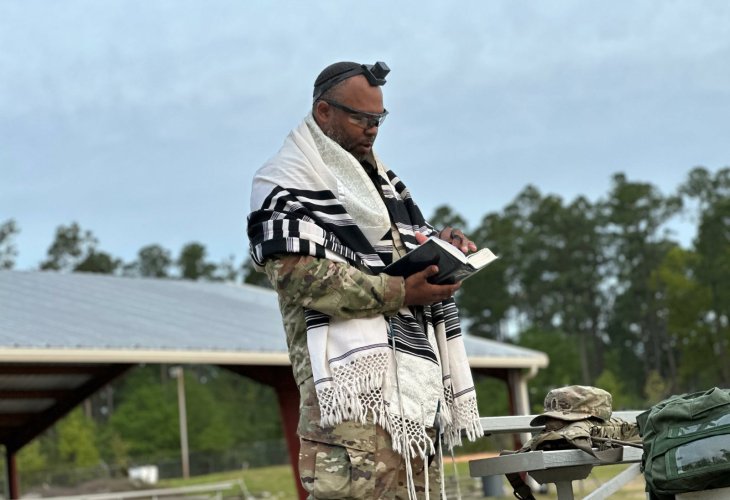 Hakham Dr. Yehonatán Elazar-DeMota praying in tefillin and tallit during military service
In the city of Baní in the Dominican Republic lives a dentist named Dr. Laura Pimentel. When Hakham Dr. Yehonatán Elazar-DeMota met her during his research, she showed him a plaque bearing the Shema Yisrael prayer in Spanish and told him that she recited it every day. Until that encounter, the researcher had concealed his Jewish identity from his research participants so as not to influence their answers.
“I did not want to tell anyone I was Jewish because I did not want to influence the fieldwork”, he says. “In this case, I felt I had to tell her. She was very interested in learning more when I told her that I was Jewish and a rabbi”.
Hakham Dr. Yehonatán Elazar-DeMota, 45, of Fort Bliss, Texas, brings together several worlds in his professional life. He is an educator, a professor of law and religion, a Jewish military chaplain, a shochet and a mohel, and a researcher who has published a fascinating book on his research, drawing on anthropological sources, Inquisition records, oral traditions, and mitochondrial DNA.
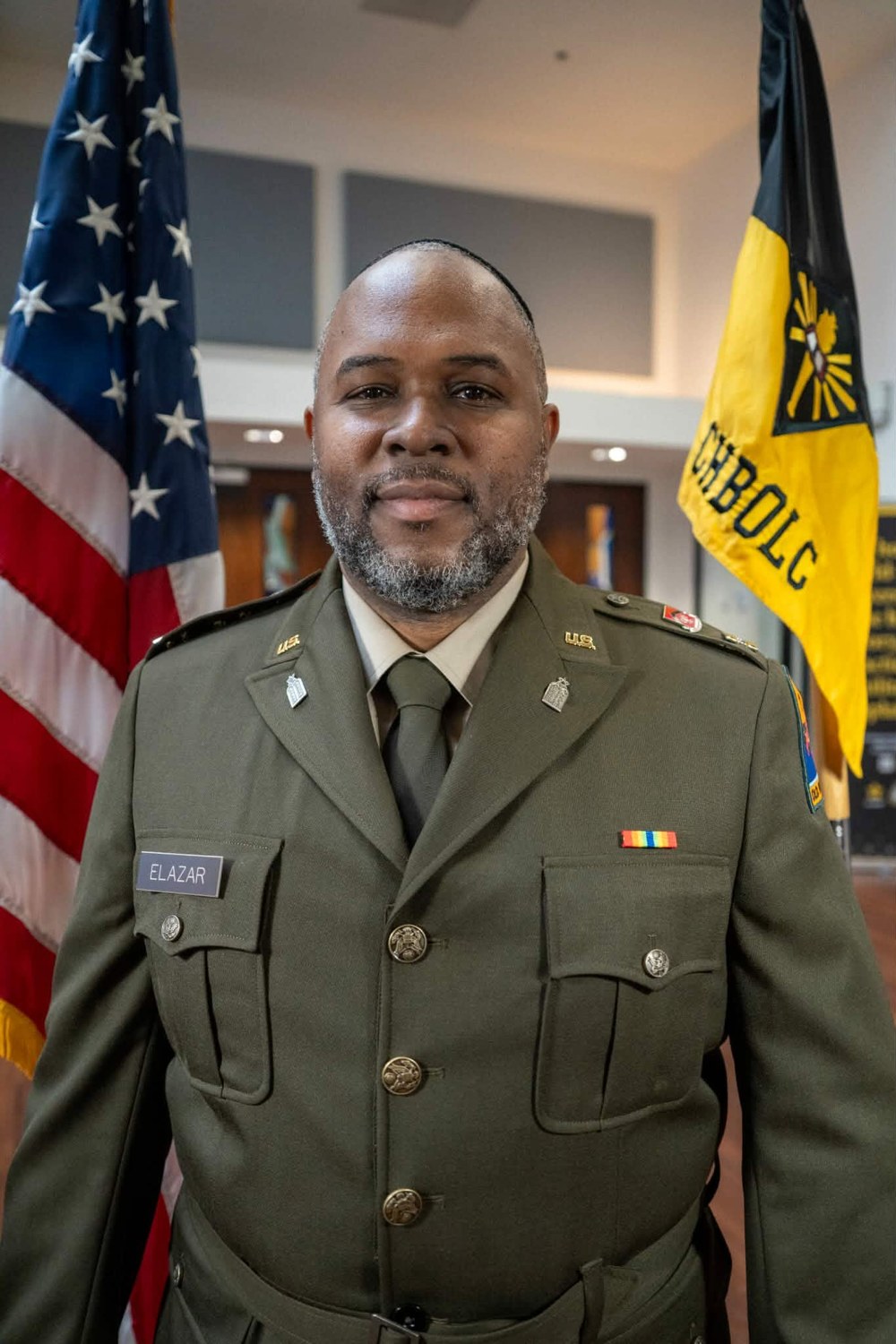 Hakham Dr. Yehonatán Elazar-DeMota, a Jewish chaplain in the US Army and the researcher behind the study of Baní
His field is Sephardic and Caribbean Jewish history, with a particular focus on the Jews of the Dominican Republic. His research on Baní examines the possibility that remnants of Jewish identity, customs, family memory, and maternal lineages survived among local families for hundreds of years, even after awareness of their Jewish origins had been lost.
His interest in Baní began in 2010, when he was teaching science at an international school in the Dominican Republic and accompanied his students on a trip to the city’s sand dunes. He noticed that the city was orderly and clean and had many businesses whose owners bore surnames familiar among Spanish and Portuguese Jews: Melo, Pinto, Pimentel, Lara, Gomez, and others. “I wanted to know more about these people and why they were so different from the rest of the Dominican population”, he says.
Before beginning his fieldwork, he read genealogical literature about the city’s residents and a book by a Haitian anthropologist on the history of Jews on the island. The book mentioned a woman from Baní who claimed that the city had been founded by Sephardic Jews, and he wanted to investigate that claim. Examining genealogical records, he discovered two Jews from Curaçao, from the Vidal and Capriles families, who had settled in Baní. One of them served as the city’s mayor in the nineteenth century.
According to the researcher, the broader background includes four waves of Jewish migration to the Dominican Republic: Sephardic anusim, Jews forcibly converted to Christianity, during the colonial period; Sephardic merchants from Amsterdam, Jamaica, Curaçao, St. Thomas, and Haiti in the eighteenth and nineteenth centuries; Sephardic Jews from the Ottoman Empire; and Jewish immigration after World War II.
“I Put Myself in the Inquisitor’s Place”
To determine what to look for, the researcher turned to Spanish and Portuguese Inquisition records, searching for “Judaizing” practices, customs that inquisitors identified as expressions of Jewish observance and regarded as heresy. Using these as a basis, he devised a questionnaire containing 70 questions on marriage, diet, family purity, superstitions, family morality, beliefs, and genealogy. “I put myself in the inquisitor’s place, searching for the Jew”, he says.
The study involved 23 women. He explains that his decision to focus on women stemmed from a pattern he identified in Inquisition sources and from the role women among the anusim played in passing their ancestral heritage on to their children.
How do you distinguish traces of a Jewish past from an ordinary local custom?
“I selected control families from surrounding towns who had no connection to Baní’s original settlers. I asked them the same questions and also took saliva samples for DNA testing”, he explains.
According to Dr. DeMota, the fieldwork findings include numerous customs, some of which parallel Jewish practices and laws. “Among the original families and their descendants”, he says, “there were separate utensils and pots for meat and dairy. One participant, Mrs. Aguasvivas, explained that milk should not be boiled in a meat pot because traces of meat would mix with the milk, but she could not explain the meaning of the custom. Another custom involves checking an egg yolk in a bowl for blood spots before eating it and discarding it if a spot is found”.
The researcher also describes a method of slaughter practiced in Baní that, he says, follows Jewish law. In examining how poultry is killed in the Dominican Republic, he documented four methods: cutting the throat, breaking the neck, breaking the spine with a blow, and striking the head with a stick.
Another finding concerns Good Friday. According to him, most Catholic Dominicans eat fish on that day and refrain from bathing in a river or the sea in remembrance of Jesus’ suffering. In Baní, however, the behavior is entirely different: on that Friday, people bathe early in the morning, before sunrise, and eat meat in the evening. The researcher saw a parallel with accounts of anusim from the Inquisition period. “I was surprised that they defied the social and religious order in this way”, he says. “I was also surprised to learn from Dr. Manuel Valera, Baní’s official historian, about a family dispute over the circumcision of a child against the wishes of the Church. There are also references to midwives who circumcised male children. I did not expect to find material like this in the records”.
“They, Too, Believed That One Must Not Point at the Stars or Count Them”
The researcher also found familiar mourning customs. After a death, people pour out the water in the house, a practice that parallels a Jewish mourning custom mentioned in the Shulchan Aruch. Another custom is washing one’s hands upon leaving a cemetery.
“Mrs. Rivera Lara, whose parents were first cousins, told me that her family had always done this. When I asked why, she could offer no theological or ritual explanation, saying only that ‘it is not good to leave it undone’.
“This is particularly significant because washing one’s hands after leaving a cemetery is an established Jewish practice associated with contact with the dead and ritual impurity. Her explanation illustrates precisely how a religious practice can survive after its original meaning has been forgotten: something that may once have been understood in ritual terms is passed down to subsequent generations simply as something one must do, or as a taboo against failing to do it”.
Other documented practices included sweeping dirt inward from the entrance of the house rather than outward, a custom found in Iberian Inquisition records, and a belief that pointing at the stars or counting them would cause warts to appear on the skin. Here, too, DeMota notes parallels in Jewish folk tradition. “Triangular markings were also observed on doorframes in rural areas, which Valera associates with the mezuzah. This is an interpretation that requires examination alongside the other evidence”, he says.
Another key finding is endogamy, meaning marriage within the group. According to the researcher, many Baní residents marry within the city, and what particularly surprised him was marriage between cousins, even though the Church did not officially permit it. “Valera attested to an unusually high level of endogamy among the founding families and to a local tradition that some of them were descendants of Jews or anusim”.
Mitochondrial DNA tests, which trace the maternal line, were conducted in 2015. According to the researcher, approximately 70 percent of those tested descended from six ancestral mothers, and three of these lineages showed a genetic connection to Sephardic Jewish data in Dr. Doron Behar’s database.
Based on his research, Dr. DeMota concluded that not only men but also women of Indigenous and African ancestry arrived in the Caribbean, some as a result of slavery.
Another finding was that many of the women were genetically related to one another, even though they knew of no family connection in recent generations. An examination of their family trees placed most of their shared ancestral connections in the seventeenth and eighteenth centuries.
The Halakhic Dimension: Are Preserved Customs Enough to Establish a Presumption of Status?
The research also examined how a presumption with halakhic significance might be established concerning communities whose Jewish origins may have endured despite the loss of formal communal institutions. According to Elazar-DeMota, the central question was whether a combination of historical and genealogical documentation, marriage patterns, household and mourning customs, oral traditions, and genetic data could help establish such a presumption.
He explains that Baní served as a case study for whether this approach might also be relevant to other isolated populations. The research also considered whether the accumulated evidence has implications for the application of halakhic principles such as chazakah, a presumption of status, and kol deparish meruba parish, the principle that something separated from a group is presumed to come from its majority, to questions of communal and individual Jewish status.
“Discovering a Historical Connection to Judaism Does Not, in Itself, Determine Who Is Jewish According to Halakhah”
The analogy to chazakah lies at the heart of the halakhic dimension: a consistent, recurring pattern may carry evidentiary weight even when there is no direct evidence of its origin. The researcher emphasizes that this does not replace historical proof. He argues that when patterns of ancestry, kinship, memory, and custom recur among related families and are corroborated by documentation, their cumulative weight should be examined.
Critics will argue that customs and genetics do not prove Jewish continuity. How do you respond?
“The strongest evidence is not a single custom, surname, or genetic marker, but the fact that several different, independent types of evidence all point in the same direction”, he says. “I agree that customs and genetic connections alone are not enough to establish Jewish continuity, but my conclusion does not depend on either of them in isolation”.
His conclusion, he explains, rests on genealogical and archival findings linking families from Baní to documented Sephardic networks, patterns of endogamy, and memories and customs transmitted independently. Genetics serves only as corroborating evidence: it indicates population continuity and does not prove Jewish status.
The researcher distinguishes among three separate things: Jewish ancestry, the preservation of Jewish cultural memory, and a Jewish religious identity maintained continuously across generations. He says that the evidence he collected supports each of these to a different degree. Discovering a historical connection to Judaism therefore does not, in itself, determine who is Jewish according to halakhah.
Nevertheless, the research changed his thinking. He says that he now views differently both the question of who is Jewish according to halakhah and the question of how much zera Yisrael, meaning descendants of the people of Israel, remains among the world’s various peoples.
What would you say today to someone who suspects they may have Jewish roots?
“Surnames are only a possible indication of Jewish ancestry, not proof. Sometimes people changed their names to conceal their identity, or when a mother raised a child, the father’s name did not appear in the record”, he replies. “People are mistaken when they say that a particular custom, such as sweeping inward, is exclusively Jewish. We need to examine the evidence as a whole, rather than a single custom that could also have been adopted by someone who was not Jewish”.
An “Excellent” Grade for the Research and a Book Bringing the Findings Together
He also offers a caution about autosomal DNA tests. “Many people take these tests today and feel ‘Jewish’ when they see the percentages. But professional genealogists are familiar with the possible errors”.
Autosomal DNA tests, the kind that display ancestry percentages such as “20 percent Ashkenazi”, examine genetic material inherited from both parents and compare it with databases of different populations. However, the percentages are statistical estimates rather than established facts: they depend on the size of the database and each company’s calculation method, so the same person may receive different results from different companies. Genetic similarity to a Jewish population does not necessarily indicate Jewish ancestry, either, because neighboring populations share genetic characteristics. There is another fundamental distinction: such a test may suggest ancestry, but it does not determine identity. Someone who sees the percentages and “feels Jewish” may be relying on incomplete information. The researcher therefore advises examining family customs and a documented family tree reaching back to the nineteenth century, rather than relying on a test result alone. “As we get closer to the 1830s, we begin to see high levels of endogamy in marriages”, he says.
The research was conducted as part of his master’s degree studies. According to Elazar-DeMota, it received a grade of “excellent” and was published as a book. He has since presented his findings at academic and religious conferences around the world. Following the research, three people from Baní approached him to understand their DNA results, but did not subsequently seek to connect with a Jewish community. By contrast, people originally from Baní who now live in the United States also contacted him, and some are now connected to Jewish communities.
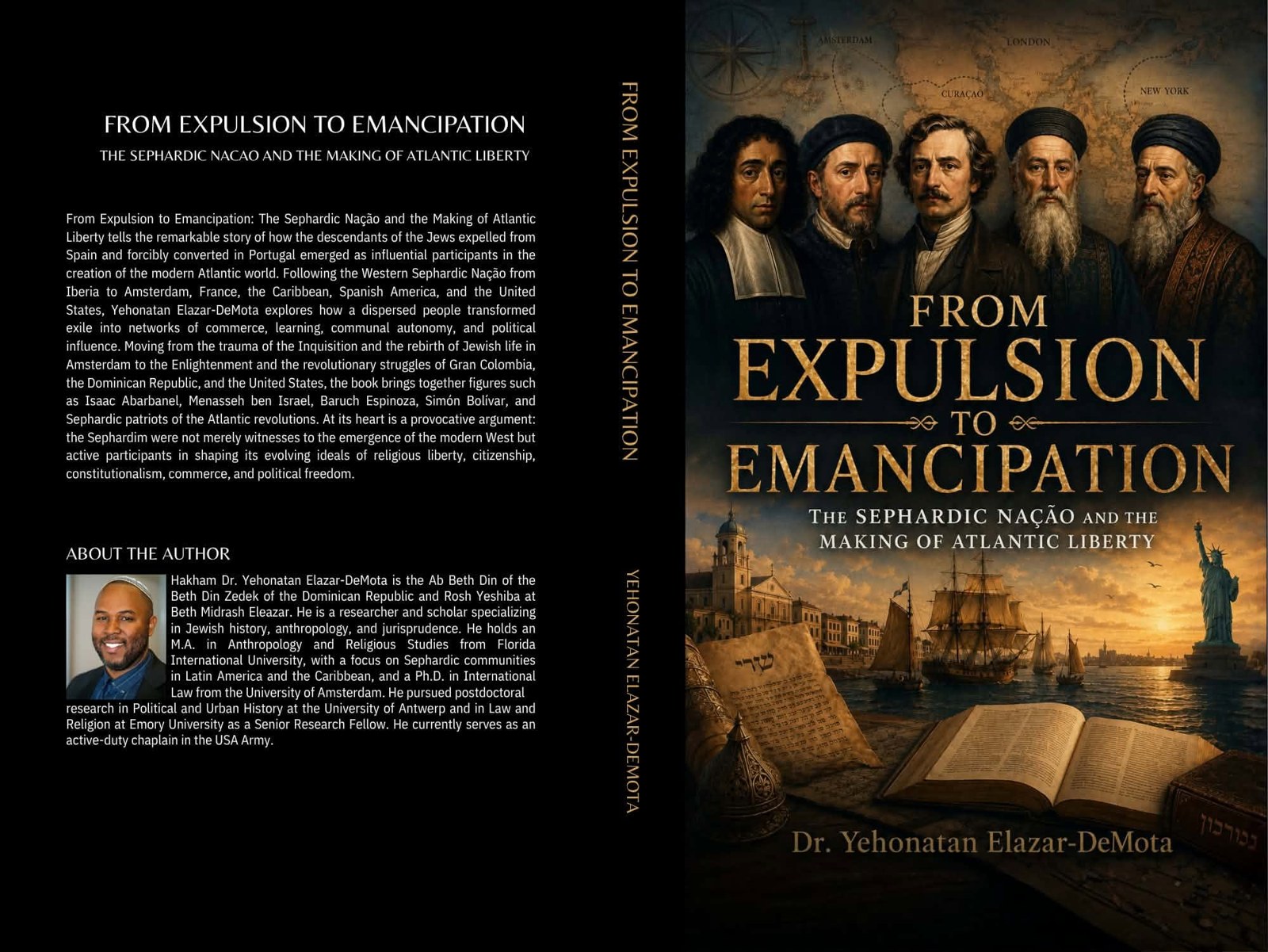 The cover of Dr. Elazar-DeMota’s book “From Expulsion to Emancipation: The Sephardic Nação and the Making of Atlantic Liberty”
He now hopes to apply his research methods in additional towns, including Puerto Plata, Moca, La Vega, Pimentel, and El Seibo, all in the Dominican Republic.
Elazar-DeMota is not content to stop with what he found in Baní. His next step is to build a genetic database integrated with genealogies to help examine connections among the Dominican towns where he suspects anusim settled.
He also hopes to establish a Jewish cultural center in Baní.
What seems to motivate him to continue working on behalf of Baní’s community is the very discovery of Jewish customs there. “The memory did not disappear. It was passed down quietly within the home, in the kitchen, in bathing on Good Friday, in washing hands after leaving the cemetery. The descendants forgot why, but continued doing what they had been taught”.
He says that surnames, kinship ties, household customs, and traditions transmitted primarily through women turn these families into “living archives”, whose memories can be examined against historical documentation and genetics.
The research also taught him about the remarkable importance of women and their role in educating children and transmitting traditions across generations. When I ask him, in closing, what he still feels is missing, he explains that Baní’s story deserves to be much more widely known. If he could add a question to his research, he would address it to the people of Baní. “I would ask them: ‘If you discovered that you were descendants of the Jewish people, would you want to learn more about that history?’ There is no answer to that question yet, but perhaps that is precisely the point: after hundreds of years of silence, someone is finally asking”.

