

Parashat Va'etchanan
What Is the Purpose of Prayer? A Powerful Lesson from Parashat Va'etchanan.
Prayer is not only about asking, but is about building a relationship with God and recognizing that every moment of life is constantly renewed by His will
- Rabbi Moshe Sheinfeld
- | Updated
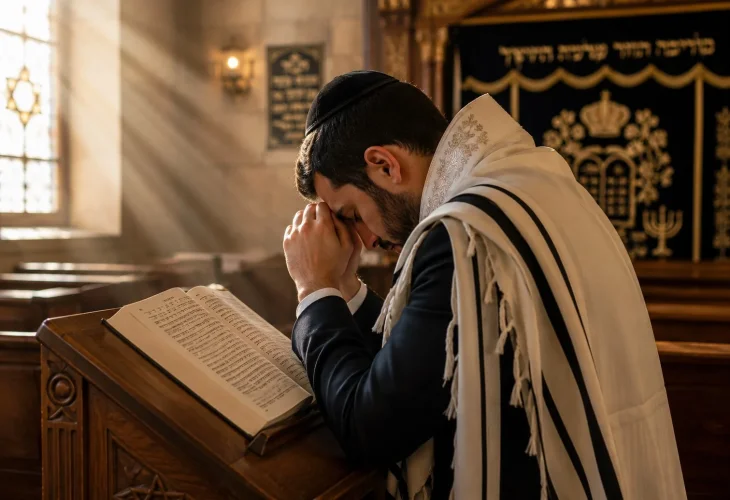
Parashat Va'etchanan addresses many of Judaism's most profound themes, each deserving careful study. The opening subject of the parashah is prayer.
After God decreed that Moses would not enter the Land of Israel, Moses pleaded repeatedly to reverse the decree. Eventually, God told him: "Enough! Do not continue speaking to Me about this matter." (Deuteronomy 3:26)
Our Sages teach that had Moses offered one more prayer, God would have been granted his request. Such is the extraordinary power of a sincere prayer that comes from the depths of the heart, that it has the ability to alter even a Divine decree.
A World Created with Perfect Precision
In the haftarah for this parashah, the famous Nachamu prophecy, Isaiah declares: "Who has measured the waters in the hollow of His hand, or marked off the heavens with a span? Who has calculated the dust of the earth by measure, weighed the mountains on a scale and the hills in a balance?" (Isaiah 40:12)
Isaiah emphasizes that God created the universe with absolute precision and perfect measure. Every element of creation has been carefully calculated. Nothing is missing, and nothing is superfluous. Who but the Creator knows the exact quantity of every drop of water in existence? Who knows the precise dimensions of the heavens, as though He measured them with a span? Who knows the exact amount of the earth's dust, or the weight of every mountain and hill?
Isaiah presents these examples to reassure the Jewish people about the coming redemption. Just as creation itself was designed with perfect precision, so too redemption will arrive at exactly the right moment — not a second too early and not a second too late.
If Everything Is Already Measured, Why Do We Need to Pray?
If every grain of sand has been measured with such precision, surely our needs have also been carefully determined.
Yet Judaism teaches that one of the primary purposes of prayer is to ask even for life's most basic necessities including health, livelihood, life itself, and every other essential need. Why should human beings have to pray for necessities if God already knows exactly what they need?
The Sages explain that although every person is born with the blessings destined for them, God established that even the blessings assigned to the righteous would not reach them without prayer. Why? Because, as the Talmud says: "The Holy One, blessed be He, longs for the prayers of the righteous." (Yevamot 64a)
Of course, this statement is not intended to attribute human emotions to God. Rather, it teaches that prayer creates a relationship between the Creator and His children. God desires that relationship. He waits, so to speak, to hear the heartfelt prayers of those He loves.
Moses' Prayer Teaches a Remarkable Lesson
A striking example of the power of prayer appears in this very parashah. Moses prayed: "Please let me cross over and see the good land that is beyond the Jordan." (Deuteronomy 3:25)
His request actually contained two separate petitions. First, "Please let me cross over." Second, "...and see the good land."
God denied Moses' first request, saying: "Enough! Do not continue speaking to Me about this matter."
But He granted the second request: "Go up to the top of Pisgah, lift your eyes westward, northward, southward and eastward, and see it with your own eyes." (Deuteronomy 3:27)
Moses merited seeing the Land only because he asked. Rashi, citing the Sages, explains that despite all of Moses' unparalleled righteousness, he would not have received even this privilege had he not prayed for it.
It is a remarkable lesson. Who knows how many blessings are waiting for us in God's storehouses, held back only until we ask?
Prayer Protects Us from Spiritual Complacency
Prayer serves another essential purpose as well.
Later in the parashah, Moses warns the Jewish people: "When you have children and grandchildren and have long dwelt in the land... you may become corrupt..." (Deuteronomy 4:25–26)
The Hebrew word "venoshantem" ("you become settled" or "grow old in the land") also carries the idea of becoming overly comfortable and spiritually complacent.
When we pray even for the most basic aspects of life, we remind ourselves that nothing is guaranteed simply because it existed yesterday. Every blessing depends, at every moment, upon God's continued will. Prayer keeps us spiritually awake and prevents us from taking God's gifts for granted.
More Than Requests: A Life of Gratitude
Prayer is not only about asking. It is also about praising God and expressing gratitude for every blessing.
Each morning we recite the Morning Blessings, thanking God for what often seem like ordinary gifts: restoring sight to the blind, straightening those who are bent over, and providing firm ground beneath our feet.
In truth, we should thank God for these gifts every moment of our lives. We recite these blessings each morning because it is easier to recognize them when we awaken to a new day. But these gifts are not renewed only once each morning — they are renewed continuously.
As we proclaim in our daily prayers: "Who renews, in His goodness, the work of Creation every day, continually."
The prayer highlights two ideas. The first is "every day," something we naturally recognize each morning. The second is "continually." Every single moment.
Creation Is Constantly Being Renewed
The entire universe proclaims this truth. Nehemiah declares: "You alone are the Lord. You made the heavens, the highest heavens and all their hosts, the earth and everything upon it, the seas and all that is in them — and You give life to them all."(Nehemiah 9:6)
The verse describes two distinct stages: "You made..." and "You give life to them all." Creation did not simply occur once in the distant past and then continue on its own. Every part of existence receives renewed life from God at every moment.
Seeing the World Through the Eyes of Prayer
This is one of prayer's greatest gifts. It teaches us to see the world through the perspective expressed in our daily liturgy: "Who renews, in His goodness, the work of Creation every day, continually."
Prayer transforms the way we look at life. It reminds us that existence is never automatic, blessings are never self-sustaining, and tomorrow is not merely an extension of yesterday. Every breath, every opportunity, and every blessing is a fresh gift from the Creator, renewed again and again with each passing moment.

