

Wonders of Creation
Meet The Fish That Can Swim Faster Than a Speedboat
With a giant folding sail, powerful tail, and swordlike bill, the sailfish is built for speed. Discover the secrets behind this remarkable fish.
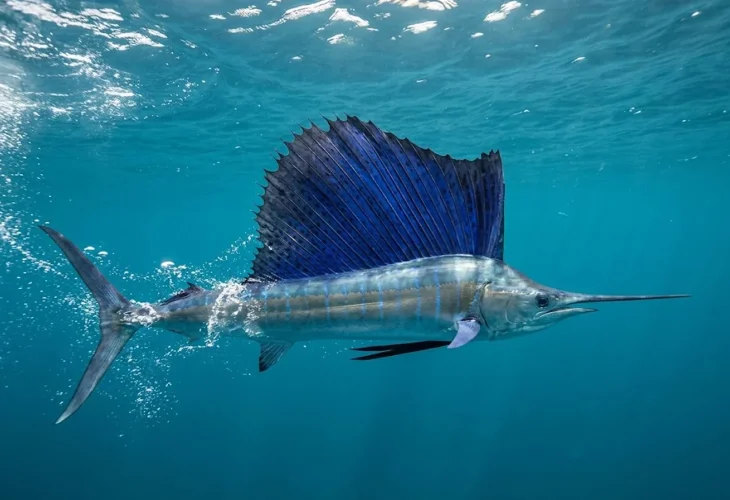
Large ships typically travel at around 25 mph (40 km/h), while speedboats can reach 37 mph (60 km/h) or more. Even racing boats must overcome enormous water resistance to achieve high speeds.
But there's a remarkable fish that can reportedly reach speeds of up to 68 mph (110 km/h), without an engine, fuel, or propeller.
Meet the sailfish, one of the fastest fish in the ocean.
Unlike cars, which travel across a solid surface, fish must push through water, a dense substance that constantly resists their movement. Yet the sailfish is remarkably well adapted to moving quickly through this challenging environment.
Its secret lies in an extraordinary combination of body shape, powerful muscles, specialized fins, and a distinctive sail that can fold away when it's time to accelerate.
A Body Designed for Speed
The sailfish has a long, streamlined body that helps it move efficiently through the water. Its pointed shape reduces drag, allowing it to swim with less resistance.
When any object moves through water, it must push the surrounding water aside. The greater the resistance, the more energy it takes to maintain speed.
The sailfish's body is shaped to minimize unnecessary turbulence and help it move smoothly through the ocean.
Its tail is another important part of this design.
Sailfish belong to the billfish family and have a narrow, crescent-shaped tail fin. Unlike the broad tails of fish that swim with slower, sweeping movements, this tail is adapted to generating powerful thrust through rapid side-to-side motion.
Working together, the streamlined body and strong tail allow the sailfish to accelerate quickly and move through the water with impressive efficiency.
Although sailfish are often credited with speeds exceeding 60 mph, their actual maximum swimming speed remains a subject of scientific debate. Some modern studies suggest that earlier estimates may have been too high.
Even so, there's no question that these fish are exceptionally fast and agile predators.
The Remarkable Sail That Folds Away
Perhaps the sailfish's most recognizable feature is its enormous dorsal fin, which stretches along its back and resembles the sail of a boat.
When fully extended, this fin can be taller than the fish's body.
At first glance, such a large fin might seem like a disadvantage for an animal built for speed. After all, a greater surface area creates more resistance in the water.
But the sailfish has an ingenious solution.
When swimming rapidly, it can fold its dorsal fin into a groove along its back, creating a smoother, more streamlined shape.
When it needs to maneuver, the fin can rise again.
This remarkable ability gives the sailfish greater control over its movements. The extended fin can contribute to stability during turns and other complex maneuvers, while the folded position helps reduce drag during fast swimming.
It's a little like having an adjustable piece of equipment that can be tucked away when it's no longer needed.
How Sailfish Hunt Their Prey
Speed alone isn't enough to make the sailfish such an effective hunter.
It also needs extraordinary precision.
Sailfish often hunt schools of smaller fish, including sardines. Rather than simply chasing their prey in a straight line, they use quick turns, carefully timed movements, and their distinctive long bills to catch individual fish.
The sailfish's upper jaw extends into a narrow, pointed bill that resembles a sword.
For years, people assumed this bill was primarily used to stab prey. But underwater observations have revealed a more sophisticated hunting technique.
A sailfish may insert its bill into a tightly packed school of fish and sweep it rapidly from side to side, striking or stunning individual prey.
Once a fish has been separated or injured, the sailfish can turn back and capture it.
Researchers studying sailfish hunting behavior have documented how these predators combine their speed with remarkable control over their bodies.
During an attack, a sailfish may accelerate, turn sharply, tilt its body, extend its dorsal fin, and swing its bill, all within seconds.
Each movement requires careful coordination.
Turning at high speed is particularly difficult underwater. A fast-moving body naturally tends to continue in the same direction, and changing course requires considerable force.
The sailfish's fins help it control these movements, allowing it to maneuver effectively while pursuing prey.
Researchers have also observed multiple sailfish hunting the same school of fish.
As the predators make repeated attacks, the smaller fish may gather into an increasingly tight group, making it harder for individuals to escape.
This creates opportunities for the sailfish to strike.
Underwater studies have shown that sailfish often take turns attacking schools of prey, demonstrating just how complex their hunting behavior can be.
Special Adaptations for an Active Predator
The sailfish's remarkable abilities aren't limited to its body shape and fins.
Like other billfish, it also possesses specialized tissues that help warm its eyes and brain, allowing these organs to function effectively when the fish encounters cooler water.
Temperature matters because the nervous system must process information quickly during a high-speed hunt.
Warmer sensory organs can help maintain visual and neurological performance, particularly when the surrounding water is colder.
This adaptation is especially useful for a predator that depends on spotting prey, reacting rapidly, and coordinating precise movements.
Together, these features make the sailfish an extraordinary example of how marine animals are adapted to their environments.
From its streamlined body and powerful tail to its folding sail and swordlike bill, almost every part of the sailfish contributes to its ability to move, maneuver, and hunt.
And while scientists continue to investigate exactly how fast it can swim, one thing is certain: the sailfish is one of the ocean's most remarkable athletes, equipped with a combination of speed, agility, and precision that even the most advanced boats cannot easily imitate.

