

Shavuot
What Is Shavuot? The Meaning, History, Traditions, and Spiritual Power of the Festival
Discover the deeper meaning of the Festival of the Giving of the Torah, why it was given in the desert, its timeless customs and mitzvot, and how each year we return spiritually to Mount Sinai to receive the Torah anew
- Naama Green
- | Updated
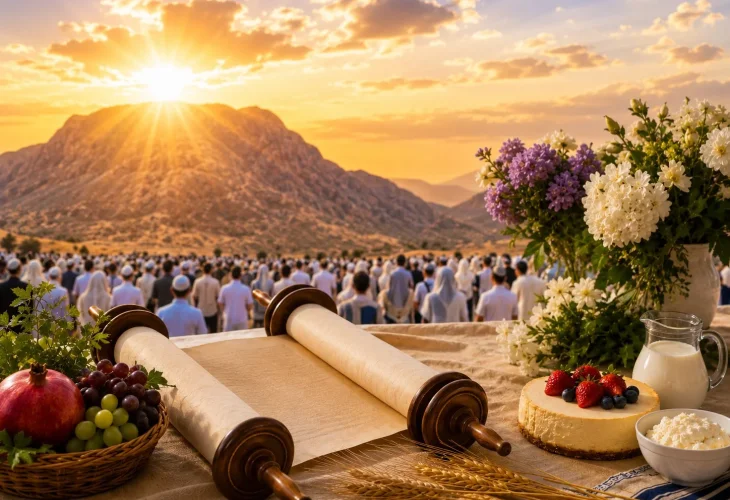
Unlike most Jewish holidays, Shavuot has no calendar date mentioned in the Torah. Instead, the Torah instructs that it be celebrated fifty days after the day following the first day of Passover. The festival marks the culmination of the seven-week counting of the Omer that begins on Passover, and it is from these seven weeks that Shavuot derives its name.
The Essence of Shavuot
More than 3,300 years ago, after leaving Egypt on the night of Passover, the Jewish people journeyed through the wilderness toward Mount Sinai. There, in the heart of the desert, the entire nation of approximately three million men, women, and children, witnessed one of history's greatest Divine revelations.
The Torah describes that extraordinary moment: "The Lord spoke to you from the midst of the fire. You heard the sound of words, but saw no form — only a voice. He declared to you His covenant, which He commanded you to perform, the Ten Commandments, and He wrote them on two stone tablets." (Deuteronomy 4:12–13)
Every year, Shavuot gives us the opportunity to relive that moment. The Jewish people did not receive the Torah only once at Mount Sinai. According to the Ramchal (Derech Hashem, Part IV, Chapter 7), every year the same spiritual illumination that descended upon our ancestors returns once again, allowing each generation to reconnect with the giving of the Torah.
He writes that whenever the cycle of a sacred time returns, the spiritual light and transformative power associated with that original event shine once again upon those who are prepared to receive it.
Rabbi Eliyahu Dessler, in Michtav MeEliyahu, offers a profound perspective on this idea. Time itself remains fixed; it is we who travel through it. The season of the Giving of the Torah permanently exists within the cycle of time, and each year we enter that same sacred moment. The degree to which we experience its blessings depends on the spiritual vessel we have prepared.
As he writes, we do not celebrate the festivals merely as historical commemorations. Rather, we return to the very holiness of those original moments, which continues to radiate in every generation.
Rabbi Tzvi Hirsch Broide, the Alter of Kelm, expressed this idea beautifully: time does not pass over us — we travel through time. Just as every week brings us back to the original sanctity of the very first Shabbat, every Passover returns us to the redemption from Egypt, and every Shavuot brings us once again to the holiness of the Giving of the Torah.
With this understanding, Shavuot is not simply a remembrance of Sinai, but it is our opportunity to receive the Torah anew.
Why Was the Torah Given in the Desert?
The Torah was given while the Jewish people were encamped in the Sinai Desert, during the forty-year period between the Exodus and their entry into the Land of Israel.
It was there that Moses ascended Mount Sinai and learned the Torah directly from God, including all of its details and explanations. Throughout the forty years in the wilderness, Moses taught the people everything he had received.
Part of that Torah was written down as the Written Torah, while another part was intentionally transmitted orally from generation to generation as the Oral Torah.
The Midrash asks an important question: Why was the Torah given specifically in the wilderness?
It answers: "The Torah was given through three things: fire, water, and the wilderness."
The Midrash then explains that just as fire, water, and the wilderness are freely available to everyone, so too the Torah belongs to everyone.
The location of Mount Sinai carries a timeless message, that the Torah is accessible to every person. No matter who you are or where you are in life, the Torah is available to you. The only requirement is a genuine desire to receive it.
The Mitzvot of Shavuot
Unlike Passover, which is defined by eating matzah, or Sukkot, with its sukkah and four species, Shavuot has no unique physical mitzvah that defines the holiday.
Instead, Shavuot celebrates the Torah itself. Every word of Torah belongs to this festival.
For this reason, it became customary for Jews to spend the night of Shavuot immersed in Torah study, preparing themselves spiritually to once again receive the Torah before reading the account of the revelation at Mount Sinai during the morning service.
During the Temple era, the central observance of Shavuot was the offering of the Two Loaves, baked from the new wheat harvest. The festival also marked the beginning of the mitzvah of bringing the first fruits (Bikkurim) to the Temple, where the Jewish people expressed gratitude to God for the gift of the Land of Israel and its bounty.
Another Torah commandment associated with the holiday is giving charity before the festival so that the poor can rejoice alongside everyone else.
The Torah states: "You shall celebrate the Festival of Weeks... and you shall rejoice before the Lord your God — you, your son and daughter, your servant, the Levite, the stranger, the orphan, and the widow." (Deuteronomy 16)
Maimonides explains that true holiday joy is incomplete unless it includes caring for those in need.
Customs of Shavuot
Among the cherished customs of Shavuot are:
Studying Torah throughout the night — or at least dedicating significant time to Torah study during the holiday.
Reading the Book of Ruth after the morning prayers.
Reciting Psalms, as King David is traditionally believed to have passed away on Shavuot.
Reciting Tikkun Leil Shavuot, the traditional compilation of Torah passages studied throughout the night.
Decorating synagogues with flowers and greenery.
Eating dairy foods and honey.
Reciting special liturgical poems, according to one's community's custom.
Meaningful Resolutions for Shavuot
The Jerusalem Talmud teaches that no sin offering is brought on Shavuot because God says: "Since you have accepted upon yourselves the yoke of Torah, I consider it as though you have never sinned."
Rabbi Yechezkel Levenstein explained the remarkable power of making a sincere spiritual resolution. When a person genuinely accepts a positive commitment upon himself, he becomes, in a sense, a new person.
Shavuot is therefore an ideal time to adopt a meaningful resolution that strengthens our connection to Torah.
Shavuot is far more than the anniversary of a historical event. It is an invitation to stand once again at the foot of Mount Sinai, to hear God's voice anew, and to renew our commitment to the Torah with the same awe, gratitude, and love that filled the hearts of our ancestors.

