

Behind the News
Rachel's Tomb Draws Thousands: Stories of Faith, Miracles, and Prayer
As thousands flock to Rachel's Tomb ahead of her yahrzeit, site manager Eyal Attia shares remarkable stories of answered prayers, growing crowds, and the extraordinary spiritual connection that draws Jews from all walks of life
- Michal Arieli
- | Updated
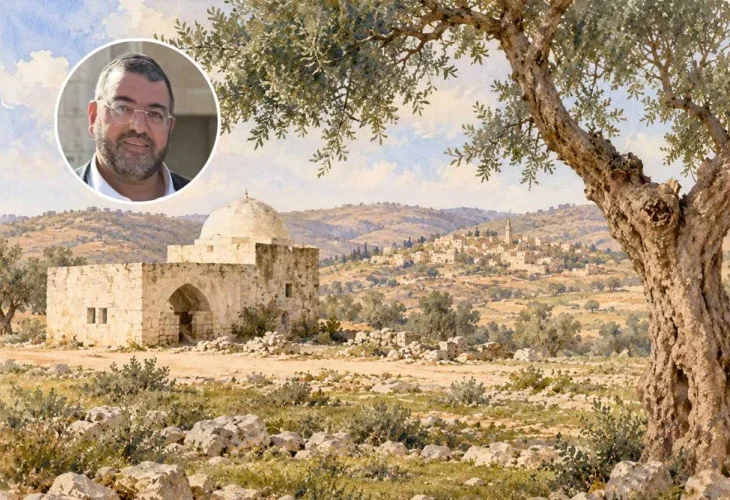 In the circle: Eyal Attia, manager of Rachel's Tomb
For some, Rachel's Tomb is far more than a place they visit occasionally. It has become an inseparable part of their lives. One of those people is Eyal Attia, the manager responsible for overseeing the sacred site. His responsibilities range from opening the gates and maintaining the facilities to coordinating visiting groups, organizing events, working with the military, and ensuring that the site remains clean, orderly, and accessible to the thousands of worshippers who arrive each day.
When asked whether his position requires him to visit Rachel's Tomb every day, Attia responds with a smile. "I visit my home every day," he jokes, "because I spend most of my time here. I usually arrive at five in the morning and stay until around eight in the evening. And even when I finally get home, I might receive a phone call after midnight telling me that an important Rebbe is arriving and someone needs to open the gate and welcome him. There are countless reasons I might be called back."
Despite the demanding schedule, Attia views his work as an extraordinary privilege, one he makes a conscious effort never to take for granted.
"The truth is that I have to work on myself constantly to avoid becoming accustomed to being here. I don't want to lose my appreciation for the privilege of spending so much time at Rachel's Tomb. I'm reminded of it again and again during the two hours each day when the gates are locked. People arrive and beg us to let them in, even if it's only for a moment. Some say, 'Please, just let me give the tomb a kiss,' while others ask for five minutes to recite a chapter of Tehillim. Seeing their longing reminds me where I am and how grateful I should be for the opportunity to serve here."
"There Simply Isn't Enough Room"
Over the past several years, Attia has witnessed a dramatic increase in the number of people visiting Rachel's Tomb. "The number of visitors has doubled," he explains. "Perhaps it's because of the major renovations that were recently completed, allowing us to accommodate more people. Or perhaps it's because of the hardships the Jewish people have been experiencing. Either way, people are searching for salvation, and they feel that Mother Rachel is a place where they can bring every question, prayer, and request."
The growing number of visitors has also created considerable logistical challenges. "Until a few years ago, we received an average of 2,000 to 2,500 visitors a day. Today, between 4,000 and 5,000 people come on an ordinary day. And on special occasions, the numbers are even higher. On Hoshana Rabbah, for example, more than 25,000 worshippers arrived. On Zot Chanukah, a day considered particularly auspicious for prayer, we receive tens of thousands of visitors."
The problem, Attia explains, is that the site itself is relatively small, making it increasingly difficult to accommodate such enormous crowds.
Are there ever times when Rachel's Tomb is relatively empty?
"Almost never," he replies. "People come to pray around the clock. Even during the war, Rachel's Tomb was one of the few holy sites that remained open. In fact, we were asked to close it, but I insisted that it was impossible. How could we close both the Western Wall and Rachel's Tomb during a war, precisely when the Jewish people needed prayer more than ever?"
According to Attia, Yehuda Avidan, director-general of the Ministry of Religious Services, arranged for protective shelters to be brought to the site, enabling it to remain open.
"People continued arriving in enormous numbers," he recalls. "During the most recent Purim, which fell two days after the outbreak of the war with Iran, worshippers recited 400 complete books of Tehillim throughout the night. I have no doubt that those prayers were beneficial and helped protect the Jewish people."
For those hoping to visit during quieter hours, Attia offers a useful suggestion. "Every morning, immediately after sunrise, the site becomes relatively quiet. Between seven and nine in the morning, there are usually about two hours when very few people are here. Those who arrived for early prayers have already gone home or left for work, while those who plan to visit after their morning prayers haven't yet arrived."
He notes that the arrangements for the upcoming yahrzeit will create an additional opportunity for those who arrive early. "On the day of the hilula, buses will not be permitted to enter between six and nine in the morning because they're needed for the city's transportation system. Private vehicles won't be permitted throughout the day either. This means that someone who arrives at six and remains until nine will have a relatively quiet opportunity to pray without the enormous crowds."
With so many visitors, how can you accommodate everyone in such a limited space?
"That's our greatest challenge," Attia admits. "The site is very small, and our goal is to allow everyone to enter and pray safely, without dangerous overcrowding."
To manage the growing demand, additional staff members are brought in throughout the year, particularly during major events and auspicious days when attendance rises sharply. "We position ushers outside the compound who close the gates when the site becomes too crowded. At the same time, we encourage worshippers to leave promptly after completing their prayers so that others can enter."
Traffic management is another essential part of the operation. During particularly busy periods, private vehicles are prohibited from entering the compound.
"One bus can transport 50 people, while ten private cars might carry the same number," Attia explains. "We simply don't have enough space for all those vehicles. It's not that we don't want people to come. We just don't have room."
Who are the people who come to pray at Rachel's Tomb?
"The people who visit today represent every segment of Israeli society," Attia says. "It's definitely not limited to religious Jews. Anyone who thinks they won't encounter secular young people from Tel Aviv, people with tattoos, or participants in the Kaplan Street protests is mistaken. We see people from every background and walk of life."
Just the previous day, he recalls, three senior physicians from Tel Aviv contacted him to ask about the quickest way to reach the upcoming hilula.
"Quite a few famous people and celebrities also visit regularly because they feel a deep connection to the place. And of course, there are the righteous women who arrive every morning at four thirty, complete the entire Book of Tehillim before sunrise, remain for Shacharit, and only then continue with their day."
Other regular visitors include kollel students who arrive as early as four in the morning to recite Shir HaShirim before dawn, as well as members of a special Tikkun Chatzot kollel who study Torah throughout the night. "I honestly don't think there's another place that attracts such a diverse cross-section of people," Attia reflects.
Interestingly, the site also attracts visitors from other religions. "Muslims sometimes come from Africa and other parts of the world because, according to their tradition, Rachel was the mother of Yusuf, or Joseph."
Attia also describes an unusual annual gathering that takes place near the site toward the end of the Gregorian calendar year. "Every year, priests and archbishops leave the church in Bethlehem and meet with representatives of other churches in Jerusalem. Their gathering takes place in the square outside Rachel's Tomb. It's a diplomatic event with connections extending all the way to the Pope, and they specifically choose to hold it here."
For Attia, this diversity reflects the extraordinary significance of Rachel's Tomb as a place that draws people from across the world.
A Personal Miracle at Rachel's Tomb
Many visitors, Attia explains, come not only to ask for blessings but also to express gratitude for what they believe are miraculous answers to their prayers.
"There's a permanent table here where people hold thanksgiving meals," he says. "They come to thank Hashem and Mother Rachel for the salvations they've experienced."
Attia himself has a deeply personal story that began long before he was appointed manager of the site. "Before our son was born, my wife experienced a very difficult pregnancy. She wasn't feeling well, and we went to the hospital, where the doctors told us that the pregnancy couldn't continue."
His wife, however, pleaded for a little more time. "She asked the doctors to give her just a few hours so that she could travel to Rachel's Tomb and pray. We went there together, and I later discovered that she had made a personal commitment, without making a formal vow, that if the pregnancy continued, she would hold a large thanksgiving meal at the tomb."
When they returned to the hospital, something unexpected happened. "Before proceeding with the termination, the ultrasound technician suggested performing one more examination. To our amazement, everything appeared normal."
Despite the encouraging results, the physician remained pessimistic. "The doctor said, 'Yes, but a miscarriage is inevitable.' Still, she agreed to wait until the following day."
One day passed, then another. Against the medical expectations they had been given, the pregnancy continued. "My wife remained on complete bed rest for three months," Attia recalls. "And eventually, Baruch Hashem, we were blessed with a healthy baby boy. Not long ago, we celebrated his chalakah, his first haircut at the age of three."
For Attia and his family, the experience remains a powerful personal reminder of the significance of prayer and their connection to Rachel's Tomb.
What are these days like for you, and how are you preparing for Rachel's upcoming yahrzeit?
"The site is already extremely crowded, even before the hilula begins," Attia explains. "At present, private vehicles are still permitted to enter, but visitors should be aware that parking is very limited."
He expects attendance on the day of the hilula to surpass previous records. "We're preparing for more visitors than ever before. The following day, Friday, is also expected to be particularly busy, especially because of 'Shabbat Rachel.' Twelve buses will transport worshippers from the nearby Har Homa neighborhood to the tomb for Friday night prayers, after which they'll return on foot."
The crowds are not expected to disappear once the hilula ends.
What about the following week?
"That will be extremely busy as well," Attia warns. "To give you an idea, last year more people came during the week after the hilula than on the day of the hilula itself."
He admits that there is little he can do to guarantee visitors a quiet and comfortable experience during this period. "Unfortunately, I don't have a solution for those who want to arrive easily and pray peacefully. Perhaps the only encouragement I can offer is my belief that the longing people feel, and the tremendous effort they make to come here, will itself contribute toward atonement and bringing them closer to the salvation they seek."
Plans to Expand Rachel's Tomb
With visitor numbers continuing to rise, several ideas have been proposed to improve the site's capacity and accessibility.
"Various possibilities are being discussed, including constructing a second floor at Rachel's Tomb," Attia says. "My personal dream is to build an underground parking facility that could accommodate the large number of vehicles."
However, any proposed expansion faces significant obstacles. "Every change, excavation, or construction project requires countless permits because of the site's archaeological sensitivities," he explains.
Land ownership is another complication. Beyond the wall surrounding the site are large parcels of land purchased by Jews approximately a century ago, which are currently considered privately owned.
"We look forward to the day when those lands can be reclaimed and made available for the needs of Rachel's Tomb. That would allow us to use them to improve the site."
In the meantime, improvements are being made on a smaller scale. "We're continuing with relatively minor renovations, like those completed over the past year. Additional work is planned for the near future, including renovating the restroom facilities and installing roofing over the road and street leading out of the compound."
New Transportation Options for Visitors
One particularly welcome development concerns public transportation to Rachel's Tomb.
"After considerable pressure and the allocation of funding, we managed to secure a new bus route from the Rosemary Junction to Rachel's Tomb," Attia announces. "The bus will depart every fifteen minutes."
The new service is expected to make the site much more accessible to residents throughout Jerusalem, many of whom previously lacked a convenient direct route. "People can now travel to the Rosemary Junction from different parts of Jerusalem, board the bus, and arrive at Rachel's Tomb within just three minutes."
Attia also notes a special transportation arrangement for the hilula. "On Wednesday night, the light rail will operate until two in the morning, which should make a significant difference for visitors arriving from the Haredi neighborhoods."
Be honest. Are you nervous about the hilula?
"I'm not nervous," Attia replies, "but we've made preparations on a scale unlike anything we've done in previous years. One of the major decisions is that buses will no longer enter the tomb compound itself but will stop at the entrance instead."
After extensive planning, he is understandably eager to see how the arrangements will work in practice. "I'm curious to see how everything unfolds, and of course, I'm praying and hoping that the entire event passes safely."
Yet even amid the enormous logistical responsibilities, Attia remains focused on the spiritual significance of his position. "These days, I keep reminding myself that it was Mother Rachel who brought me to this extraordinary role, not any particular individual. She decided that I should be here."
That conviction shapes the way he approaches his work. "If I've been given the privilege of serving here, then I have a responsibility to use this place to bring goodness to the Jewish people and to preserve its sanctity and purity."
He pauses before adding a final, heartfelt wish. "May I be worthy of fulfilling that responsibility."

