

World News
Hitler’s Birthplace Reopens as Police Station to Deter Nazi Pilgrimages
Austria rejected leaving the site empty, demolishing it or creating a museum, choosing an active police presence instead
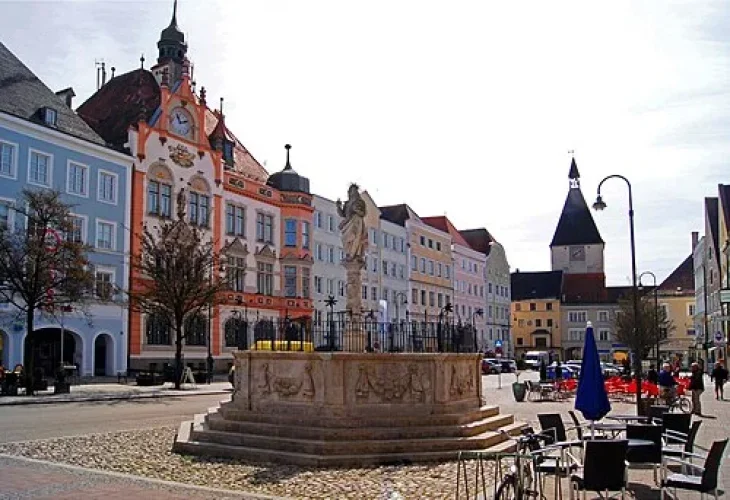 Braunau town centre
Adolf Hitler’s birthplace in Braunau am Inn, Austria, officially reopened Wednesday as a functioning police complex intended to end the building’s appeal as a pilgrimage site for neo-Nazis and admirers of the Nazi dictator. Around 50 officers are expected to work at the site near the German border, which will house both the local police station and the Braunau district police command.
Austria had struggled for years over what to do with the building. Leaving it empty risked allowing it to remain a symbolic destination for extremists, while officials feared that turning it into a museum could increase its attraction. Demolition was also rejected over concerns that it could appear to erase the site’s history.
The government instead chose to give the building an ordinary public function while placing officers and surveillance at a location repeatedly visited by far-right extremists. Police are not merely guarding the former Hitler residence. They will operate from it as their headquarters.
“Today’s police, our Austrian federal police, are the exact opposite of the symbolism associated with this place,” Interior Minister Gerhard Karner said. “Our police stand for democracy and the rule of law.”
Parts of the complex will also be used for police training related to human rights. A memorial stone will remain outside the house with the inscription: “For freedom, democracy and liberty. Never again fascism. Millions of dead remind us.”
Hitler was born in the building on April 20, 1889, but his family lived there only briefly before moving elsewhere. The stone was installed in 1989 and came from the quarry at the Mauthausen concentration camp. It does not mention Hitler by name.
Austria spent approximately €20 million renovating the building and making it less recognizable. Its ochre-yellow exterior was painted white, arched windows were replaced with rectangular ones and the facade was extended upward. Only the word “Police” identifies its new purpose. Construction debris was disposed of at a secret location to prevent pieces of the building from being collected as Nazi memorabilia.
Recent incidents showed that the site continued to attract extremists. In 2024, four Germans placed white roses outside the building and posed for photographs. One woman allegedly performed the prohibited Hitler salute. A visitor from Berlin had reportedly left a wreath there in 2021, while other far-right visitors previously photographed the house, removed stones and left flowers.
Critics do not generally argue that the building should have remained empty. They say Austria went too far in making it ordinary and failed to create a substantial historical or educational component.
“A unique historical opportunity was missed to use the birthplace of history’s greatest mass murderer in a lasting and historically responsible way,” said Eveline Doll, a spokesperson for the local Diskurs Hitlerhaus citizens’ initiative.
Robert Eiter of the Mauthausen Committee Austria offered a sharper criticism: “And in Braunau they are saying: Let’s forget as quickly as possible.”
Other remembrance advocates have also questioned whether police are an uncomplicated symbol at the site, noting that Austrian police institutions served the Nazi state.
Austria’s Interior Ministry had rented the building since 1972 to prevent its misuse and sublet it to charitable organizations. It stood empty after a care center for adults with disabilities moved out in 2011. Austria later expropriated the property after the owner refused to sell, and the country’s highest court upheld the move in 2017.
“From Braunau’s perspective, I believe another chapter is now being added to the centuries-long history of the house,” Mayor Johannes Waidbacher said, “and it will probably bring the debate over its future use to an end.”

