

World News
Trump on Possible F-35 Sale to Turkey: "No One Tells Us What to Sell"
Qatar and Pakistan are stepping up mediation efforts between the U.S. and Iran. President Donald Trump says Tehran asked to restart talks, while also weighing in on his relationship with Prime Minister Benjamin Netanyahu and on Turkey.
- Yuval Aviv
- | Updated
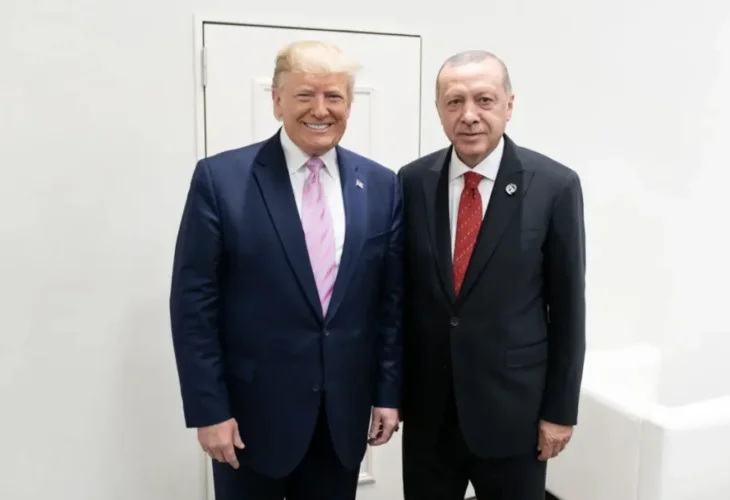 Trump and Erdogan (Photo: The White House)
The countries mediating between the U.S. and Iran have made progress in efforts to bring Washington and Tehran back to the negotiating table, the AP news agency reported today (Monday), citing two regional officials familiar with the details of the contacts. According to them, Qatar and Pakistan are leading the push to bridge the gaps between the sides, with the goal of renewing talks and restoring the temporary ceasefire agreement that collapsed after exchanges of fire between the countries.
The officials said the diplomatic efforts are moving forward on several parallel tracks. One of them even described the progress as "significant," noting that the mediators are working with Iran and Oman to formulate a new mechanism for regulating ship traffic in the Strait of Hormuz — the issue that led to the latest flare-up between the sides.
According to the report, Iran is demanding recognition of its sovereignty over the Strait of Hormuz, seeking to manage ship traffic there itself and collect fees from vessels passing through the waterway. Washington, for its part, is rejecting those demands and working to advance the "southern route" — an alternative maritime path along the coast of Oman, which Iran views as an attempt to undermine its control of the strait.
At the same time, U.S. President Donald Trump addressed the developments in a conversation with reporters aboard Air Force One, saying that Iran was the side that asked to renew contacts: "They want to meet, and we're meeting. We'll see what happens. There's a chance we'll reach a deal. Without what we did, they wouldn't even be talking to us."
Trump then argued that the military pressure applied to Iran was what led to the shift in its position: "Iran took a hard hit in the last 14 days, and they asked us very nicely: please stop, let's meet. That's where we are right now. We'll see what happens." At the same time, he stressed that if the diplomatic efforts do not ripen into an agreement, "we'll go back to the same place."
Trump also addressed reports claiming that his decision not to escalate the attack against Iran stemmed from a shortage of interceptors and advanced munitions, and dismissed them: "No, we have plenty. We have a lot of ammunition, of different kinds,". At the same time, he added: "We're in very good shape, but when it comes to the more sophisticated things, we would definitely like to have more."
When asked whether Prime Minister Benjamin Netanyahu would prefer the U.S. to pursue an agreement with Iran or continue military action, Trump avoided answering directly: "I'm not going to say that. But Bibi was great. He was a wartime prime minister. We worked very well together. And if you look at Iran now, they're 8% of what they were four months ago. So we'll see how it all works out."
Trump later also addressed Netanyahu's reported opposition to selling F-35 fighter jets to Turkey, making clear that he does not accept that position: "No, look, Turkey has been a great ally for me. I think he (Turkish President Recep Tayyip Erdogan) did a very good job, did a very good job in Syria. He's a friend of mine, and no one tells me what we should sell." According to Trump, "And Turkey has been a tremendous ally. It's up to Turkey. Turkey is not a big fan of Israel. You know that, right?"
At the end of his remarks, Trump also addressed U.S. relations with Israel, claiming: "You know who wouldn't survive without us? Israel. Bibi is coming. He'll tell you. If I hadn't intervened, and if I hadn't blown it to dust, as I call it, that weapon that was about to become nuclear, Israel would have been wiped out months ago and years ago, if I hadn't killed Obama's horrible deal."

