

Torah Personalities
The Jerusalem Rabbi Who May Have Been Britain's Most Unlikely Spy
Discover the incredible story of Rabbi Alter Levin, whose life combined faith, business success, literature, and alleged espionage during the final years of the Ottoman Empire.
- Yehosef Yavetz
- | Updated
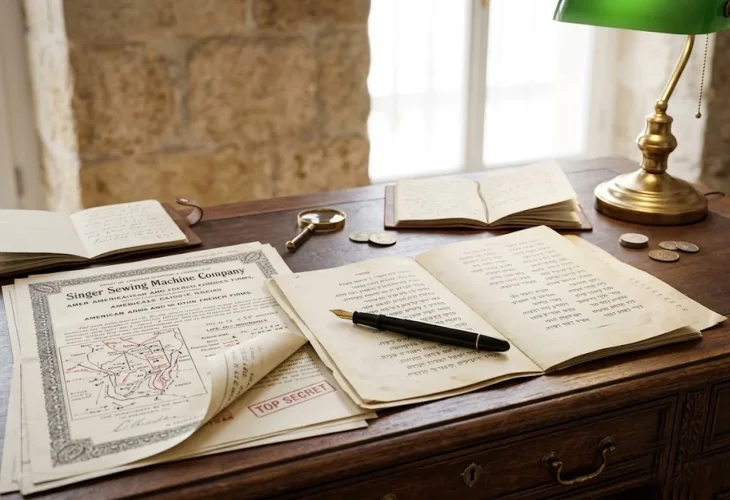
Rabbi Alter Yitzhak Levin, better known by his pen name Asaf HaLevi Ish Yerushalayim, was born on January 4, 1883, on the Starinka estate near Horodishitz, Belarus. As a young child, he immigrated with his family to the Land of Israel, where they settled in Jerusalem.
He studied at the Etz Chaim Yeshiva under Rabbi Chaim Yehoshua Kosovsky while also pursuing private studies in languages and science. Remarkably, he taught himself English, French, German, Italian, Turkish, Arabic, Hebrew, and Yiddish, skills that would later shape his extraordinary career.
As a young man, Levin began writing for the newspaper Havatzelet, publishing poetry under the name Asaf HaLevi Ish Yerushalayim. His poems later appeared in Hapoel Hatzair, Haaretz, and Bustanai. Several were set to music and became well known throughout the country.
From Poet to Business Pioneer
At the same time, Levin built an impressive business career. He managed the Jerusalem branches of both the Singer sewing machine company and the Underwood typewriter company before becoming one of the pioneers of Israel's insurance industry.
He opened what he called an "Office for Life Responsibility," coining the Hebrew expression "life responsibility" as a translation of "life insurance." He also introduced fire insurance at a time when it was virtually unknown in the country.
Operating from the prestigious Sansur Building on Jaffa Road, Levin represented American, British, and French insurance companies. At its height, his office employed seven staff members and dozens of agents, and was considered one of the most luxurious business offices in the Middle East.
His clients' homes were marked with distinctive metal fire-insurance plaques, known as fire marks, which became one of his trademarks. Beyond insurance, Levin served as a trusted intermediary, connecting businesses, families, consulates, government officials, and international financial institutions.
His gravestone on the Mount of Olives reflects the many facets of his life. It bears several names and titles, including Rabbi Yitzhak HaLevi, Asaf HaLevi Ish Yerushalayim, and Alter HaLevi, "titan of commerce and pioneer of responsibility in the Land." Historians have described it as "three different figures resting in one grave."
A Secret Life?
For decades, Levin was remembered primarily as a businessman and poet.
Then, in 1991, researcher Eliezer Tauber published material based on the diaries of Aziz Bey, the head of intelligence for the Ottoman Fourth Army, presenting an astonishing new claim: that Levin had served as a key double agent for British intelligence during World War I.
According to Aziz Bey's account, Levin's business activities gave him unusual access to senior Ottoman officials. His fluency in Arabic, together with his appearance and manners, reportedly enabled him to build close relationships with influential figures, including Jamal Pasha, the Ottoman governor of Syria and the Land of Israel.
The diaries claim that Levin used his insurance business as an ideal cover for gathering intelligence. Insurance agents could legitimately enter homes, businesses, and government offices while asking questions that would have seemed suspicious coming from almost anyone else.
According to Aziz Bey, Levin's network collected information about military movements, government officials, and public opinion throughout the Ottoman Empire. The operation also relied on cafés and entertainment venues frequented by soldiers to gather rumours, battlefield reports, and military intelligence.
Arrest, Escape, and Imprisonment
When the United States entered World War I on the side of the Allies, Ottoman authorities arrested American citizens living in Jerusalem, including Levin.
He managed to escape and found refuge in the Old City home of his friend and Arabic teacher, Khalil al-Sakakini.
Eventually, both men were betrayed, arrested, taken to Damascus, and sentenced to severe punishment. They were ultimately released only after the Ottoman army began retreating during the war.
A Devoted Family Man and Torah Scholar
After the war, Levin returned to Jerusalem and resumed his business career.
According to the National Library, following his imprisonment and forced exile, he sent his wife, Gitel, and their three daughters to Europe to recover from the hardships they had endured.
Researcher Moshe Nachmani notes that tragedy soon struck again when Levin's eldest daughter, Rivka Devorah, died in a Berlin sanatorium after a prolonged illness. From that point on, his family letters reveal a father deeply concerned about the spiritual lives of his daughters, who remained in Europe after the upheavals they had experienced.
Writing in rich Jerusalem Hebrew, Levin encouraged them to remain connected to Judaism and the Hebrew language despite living abroad. In one letter before the High Holidays, he urged them to pray in a traditional synagogue rather than attend a modern Neolog congregation, writing:
"You are daughters of Jerusalem, and you must not surrender before false culture."
These letters reveal a side of Levin that does not appear in business records or intelligence accounts—a Torah scholar and devoted father who remained unwavering in his commitment to Jewish life and values.
A Lasting Legacy
In 5683 (1923), Rabbi Alter Levin built his home in Jerusalem's Romema neighborhood. Part of the original house still survives today, and the inscription "Asaf HaLevi Ish Yerushalayim" remains carved into its stone fence.
One journalist captured the duality of his remarkable life with a memorable observation:
"Alter Levin was his weekday clothing, and Asaf HaLevi was his Shabbat clothing."
On the eve of Sukkot in 5693 (1932), Rabbi Alter Levin died suddenly in his Jerusalem home. His unexpected death gave rise to numerous rumours, adding yet another layer of mystery to an already extraordinary life.
Today, the Alter Levin Archive at the National Library preserves thousands of his letters, poems, business papers, and personal documents.
Whether remembered as a gifted poet, a pioneering businessman, a Torah scholar, or the alleged mastermind of a wartime intelligence network, Rabbi Alter Levin remains one of the most remarkable and multifaceted figures in Jerusalem's modern history.

