

History and Archaeology
French WWI Soldier’s Bedroom Left Untouched for Over 100 Years
For more than a century, Hubert Rochereau’s bedroom remained frozen in time. Now, hundreds of his belongings are being preserved and his remarkable room recreated for the public.
- Yehosef Yavetz
- | Updated
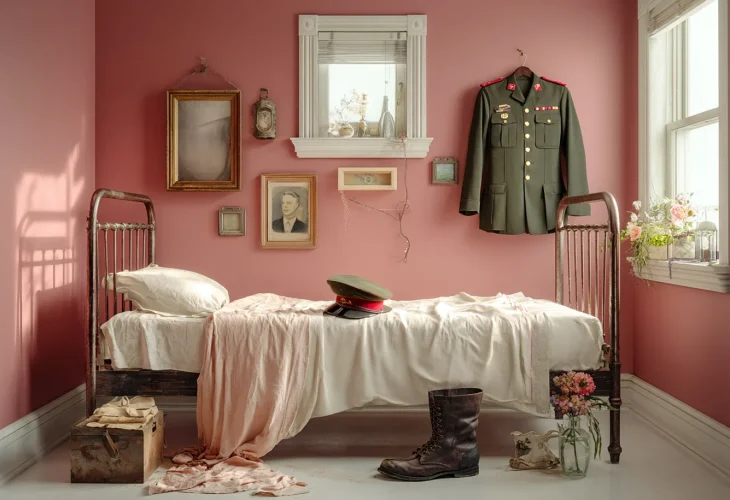
Hubert Guy Pierre Alphonse Rochereau was born on October 10, 1896, in Belâbre, a small town in France’s central Indre region. The only child of a wealthy family, he could hardly have imagined that decades after his death, his childhood bedroom would become an extraordinary time capsule of World War I.
World War I broke out in August 1914, when Rochereau was about 18 years old. He was drafted at 19, eventually joining the cavalry, one of the military branches most closely associated with old France. But the conflict he entered bore little resemblance to the cavalry wars of earlier generations. This was a war of trenches, shells, mud, machine guns, and mass mobilization.
A photograph of Rochereau as a young officer hung above his bed in his family home. It would remain there for decades, eventually becoming one of the most striking features of a room seemingly frozen in time.
A Young Soldier Killed in World War I
In the spring of 1918, Germany launched its final major military push in the West. After Russia withdrew from the war following the revolution, Germany was able to concentrate more forces on the Western Front and begin its Spring Offensive.
One of the key battle zones was Flanders and the area around Mont Kemmel in Belgium, a strategically important hilly region. On April 25, 1918, during the Battle of Mont Kemmel, Rochereau’s regiment was on the front line facing the German attack.
A shell fragment struck his left temple, fatally wounding him. The following day, April 26, 1918, Hubert died in a British field ambulance.
He was initially buried in a British cemetery. His parents did not know the location of his grave until 1922, when his body was found and returned to Belâbre for reburial. His fellow soldiers held another funeral for him on April 28, 1922, during which General Pourrat spoke in his memory.
His Parents Left His Bedroom Untouched
After receiving the news of their only son’s death, Rochereau’s parents did not touch his belongings. Instead, they left everything exactly as it had been when he departed for war.
The bed remained. The books remained. His photographs and uniform stayed in place. Over time, the bedroom became a remarkable collection of around 500 items that had belonged to the young soldier.
Among them were his neatly made bed, a Saint Cyr cap resting on it, military boots beside the wall, a hanging uniform, a pipe, hand rolled cigarettes kept inside a rusty box, toothpaste from his time at the front, photo albums, and numerous other personal belongings.
In 1935, Rochereau’s parents sold the house, but they included an unusual requirement in the sales agreement: the room was to remain exactly as it was for 500 years.
The parents had the clauses drawn up before a notary and also included an instruction that no celebrations be held inside the house. Under French law, however, such a 500 year commitment has no real legal force. Even so, successive owners of the home respected the parents’ wishes for decades.
A Bedroom Where Time Seemed to Stop
Rochereau’s room was never a public museum. It remained inside a private home, hidden away behind doors that slowly aged along with everything inside.
As the decades passed, the wallpaper yellowed and peeled. Dust accumulated, fabrics deteriorated, spiders spun webs across the uniforms, and the furniture gradually showed the effects of time.
In 2014, as the world marked 100 years since the beginning of World War I, the remarkable bedroom attracted widespread media attention. Belâbre Mayor Laurent Laroche described the experience of entering it to The Guardian: “When you enter it, it feels as though time has stopped.”
He even compared the experience, on a much smaller scale, to opening an ancient tomb that had remained untouched.
The publicity transformed Rochereau’s bedroom from an almost hidden local curiosity into an international story. French and British newspapers published photographs of the bed, portrait, cap, uniform, and faded interior. Until then, few people outside Belâbre had known the name of the young cavalry officer. The discovery of a room preserved for nearly a century suddenly brought his story to a much wider audience.
Saving the Room Before It Disappeared
In 2021, the house was sold once again. This time, the new owners, one of whom was a notary familiar with the legal status of the original agreement, made it clear that the room had reached an advanced state of deterioration and that they planned to clear it out.
Faced with the possibility that this remarkable piece of World War I history could disappear, local authorities and the French Heritage Foundation stepped in.
Teams of curators and historians entered the room and carefully documented, cataloged, and packed its contents. Their work extended beyond Rochereau’s personal belongings. Everything was preserved, from the peeling wallpaper to even the dirt that had accumulated inside the room.
The objects were then restored and disinfected in specialized laboratories in Paris and Limoges.
More than a century after Hubert Rochereau left his bedroom to serve in World War I, efforts are now underway to preserve the room for future generations. Construction has begun on a new memorial center in Belâbre, where the bedroom will be carefully recreated as it appeared in the family home.
The recreated room is expected to open to the public in 2027, allowing visitors to step into a space that Rochereau’s grieving parents tried to preserve for 500 years and experience one young soldier’s story more than a century after his death.

