

World News
Progressives Say They Love Jews—But Only Without Israel
Leading progressives say they oppose antisemitism while increasingly treating support for Israel as support for apartheid and genocide
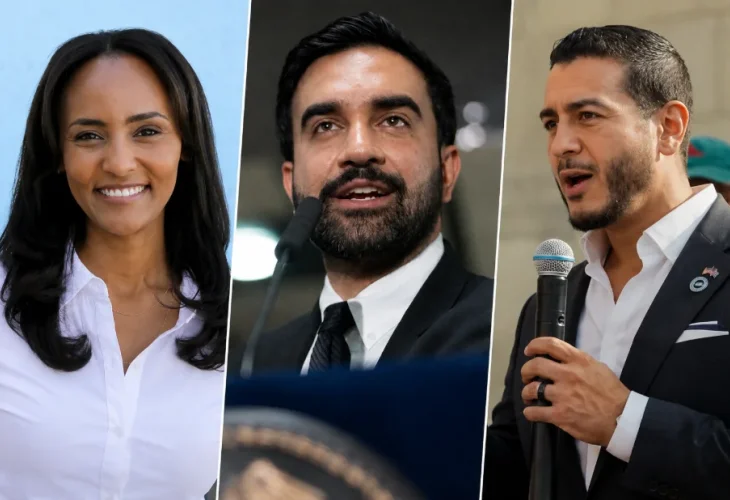
Progressive politicians have found a remarkably easy way to condemn antisemitism without reconsidering any of their rhetoric about Israel. They say they “love” Jews and Judaism, and promise to fight “actual antisemitism.”
Conveniently, they simply separate all of that from Israel. Jews are welcome as a religious minority, protected under the Constitution like everyone else. Zionism, however, is described as racism, apartheid or support for genocide. And when Jews say this rhetoric is crossing into antisemitism, they can be told that they are only making that accusation to shut down criticism of Israel.
That way of thinking is increasingly becoming the language of progressive politicians.
Melat Kiros, the Democratic nominee for Colorado's 1st Congressional District, offered one of the clearest examples yesterday: "I also reject the notion that anti-Zionism is antisemitism," Kiros wrote. "My concern is while voters across the political spectrum wake up to Israel's atrocities and our government's complicity in it, the Democratic Party is failing to meet this moment. And when the Party refuses to lead morally on this issue, they are letting antisemites on the right co-opt the movement.”
Kiros isn't excusing antisemites. But she is explaining why she thinks they're gaining traction: because Democrats haven't done enough to oppose Israel. The result is that Israel and its defenders become part of the explanation for the rise in antisemitism.
Michigan Senate candidate Abdul El-Sayed made the formula even clearer when he was asked if he was echoing old antisemitic tropes. “The idea that somehow we are going to use the specter of antisemitism to defend what a foreign government is doing does a deep disservice to the well-being of Jewish Americans in this country,” he responded. “Judaism and the Jewish people are a light unto the world,” he continued. “But we cannot sit idly by and ask why it is that our $3.3 billion a year at baseline is used to fund apartheid, genocide...”
That captures the argument clearly: praise Jews, treat Israel as a separate political issue, and dismiss their concerns about antisemitism as an attempt to silence criticism of Israel.
The reasonable version of this argument is obvious: American Jews should not be blamed for every decision made by an Israeli government. But these politicians go further. Once they declare Zionism itself oppressive and Israel guilty of genocide, a Jew’s position on Israel becomes a test of whether he is innocent or morally complicit.
New York City Mayor Zohran Mamdani shows where that distinction can lead. He has repeatedly described Israel’s actions in Gaza as genocide and said Netanyahu should be treated as a criminal rather than simply a controversial foreign leader.“Benjamin Netanyahu is not welcome in New York City, nor is any other war criminal at large,” he said.
That is the message. Once Israel’s “guilt” is treated as settled fact, supporting it is no longer viewed as a normal disagreement over foreign policy. It becomes, in their framework, support for genocide and a criminal regime. The Zionist Jew is no longer merely wrong. Once those premises are accepted, he can be treated more like someone defending Nazism or Stalinism than someone holding a different view of Israel.
This creates a divide between Jews who are seen as innocent and those treated as morally responsible. A Jew who condemns Israel can be presented as proof that anti-Zionism is legitimate and not antisemitic. But a Jew who supports Israel—or even rejects the claim that it is committing genocide—can be treated as complicit in those alleged crimes.
Once that happens, hostility toward him becomes easier to excuse. He is no longer described as being targeted because he is Jewish, but because he defended apartheid, genocide or a criminal state. Protection from antisemitism can then become conditional on whether his politics align with the movement.
Again, Kiros, El-Sayed, and Mamdani have not said Zionist Jews deserve antisemitism. But consider where their premises can lead.
A synagogue can be targeted because it supports Israel, with the protest described as political activism. A Jew can be harassed over Zionism and told the hostility was not antisemitic because it was directed at his politics, not his religion. Jews would not be blamed for being Jews. They would be blamed for being the wrong kind of Jews, and that distinction would allow everyone involved to deny that antisemitism had anything to do with it.
Their implied answer to antisemitism is therefore not only to confront antisemites. It is also to remove what they see as the cause of the anger: Israel’s actions, U.S. support for Israel and the refusal of pro-Israel groups to condemn Zionism.
The message to Jews is difficult to miss: separate yourselves from Israel, stop defending Zionism and help end American support for the Jewish state. They may still promise to fight antisemitism. The danger is that, by the time they define what counts as “actual antisemitism,” many of the Jews facing it will no longer qualify as innocent victims.

