

Magazine
Bridging the Gap: Exploring the Heart of the Ultra-Orthodox Community
Tour guide Dodi Bar Sela takes visitors beyond Jerusalem’s familiar landmarks to discover Haredi life, hidden neighborhoods, Jewish traditions, and the personal encounters that replace stereotypes with understanding
- Michal Arieli
- | Updated
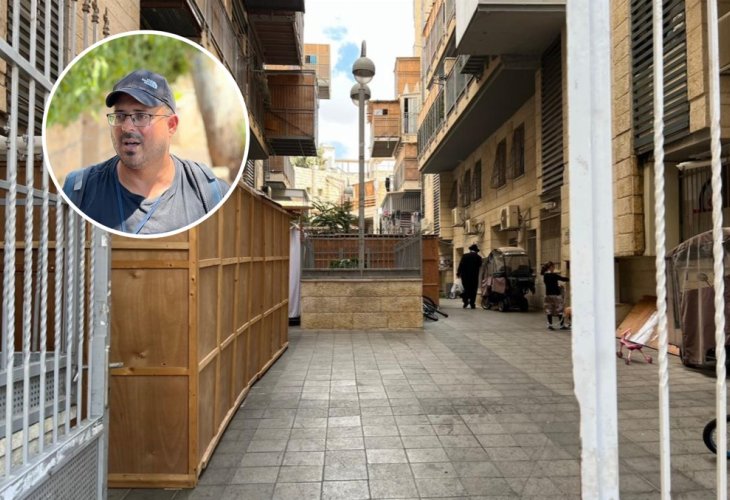 In the circle: Dudi Bar Sela. (Photo: Dudi Bar Sela)
The scene that unfolded last Sukkot near the Zichron Moshe synagogue in Jerusalem was both moving and surreal. A group of several dozen tourists stood together as a set of the Four Species passed from hand to hand. One by one, each member of the group recited the blessing and shook them as required.
The most touching part of the scene was the young Chassidic man standing nearby with several small children, all with long sidelocks. They waited patiently until the very last tourist had completed the mitzvah.
The tourists had not planned to perform the mitzvah of taking the Four Species. They had simply arrived in the area with their tour guide, Dodi Bar Sela. As they passed the impressive synagogue, a young man from the Ger Chassidic community happened to walk by with his children. On the spur of the moment, he offered the group the opportunity to recite the blessing over his Four Species.
The offer was warmly received, and soon dozens of visitors were taking turns fulfilling the mitzvah.
Jerusalem Beyond the Usual Attractions
Dodi Bar Sela is a tour guide who leads groups throughout Israel, but his specialty is what he calls “Jerusalem outside the box.” He offers tours through his website and personally guides visitors through parts of the city they would be unlikely to discover on their own.
“I take groups to places in Jerusalem that they would not normally reach by themselves,” he explains, “or I introduce them to unusual themes and stories hidden behind places they may already know.”
Most visitors to Jerusalem, he notes, tend to look for the familiar highlights. Those seeking a picturesque setting go to Ein Kerem. Those interested in a market visit Mahane Yehuda. Those looking for history, archaeology, and holiness head to the Old City.
“But I enjoy showing people the city’s lesser known corners,” he says. “I especially like neighborhoods such as Talbiya, Musrara, the Bukharan Quarter, the German Colony, and the Greek Colony. These neighborhoods give Jerusalem its distinctive character and color.”
Even when guiding groups through the Old City, Bar Sela tries not to focus only on famous landmarks. He introduces visitors to overlooked stories and small corners that reveal other layers of Jerusalem’s history.
“When discussing Jewish history, for example, there are areas in the Christian and Muslim Quarters where members of the Old Yishuv once lived,” he explains. “That gives me an opportunity to speak about the students of the Vilna Gaon who came to the Land of Israel with the hope of advancing the redemption. Their vision was not merely practical but also spiritual and national. There are many fascinating milestones that most visitors know nothing about.”
Discovering the Diversity of Haredi Society
Jerusalem’s Haredi neighborhoods are another important part of Bar Sela’s tours. He enjoys introducing visitors to a way of life that many have never encountered closely.
“The Haredi world is very distinctive, but many people know very little about it,” he says. “Most of the visitors I guide are very far removed from that world. Because of this, they often see it as one uniform society and assume that all Haredi Jews are exactly the same.”
The opportunity to look more deeply and observe Haredi life from within is extremely appealing to them. “It is a different and unfamiliar world that exists just beyond what they normally see, and that makes it fascinating.”
Bar Sela creates this introduction in several ways. Some tours focus on food, particularly on Fridays before Shabbat. Others explore the diversity within Haredi society and introduce visitors to its many communities and styles.
On some tours, he explains the most basic distinctions, such as the difference between Chassidim and Lithuanian yeshiva communities, or the customs and clothing of different Chassidic groups.
“The visitors listen carefully and enjoy learning how to recognize the different types of people they see in the street,” he says. “I feel that I am opening their eyes.”
The tours also address differences in ideology. Many visitors assume, for example, that the Eda Haredit, known to them mainly through its kosher certification, represents the same outlook as Haredi parties serving in the Knesset.
Bar Sela explains the long-standing disagreements between the Eda Haredit, Agudat Yisrael, and the Lithuanian Haredi community. While the Eda Haredit strongly opposes participation in the State of Israel and believes that even a Haredi prime minister should not be joined before the arrival of the Messiah, the Torah leaders of Agudat Yisrael and Degel HaTorah have supported participation in elections and public life.
“The Chazon Ish said that one was obligated to vote and even described it as a mitzvah,” Bar Sela explains. “However, when someone asked whether it was a mitzvah like eating matzah on Passover, he replied, ‘No, it is a mitzvah like eating maror.’ In that way, he expressed his opposition to the fact that the state was not governed according to Torah, while still emphasizing the obligation to participate and exert influence.”
Do secular visitors really find these details and explanations of Haredi society interesting?
“In most cases, they are extremely interested,” Bar Sela says. “At the end of a tour, after spending hours walking through different neighborhoods and visiting synagogues and yeshivot, they almost always ask, ‘Why don’t you take us to the most extreme place, Mea Shearim?’”
His answer is that he does not see much value in doing so.
“First, I am concerned about the reactions we might receive, because some residents of Mea Shearim do not want tour groups entering their neighborhood. More importantly, Mea Shearim does not represent Haredi society as a whole. My goal is to show visitors the wider community, not merely offer them an extreme experience.”
Occasionally, Bar Sela’s groups are invited into the homes of Haredi families who open their doors and welcome them warmly.
He mentions the Nadav family in Shaarei Chesed as one example. The father is a rabbinical judge and respected Torah scholar, while the mother is, in his words, an exceptional woman.
“I have brought groups to their home even during periods of intense social division,” he says. “Every time, the visitors left with new insights and somewhat different views of Haredi society.”
Visitors often tell him that while they do not agree with everything the family believes, they cannot remain unmoved by their warmth and wholehearted hospitality.
“They say it is completely different from the picture shown to them in the media.”
A Family Returns to Its Past
On another occasion, Bar Sela guided a group of around fifteen relatives who wanted to celebrate their grandmother’s birthday by visiting the home where she had grown up near Batei Arza in the Gush 80 neighborhood.
They arrived by minibus on a Friday afternoon, one of the busiest times of the week in a Haredi neighborhood.
“Despite the timing, the residents received us wonderfully,” he recalls. “They asked what we were looking for, and when we explained the story of the grandmother’s childhood home, they guided us to the exact building.”
The group entered the building noisily and stood out clearly from the neighborhood’s Haredi atmosphere, but the residents still greeted them with warmth.
One woman offered them challah she had baked for Shabbat. Another said she remembered members of the grandmother’s extended family. Fascinating conversations developed between the visitors and local residents.
Meanwhile, the group watched children returning home from school. One boy carried the weekly Torah sheet he had received in cheder, while a girl held the treat she had been given during a Shabbat celebration at school.
“These scenes warmed everyone’s hearts,” Bar Sela says. “They were filled with grace and Jewish beauty. We all felt that this was the real Jewish people, without the divisions and labels that people try to sell us.”
Sukkot in the Haredi Neighborhoods
Bar Sela also leads special tours during Sukkot, a holiday he has found to be especially fascinating for visitors.
“People want to learn as much as possible about Haredi society, and the holiday atmosphere in the streets, along with the sukkahs built on every corner, makes that possible.”
Visitors often become deeply interested in the halachic details. They ask why some sukkahs have only three walls or occupy very small spaces yet are still considered valid. They are also curious about the enormous sukkahs constructed near synagogues.
At times, they are understandably alarmed by sukkahs built in apparently unsafe ways on balconies that seem to have doubled or tripled in size.
“I always joke that ten miracles occurred in Jerusalem, and this is the eleventh,” Bar Sela says. “But of course, it is not really funny. It can be extremely dangerous, and the issue must be taken seriously.”
Some tours continue into the evening, after which visitors attend Simchat Beit HaShoeva celebrations and other events taking place throughout the city.
“It is an unfamiliar experience for them, and it brings tremendous color and interest.”
At a time of painful division and polarization within Israeli society, do tense encounters ever occur between visitors and local residents?
“It happens rarely,” Bar Sela says. “Sometimes a visitor expresses an opinion about the Haredi world without noticing that other people in the street can hear. On the other side, an occasional extremist living near Mea Shearim may shout at the group and tell us to leave.”
Overall, however, he says there is mutual respect.
“It is a remarkable and moving opportunity to see the real Haredi world. Even when one person says something inappropriate, I explain to the group that this is one bad apple and does not represent the entire community. They understand that.”
Each time his visitors leave a tour inspired and impressed, Bar Sela feels that he has made a small contribution to Jewish unity.
“Hatred grows where there is ignorance and no personal connection,” he says. “Once people become familiar with one another, they may still disagree, but hatred becomes much less likely.”
He is confident that the sights and experiences of these tours remain with participants long afterward.
“When they later hear unpleasant claims about the Haredi world through the media or other sources, they will remember what they saw for themselves. That will help them view the picture in a much more balanced and accurate way.”

