

Prophets
The Wise Woman of Tekoa: II Samuel Chapter 14 Explained
Explore II Samuel chapter 14, as Joab sends the wise woman of Tekoa to King David, Absalom returns to Jerusalem, and father and son finally reunite.
- Yonatan HaLevi
- | Updated
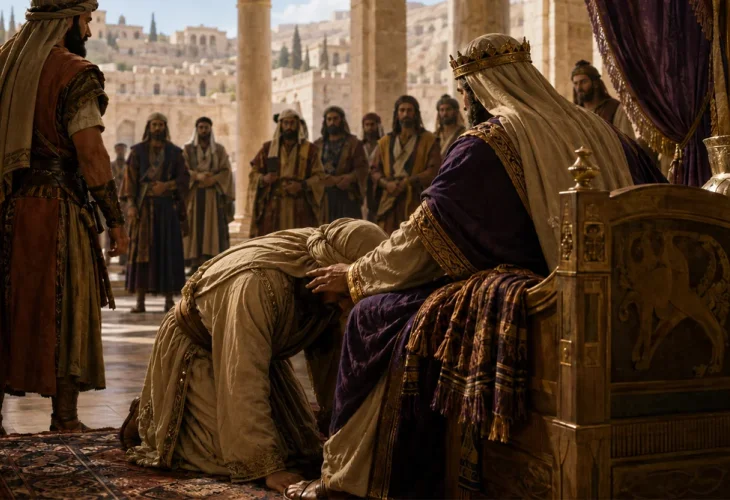
II Samuel Chapter 14 tells the story of the complicated reconciliation between King David and his son Absalom. Through Joab’s intervention and the carefully chosen words of a wise woman from Tekoa, David agrees to allow Absalom to return to Jerusalem. Yet the distance between father and son remains, setting the stage for what will come next.
Chapter Summary
The wise woman of Tekoa tries to persuade David: Joab tries to make peace between Absalom and David, hoping to convince David to bring Absalom back. Joab understands that this will not be easy, so he brings a wise woman from Tekoa to persuade David.
At first, the wise woman tells a story: She is a widow with two sons. One son killed the other, and now the family demands the death of her only remaining son. The conversation takes several twists and turns, and the woman does not let up until David realizes that Joab sent her.
David and Joab meet: The king summons Joab and is persuaded: “Go and bring back the young man Absalom.” Joab is overjoyed by David’s words: “Joab fell facedown to the ground and bowed, and he blessed the king. Joab said, ‘Today your servant knows that I have found favor in your eyes, my lord the king, because the king has done what your servant asked.’”
Absalom tries to persuade Joab: Absalom arrives in Jerusalem, but David still refuses to meet him: “The king said, ‘Let him return to his own house, but he shall not see my face.’ So Absalom returned to his own house, and he did not see the king’s face.”
Absalom, who wants to meet with his father, tries to send messengers to Joab with the request, but Joab refuses to contact him. Absalom decides to set Joab’s field on fire so that he will pay attention to him, and that is exactly what happens.
David and Absalom meet: Joab comes to David and asks him to meet with Absalom: “Joab came to the king and told him. He summoned Absalom, who came to the king and bowed facedown to the ground before the king, and the king kissed Absalom.”
The Full Chapter
(1) Joab son of Zeruiah knew that the king’s heart was with Absalom.
(2) Joab sent to Tekoa and brought from there a wise woman. He said to her, “Please act as though you are mourning. Put on mourning clothes and do not anoint yourself with oil. Be like a woman who has been mourning for the dead for many days.
(3) Then go to the king and speak to him in this manner.” And Joab put the words in her mouth.
(4) The woman of Tekoa spoke to the king. She fell facedown to the ground and bowed, saying, “Help me, O king!”
(5) The king said to her, “What troubles you?” She said, “Indeed, I am a widow; my husband has died.
(6) Your servant had two sons, and the two fought in the field. There was no one to separate them, and one struck the other and killed him.
(7) Now the entire family has risen against your servant, saying, ‘Hand over the one who struck his brother, so we may put him to death for the life of his brother whom he killed. Then we will destroy the heir as well.’ They would extinguish my remaining ember, leaving my husband neither name nor remnant on the face of the earth.”
(8) The king said to the woman, “Go home, and I will give instructions concerning you.”
(9) The woman of Tekoa said to the king, “Let the guilt be upon me, my lord the king, and upon my father’s house; the king and his throne are innocent.”
(10) The king said, “If anyone speaks against you, bring him to me, and he will never trouble you again.”
(11) She said, “Please let the king remember Hashem, your God, so that the avenger of blood will not keep multiplying destruction, and they will not destroy my son.” He said, “As Hashem lives, not a hair of your son’s head shall fall to the ground.”
(12) The woman said, “Please let your servant speak one more word to my lord the king.” He said, “Speak.”
(13) The woman said, “Why, then, have you devised such a thing against the people of God? In speaking this word, the king is guilty, since the king has not brought back his own banished one.
(14) For we will surely die and become like water spilled on the ground, which cannot be gathered again. Yet God does not take away a life; rather, He devises ways so that the banished one will not remain banished from Him.
(15) And now, the reason I have come to speak this word to my lord the king is that the people have frightened me. Your servant said, ‘Let me now speak to the king; perhaps the king will do what his maidservant asks.
(16) For the king will listen and save his maidservant from the hand of the man who would destroy both me and my son together from the inheritance of God.
(17) Your servant said, ‘May the word of my lord the king bring relief, for my lord the king is like an angel of God, able to discern good and evil. May Hashem, your God, be with you.’”
(18) The king answered and said to the woman, “Please do not hide from me anything that I ask you.” The woman said, “Please speak, my lord the king.”
(19) The king said, “Is Joab involved with you in all this?” The woman answered and said, “As you live, my lord the king, no one can turn to the right or to the left from anything my lord the king has said. For your servant Joab commanded me, and he put all these words in the mouth of your maidservant.
(20) Your servant Joab did this to change the face of the matter. But my lord is wise with the wisdom of an angel of God, knowing everything that is in the land.”
(21) The king said to Joab, “Look, I have done this. Go and bring back the young man Absalom.”
(22) Joab fell facedown to the ground and bowed, and he blessed the king. Joab said, “Today your servant knows that I have found favor in your eyes, my lord the king, because the king has done what your servant asked.”
(23) Joab arose, went to Geshur, and brought Absalom to Jerusalem.
(24) The king said, “Let him return to his own house, but he shall not see my face.” So Absalom returned to his own house, and he did not see the king’s face.
(25) In all Israel there was no man as praised for his beauty as Absalom. From the sole of his foot to the crown of his head, there was no blemish in him.
(26) Whenever he cut the hair of his head, he cut it at the end of every year because it became too heavy for him. He would cut it and weigh the hair of his head: two hundred shekels by the king’s weight.
(27) Three sons and one daughter were born to Absalom. Her name was Tamar, and she was a woman of beautiful appearance.
(28) Absalom lived in Jerusalem for two full years, yet he did not see the king’s face.
(29) Absalom sent for Joab, to send him to the king, but Joab was unwilling to come to him. He sent again a second time, but Joab was unwilling to come.
(30) So he said to his servants, “Look, Joab’s field is next to mine, and he has barley there. Go and set it on fire.” And Absalom’s servants set the field on fire.
(31) Joab arose and came to Absalom’s house. He said to him, “Why have your servants set my field on fire?”
(32) Absalom said to Joab, “Look, I sent for you, saying, ‘Come here, so I can send you to the king and say: Why did I come from Geshur? It would have been better for me to remain there. Now let me see the king’s face; and if there is guilt in me, let him put me to death.’”
(33) Joab came to the king and told him. He summoned Absalom, who came to the king and bowed facedown to the ground before the king, and the king kissed Absalom.
Explaining Difficult Words in the Chapter
“They would extinguish my remaining ember”: If they kill the brother who committed the murder, they will put out the small light that remains for me after the deaths of my husband and son. They will end the small amount of comfort I have after my husband and one of my sons have already died.
“So that the avenger of blood will not keep multiplying destruction”: Even when the respected avenger of blood stands before you, lays out his claims, and says that he wants to kill my son, remember Hashem, your God. Just as He is merciful, you too should show mercy to my son.
“He would cut it and weigh the hair of his head”: When Absalom would cut his hair, he would weigh the hair he had removed from his head.
“Two hundred shekels by the king’s weight”: When Absalom had his hair cut and weighed it, the hair weighed two hundred shekels according to the king’s standard weights.
Insights From Commentators
“The two fought in the field” — Metzudot: The woman had three arguments for why the son did not deserve to die, and therefore why Absalom did not deserve to die either:
- The fight took place in a field, so there were no witnesses or prior warning before the killing.
- There was no one to separate them. If someone had been able to intervene, one brother would not have killed the other. Similarly, if David had judged Amnon, Absalom would not have killed his brother.
- The fight involved each one striking the other, so each brother was considered to be pursuing the other. Likewise, Amnon assaulted Tamar, which was as though he had assaulted Absalom himself.
“Three sons were born to Absalom” — Malbim: These sons died, as will become clear later. This is why Absalom wanted to become king:
- So that he would have a remembrance among the people of Israel.
- David did not come to comfort him over the death of his sons, and Absalom understood from this that David did not intend to make him king.
“It would have been better for me to remain there” — Mahari Kara: Absalom said that while he was in Geshur, everyone was afraid to harm him because they saw his closeness to the king. But here, everyone knows that David is angry with him and thinks that he deserves death, so they may harm him.
An Intriguing Midrash on the Chapter
“Joab sent to Tekoa and brought from there a wise woman”: Rabbi Yochanan said: “Because they were accustomed to olive oil, wisdom was common among them. And these are things that restore learning: being accustomed to olive oil.”
A Reconciliation, but Not Yet a Resolution
The chapter ends with the long awaited meeting between David and Absalom. After years of separation, Absalom finally comes before his father, bows to the ground, and David kisses him. On the surface, father and son have been reconciled.
Yet the events of the chapter show that the distance between them was not easily erased. Absalom spent two years in Jerusalem without seeing his father, and their eventual reunion came only after Joab intervened once again. The chapter closes with a moment of reconciliation, while leaving the complicated relationship between David and Absalom far from resolved.

