

Raising Children
Parenting Without Anger: 7 Reasons to Stay Calm When Kids Misbehave
Children need boundaries, but anger can get in the way of the lesson. Discover seven reasons to discipline with patience, clarity, and self control.
- Shira Dabush
- | Updated
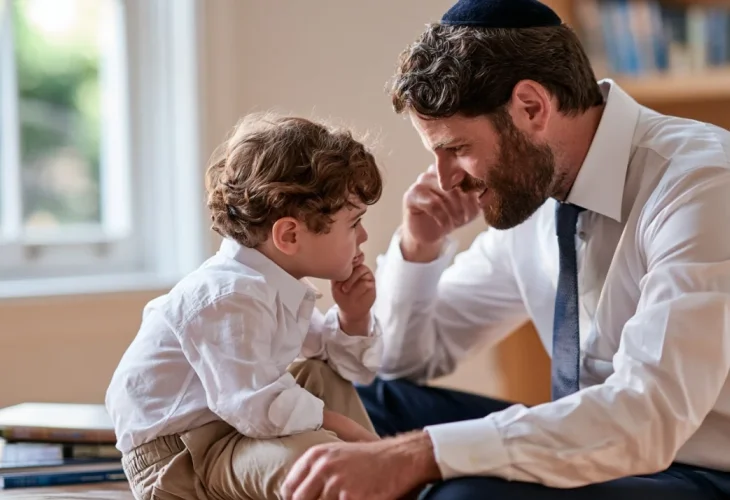
Every parent knows the moment: You ask once, then again, and again, but your child seems not to hear you. Eventually, the frustration sets in when you realize that nothing you asked for has been done. Sometimes it is a bedroom so messy you can barely walk through it. Sometimes it is another fight between siblings. And sometimes, yes, a child does exactly the opposite of what you asked.
And then the anger arrives.
We want our children to understand that there are boundaries, to learn respect, and to know that not every behavior is acceptable in our home. These are important parenting goals. The problem begins when, in a highly charged moment, we are no longer really educating. We are simply reacting.
The Torah warns us against acting impulsively out of anger, which can cause far more harm than good. Judaism does not ask parents to ignore inappropriate behavior. On the contrary, children need boundaries, guidance, and discipline. But there is an important difference between making it clear that certain behavior is unacceptable and losing control in anger.
Rambam writes that even when a person needs to display anger toward their children in order to guide them onto the right path, they should only appear angry outwardly while remaining composed within. In other words, even firmness should come from a place of control rather than an emotional storm.
So why is it so important not to parent from anger? Here are seven reasons to keep in mind.
1. In a Moment of Anger, We May Stop Educating and Start Unloading
This may be the most important distinction. A consequence is meant to help a child understand that their behavior has an outcome and teach them how to act differently next time. But when we are extremely angry, it is easy for our response to stop matching what actually happened.
The child spills something, and suddenly we are bringing up what they did yesterday. They speak disrespectfully, and we start making sweeping statements such as, “You never listen,” or, “How many times do I have to explain this to you?”
Instead of educating, we begin unloading our frustration onto the child. The child may then experience the response as personal rejection rather than guidance, making it much harder for them to absorb the message we are trying to teach.
That is why it is often better to stop, regain our composure, and only then respond thoughtfully and calmly.
2. Children Learn More From How We Behave Than From What We Say
You can tell a child a thousand times, “When you’re angry, you don’t yell.” But if we yell those words, we have communicated an entirely different lesson.
Children learn emotional regulation largely by watching the adults around them. When a parent can say, “I’m very angry right now, so I want to think before I respond,” they are modeling a far more powerful lesson in self control than any lecture could provide.
Sometimes the greatest parenting happens in the few seconds when a parent chooses not to say the words that first came to mind.
3. Fear Is Not the Same as Respect
A child may obey a parent because they are afraid. They may stop talking, clean their room immediately, or apologize quickly. From the outside, it may even seem as though the anger “worked.”
But it is worth asking: What did the child actually learn?
Did they understand why their behavior was wrong, or did they simply learn that when Mom or Dad becomes angry, they should do whatever it takes until the storm passes?
The goal is not to raise a child who behaves properly only because a parent is in the room. The goal is to raise a person who understands right from wrong and learns to choose what is right even when no one is watching.
4. When We Are Angry, We See the Behavior and Forget the Child
The child standing in front of us is not “the mess they made.” They are not the grade they received, the fight they started, or the disrespectful answer they gave a moment ago.
Behind the behavior is an entire child, with thoughts, feelings, desires, struggles, and needs of their own. What works for one child may not work for another, as the verse teaches, “Educate a child according to his way.”
Before correcting the behavior, it is important to first see the child. Understanding what lies behind a child’s actions does not mean excusing inappropriate behavior. It simply allows us to respond in a way that is more likely to reach them.
5. Even When a Child Makes a Mistake, They Need to Know the Relationship Remains
Even when you are angry about something specific your child has done, anger should not become the only thing the child sees.
Our sages teach that the proper approach is for “the left hand to push away while the right hand draws close.” There is a place for the left hand: boundaries, discipline, consequences, and a clear “no.” But there must always be a right hand drawing the child close as well.
Positive communication and connection should occupy a far greater place in the parent child relationship than criticism, correction, and punishment.
A child needs to know: You did something you were not allowed to do, and we are going to deal with it. But you are still my child, and our relationship is not put on trial every time you make a mistake.
6. A Child’s Behavior Can Sometimes Teach Us Something About Ourselves
It is easy to think of parenting as a project in which we are constantly trying to shape and educate our children. But Judaism reminds us that parenthood shapes and educates us as well.
When a child pushes exactly the button that is hardest for us, we come face to face with our own patience, pride, need for control, and ability to stop ourselves before reacting.
Difficult parenting moments can therefore become opportunities to work on our own character traits, particularly patience and self control.
Instead of asking only, “How do I get this child to change?” we can sometimes ask, “What is this moment asking me to change in myself?” or, “What am I learning about myself from this situation?”
That shift can transform the way we approach parenting.
7. You Can Be Firm Without Losing Control
This may be one of the biggest misconceptions about parenting without anger. Staying calm does not mean giving in to children. It does not mean that anything goes, that consequences are forbidden, or that a parent must smile when a child crosses a serious boundary.
Sometimes a parent needs to give a sharp and unmistakable “no” to stop inappropriate behavior. But it is possible to set a firm boundary without humiliating a child or losing control.
You can make it clear that certain behavior is serious without making the child feel that they themselves are bad. And sometimes the wisest response is simply to say, “I’m too angry right now. We’ll talk about this in ten minutes.”
What If You Already Lost Your Temper?
Parents are human, and there will inevitably be moments when anger gets the better of us. What matters is what we do afterward.
A parent can return to a child and say, “What you did was not okay, but the way I spoke to you was not right either.”
Apologizing does not necessarily weaken parental authority. In fact, it can teach a child an enormously important lesson: A person can make a mistake, take responsibility, ask forgiveness, and try to respond differently the next time.
Ultimately, parenting without anger does not mean parenting without boundaries. It means trying to make sure that our boundaries come from a place of thought, responsibility, and love rather than uncontrolled emotion. When we remain in control of ourselves, we are better able to give our children what they truly need: clear guidance, firm boundaries, and the security of knowing that even when they make mistakes, they are still loved.

