

Personal Stories
From Rebellion to Faith: Miriam Shmueli’s Journey Back to Judaism
After years of trauma, spiritual struggle, and dangerous choices, musician Miriam Shmueli found her way back through faith, professional help, music, and the decision to rebuild her life one step at a time
- Michal Arieli
- | Updated
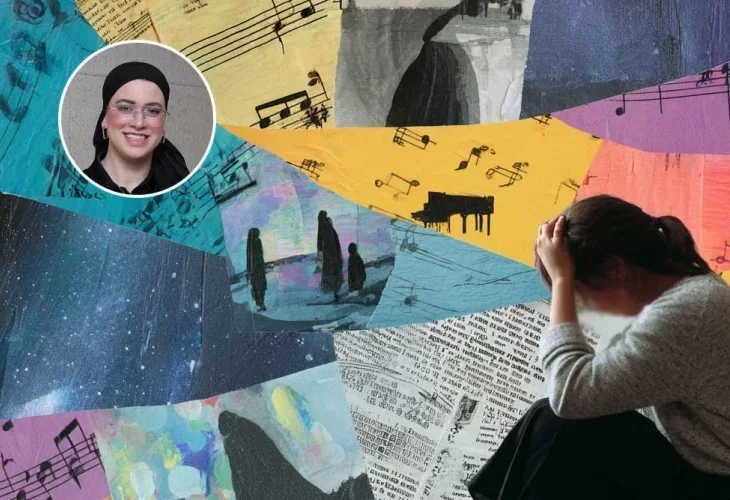
“When I was 16, I broke Shabbat for the first time,” Miriam Shmueli recalls painfully. She takes a deep breath before continuing with striking honesty.
“It is impossible to describe how difficult it was for me. I forced myself to listen to music on a player on Shabbat. Later, I ate dairy after meat. But I did everything quickly, with this feeling that I simply couldn’t bring myself to do it. I knew it was forbidden. I had been raised differently my entire life. But perhaps precisely because of that, I felt an overwhelming need to break through that barrier.”
To understand the magnitude of Miriam’s transformation, it is worth revealing where her story eventually leads. Today, Miriam is an observant Jewish woman, married to a God fearing husband and the mother of a sweet baby. A gifted musician, she performs throughout Israel for a wide variety of audiences, including Haredi women, women who have returned to religious observance, teenage girls at risk, and women of all ages. She also runs a large email community and has become an influential voice in the world of music.
But she cannot, and does not want to, forget the years when she was caught between truth and falsehood, struggling within an intensely turbulent emotional world.
“I share these experiences quite often during my talks,” she says. “People always ask me, ‘How can you reveal such a personal story?’ The answer is that it really isn’t easy. But I believe this is something our generation needs, and girls need to hear these things. If only I can save even one soul, say exactly the right words at exactly the right moment, and be a good messenger to prevent similar situations, situations that unfortunately can end very differently from my story, then it is worth it.”
A Child Surrounded by Love
Miriam grew up in a traditional Haredi home in Bnei Brak, the seventh child in a family with five older sisters and one older brother.
“My mother grew up on Rashbam Street, in the building next to the home of Rabbi Chaim Kanievsky, of blessed memory. As they say, she grew up as close to royalty as you could get,” Miriam recalls. “My mother absorbed an enormous amount of holiness from the rabbi and rebbetzin, and she passed that message on to all of us.”
As the youngest child, Miriam received plenty of attention from her family.
“Everyone always made sure I had the best of everything. I wasn’t expected to help or clean much around the house. I felt loved and appreciated at every moment, and I was very spoiled.
“But apparently there are some things that even tremendous love cannot prevent. When I was five, I experienced a severe and traumatic incident that continued to affect me throughout my childhood, until around the age of 13. I didn’t tell anyone or speak about it, but looking back, I think there were warning signs that could be seen from the outside.
“By seventh grade, those warning signs had turned into full blown alarms,” she continues. “I had always been mischievous. I loved making everyone laugh, and I wasn’t afraid of much. I was later diagnosed with ADHD. But my teachers loved me, and I never tried to hurt anyone. I even had a good relationship with the principal, and people tended to forgive me when I crossed boundaries.
“But then, at the end of seventh grade, came the first major eruption. I ran away from home.”
Was there a specific reason?
“To this day, I cannot explain it logically. I don’t think the decision to run away came from any carefully planned thought or deep understanding. I simply felt that I had to get as far away as possible.
“My parents located me that same night. In their wisdom, they decided not to come themselves. Instead, they sent my seventh grade homeroom teacher, someone I respected tremendously. I refused to return home, and this remarkable teacher took me into her own home for two full weeks.
“She did everything she could to make me feel safe and comfortable. She also acted as a mediator between my parents and me until I finally ‘agreed’ to return home, but only after setting a series of conditions and going through what was essentially a negotiation.
“I returned home and continued to be the most beloved child in the family. The special, close relationship I had with my mother remained intact. But inside, I felt as though everything was burning. Something within me could not find peace, and I desperately wanted something to change.
“It is important to mention that during that period I received professional therapy to process what I had experienced, but I was still deeply affected by the trauma. Because many people in the community had learned about what happened, I felt as though everyone was looking at me, pitying me, and talking about me behind my back. I felt as though something inside me had gone out. The joy that had always defined me disappeared.”
A Rapid Decline
Outwardly, Miriam continued playing the familiar role of the girl for whom everything was fine. She began ninth grade at a seminary just like her friends.
“I attended one of the best seminaries in Bnei Brak,” she says. “From the outside, I looked charismatic and extremely self confident. I participated in all the seminary programs, and whenever they needed someone to improvise something onstage, they would send me up.
“But internally, my condition was deteriorating. Eventually I developed severe eating problems. My devoted parents sent me for treatment, which helped somewhat, but I still had very difficult feelings surrounding food. There were days when I barely ate anything. I lost 21 kilograms in two months, until I reached the point where I would eat bread only on Shabbat. I was even careful not to swallow water while brushing my teeth because I was afraid it might stimulate my appetite.”
An alert family doctor became the person who intervened. After encountering Miriam, she gave her a clear ultimatum: “If you continue losing weight, I will send you to the hospital immediately.”
The warning frightened Miriam enough to begin eating a little more.
“By tenth grade, my spiritual struggle began,” Miriam continues. “At first, I simply felt that I was becoming less careful and less observant of mitzvot. I tried not to do anything publicly, and certainly not at home, because I did not want to hurt my parents, whom I loved so much.
“But the decline was rapid. Eventually, I could no longer hide it, and everything erupted outwardly. I have to give the seminary tremendous credit. Even though the administration knew what I was doing, they showed great patience and allowed me to finish the school year.
“Toward the end of the year, terrible rumors began circulating about me, including accusations about things that had never happened. At that point, I could no longer remain within the framework. I left everything behind and went out onto the streets. It did not take long for some of the worst people out there to find me.
“I was only a 16 year old girl from a good home with devoted parents, yet I ended up in extremely difficult and complicated places.
“But there is one thing I have to emphasize. Even when I found myself in unbearable situations, deep in my heart I still believed in the Creator. I loved Him, and I spoke to Him constantly.
“I remember myself one day on the roof of a Jeep during a dangerous extreme ride, searching for thrills, while at the same time praying to Hashem and talking to Him.
“That contradiction accompanied me throughout the years when I was distant. There was anger inside me and there were unresolved emotions, but at the same time, I always felt embraced. In fact, the first song I ever wrote was about how I supposedly felt more betrayed by Hashem than by anyone else in the world, while at the same time knowing that He was the only One who truly loved me and the One I could always turn to.”
Were you still in contact with your parents during that period?
“Yes. We remained in contact, although naturally I visited home less often. My parents tried to understand what was happening and involved professionals and community figures. But by then I was already deeply immersed in that world and very far away.”
A Moment of Truth
For three years, Miriam endured an extremely difficult period. During some of that time, she still spent her mornings in various educational frameworks, trying to study and make it through her classes. But in the evenings, she ventured into increasingly dangerous environments. At certain points, even the structure of her mornings disappeared.
The first major turning point, she says, came when she was invited to a Shabbat retreat that included several lectures. One of the speakers was Rabbi Aharon Levy.
“It was a fascinating lecture in which he presented arguments for the truth of the giving of the Torah, and his words penetrated deeply into my heart,” she explains. “He brought so much evidence and so many concrete facts that I could no longer simply continue as before.”
For several days after that Shabbat, Miriam wrestled with conflicting emotions. Yet her downward spiral continued.
“For a certain period, I even joined a very problematic cult and drew other girls into it as well. I went through more difficult experiences that left their mark on me.
“Then one day I crossed a particular boundary that until then had been an absolute red line for me. I remember sitting down at a station and feeling, at that moment, that I simply wanted to vomit myself out. I couldn’t tolerate the lie anymore.
“I told myself, ‘There is no excuse in the world that can justify what you are doing.’
“These were not moments of despair. Strangely enough, they were moments when faith suddenly began to grow. Hope appeared, along with a desire that began awakening inside me. Until then, I hadn’t really wanted anything, certainly nothing spiritual.
“Suddenly I felt that I had to protect myself from myself. Something inside me began to fight.
“The feeling was: ‘Either you take hold of yourself right now, or you will be pushed completely outside, fall for good, and forget forever who you are.’”
Not long afterward came another defining moment.
“One evening, during terrible rainy weather, I found myself out on the street with no food, no money, and no one close to me. I felt abandoned and alone, in the most humiliating state imaginable.
“And then something happened that had not happened in years. I began crying to Hashem. I spoke to Him consciously, directly, and with a sense that He was truly there.
“Through my tears, I found myself saying, ‘I don’t know what good feels like, because I don’t think I have ever truly experienced good in my life. But You are the Source of goodness. You are entirely good. And I understand that if I want my life to become good, I have to attach myself to You.’
“I understood that I needed to create the conditions that would allow me to be close to Him.
“Suddenly, I made a conscious, carefully considered decision: ‘From now on, I am going to act in ways that will make my life good, and I am stopping this downward spiral.’
“I decided to get myself the best professional help possible, whether through psychologists or other professionals. What mattered was getting onto the right path and finding the life I truly wanted to live.”
“I Knew This Was My Test”
From that point forward, Miriam began a remarkable transformation.
“Suddenly I had a reason to get up in the morning. Suddenly I had a goal. I decided that I was going to rebuild my life from the ground up, and I did it one step at a time.
“It wasn’t always easy. There were setbacks. People from my past tried to contact me and pull me back. But during those moments, I learned to tell myself, ‘This is your test. If you don’t keep the commitment you made to yourself, you won’t have a chance of getting out of this.’
“I gathered my courage, lifted my head, and said no.
“I learned to say that same ‘no’ to myself as well. I said no to a way of life that kept pursuing me but that I no longer truly wanted. I said no to fears, thoughts, anxieties, fantasies, feelings of inferiority, and a lack of self worth.
“Later, I learned to bring that ‘no’ into my spiritual life as well. I learned to say no to laziness and the yetzer hara, but also to spiritual extremism, which is something we need to be careful of too.
“Today I understand that only when we learn to say no to what is harmful can we begin saying yes to what is good. That was exactly the next stage of my journey.
“To this day, I do not go anywhere near anything connected to that former world, not even as a joke. I have a new life, thank God, and I chose it consciously and thoughtfully.”
The Music That Never Left
What are you doing today?
Miriam pauses before explaining that throughout her process of recovery and rebuilding, music took on a central role in her life. It was what helped her keep her head above water through all those years.
“In eighth grade, I discovered for the first time that I could play music by ear. After that discovery, I played constantly. I sang and composed. My mother sent me to study with one of the best music teachers in the field, and I studied seriously with her for three and a half years.
“Later, I studied voice and began composing professionally. Over the years, I had many opportunities to perform with my piano and my own songs.
“Even during the darkest periods, I never stopped playing. I felt that through music I was speaking to myself. Only later did I understand that I had actually been speaking to Hashem.”
Miriam went on to pursue a degree in music and opened a professional recording studio. Today, music fills her days as she records, sings, composes, and performs.
“The most amazing thing is that my husband went through a somewhat similar journey. At one point, he too left yeshiva and searched in different directions, until eventually he returned and found the place that was truly right for him.
“Then our match came about, with a degree of Divine Providence that still moves me whenever I think about it.”
Each time Miriam tells her story, she says, she is moved all over again.
“It reminds me that no matter where a person finds themselves, they must never give up hope. Hashem is a compassionate Father. He always has mercy on us and wants what is good for us.”

