

Personal Stories
From Israeli Judge to Torah Scholar: Shimon Feinberg’s Journey of Faith
Former judge Shimon Feinberg reflects on his years in Israel’s legal system, his return to Jewish observance, and how standing before human courts deepened his understanding of Divine justice, Yom Kippur, and the mercy of the true Judge
- Michal Arieli
- | Updated
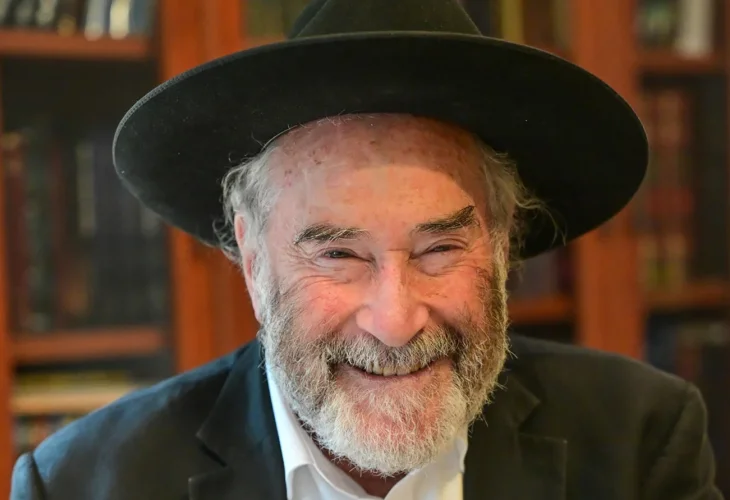 Shimon Feinberg today (Photo: Kobi Gideon)
“Court is now in session!”
The announcement rang out from the court clerk as he noticed the judge making his way toward the bench. Everyone in the courtroom rose in respect as the young judge entered for the first time, dressed in a black judicial robe.
It was Shimon Feinberg, one of the youngest judges in the State of Israel.
Speaking today, more than thirty years later, Feinberg still remembers that significant day in September 1995, when he first assumed the prestigious position.
“I was born in the United States,” he says. “I immigrated to Israel as a teenager with my family, between the Six Day War and the Yom Kippur War. We were Conservative Jews at the time. After serving in a combat unit in the army, I took my first job at the Israel Broadcasting Authority. From there, I went on to study law at the Hebrew University of Jerusalem. At the same time, I became a news editor and even worked as a radio announcer, which was considered a very prestigious position in those days.”
The Judge Behind the Curtain
Feinberg’s life has taken many unexpected turns. Even before becoming a judge, he made legal history as an attorney by participating in a groundbreaking lawsuit that is still regarded as an important precedent concerning parents’ obligations toward their children.
Still, he never imagined that he would one day sit on the bench himself.
“It surprised me too,” he admits. “At the same time, it came with an enormous sense of responsibility. As a judge, you are constantly aware of the weight that rests on your shoulders. You consider every word you say in the courtroom because you know that every statement can have legal consequences for the people standing before you.
“You also have to know every detail of the cases and be familiar with all the relevant laws, even though there is no special school that prepares you for what it actually feels like to become a judge. You could say I was thrown into the water and expected to start swimming immediately.”
Do you remember the first case you presided over?
“Of course. It was a libel case against a journalist who had written an article criticizing another journalist because of some dispute between them. The journalist who had been attacked sued him, and each side arrived with a highly skilled lawyer.
“The first witness took the stand, and as soon as the first question was asked, the opposing attorney jumped to his feet and objected, offering an elaborate explanation as to why the question was improper. The first lawyer then launched into an equally detailed argument explaining why the question was perfectly legitimate.
“In the end, almost the entire hearing was spent debating the fate of that first question.
“Looking back, I can say that my lack of experience was obvious. But over time, I learned how to prevent situations like that, where instead of hearing the actual case, I would end up adjudicating endless objections between the attorneys. The more experience I gained, the more knowledge and tools I had to guide the proceedings.”
What happens emotionally to someone who becomes a judge?
“I was a king,” he says simply. “And the truth is, there was something pleasant about it.
“Suddenly everyone around me addressed me with honorifics: ‘Sir,’ ‘Your Honor,’ ‘Honorable Judge.’ I began realizing that I was the one telling everyone what to do, and nobody dared argue with me. People even laughed at my jokes because they wanted to please me.
“Fortunately, I quickly realized that I did not connect with that sense of pride, either in my personal life or as a judge. So I tried to distance myself as much as possible from that feeling of being elevated above everyone else. During hearings, I made an effort to speak to the litigants at eye level.
“From the very beginning, I also insisted that my photograph not appear anywhere, including on the Ministry of Justice website. Until this interview, no photograph of me had ever appeared in the media, and I am very happy about that.
“I made a similar decision recently when I published The Judge’s Son, an autobiographical book about my life. It tells my story in full detail, but it was published under a pen name. It is not difficult to work out my real name from the information in the book, but I find satisfaction in remaining behind the curtain. Ultimately, who I am is a secondary detail. What matters is the journey I went through.”
“A Right Wing Extremist Judge”
Feinberg’s years on the bench at the Jerusalem Magistrate’s Court brought him a wide range of fascinating cases, some of which had life changing consequences.
“Only about two months after I became a judge, Yitzhak Rabin was assassinated,” he recalls.
“At that time, an indictment landed on my desk against a resident of one of the communities in the Hebron area. He was charged because, when a television reporter held out a microphone and asked what he thought about the assassination, he responded that he was happy or pleased that Rabin was dead, or words to that effect.
“This is not the place to go into the entire lengthy trial and all the arguments on both sides, but I can say one thing: in the end, I acquitted him completely. Not because I agreed in any way with what he had said, God forbid, but because legally I believed acquittal was the correct outcome.
“It is called freedom of speech.
“If a similar charge had been brought against a defendant from the political left who praised violence against someone on the political right, I would have reached exactly the same conclusion.”
But that ruling had consequences.
“From that moment on, I began noticing looks around me that seemed to define me as too right wing, even extremist. I started feeling that within the judicial system itself, I was being viewed as someone who did not belong to the accepted circle. The fact that I lived in Judea and Samaria certainly did not help.
“After I issued the acquittal, the prosecution appealed to the District Court. The appeal was accepted, and the man I had acquitted was convicted.
“What was interesting was that not long afterward, an Arab defendant was charged under exactly the same provision after publishing praise for Arabs who threw stones and Molotov cocktails at IDF soldiers. Surprisingly, he was acquitted.
“That was frustrating and infuriating. At the same time, I have to point out that the Jewish man who had been convicted in the case I handled, along with other defendants after him, later requested retrials based on that ruling and were ultimately acquitted. Without that later acquittal, they might well have remained branded as criminals.”
Toward the end of his judicial career, Feinberg was selected to sit on a panel hearing, for the first time in Israeli history, a criminal case brought against a sitting president.
“There was a huge media spectacle surrounding it,” he recalls. “As the hearing approached, I left my chambers and walked into the corridor, which was already filled with reporters, photographers, and television crews.
“I tried to make my way through, but I couldn’t. One reporter actually pushed me aside and said, ‘Move. The judges are going to arrive any minute and you’ll interfere with the photographs.’
“I laughed to myself. The reporter had no idea that one of the judges he was waiting so eagerly to photograph was standing right in front of him.”
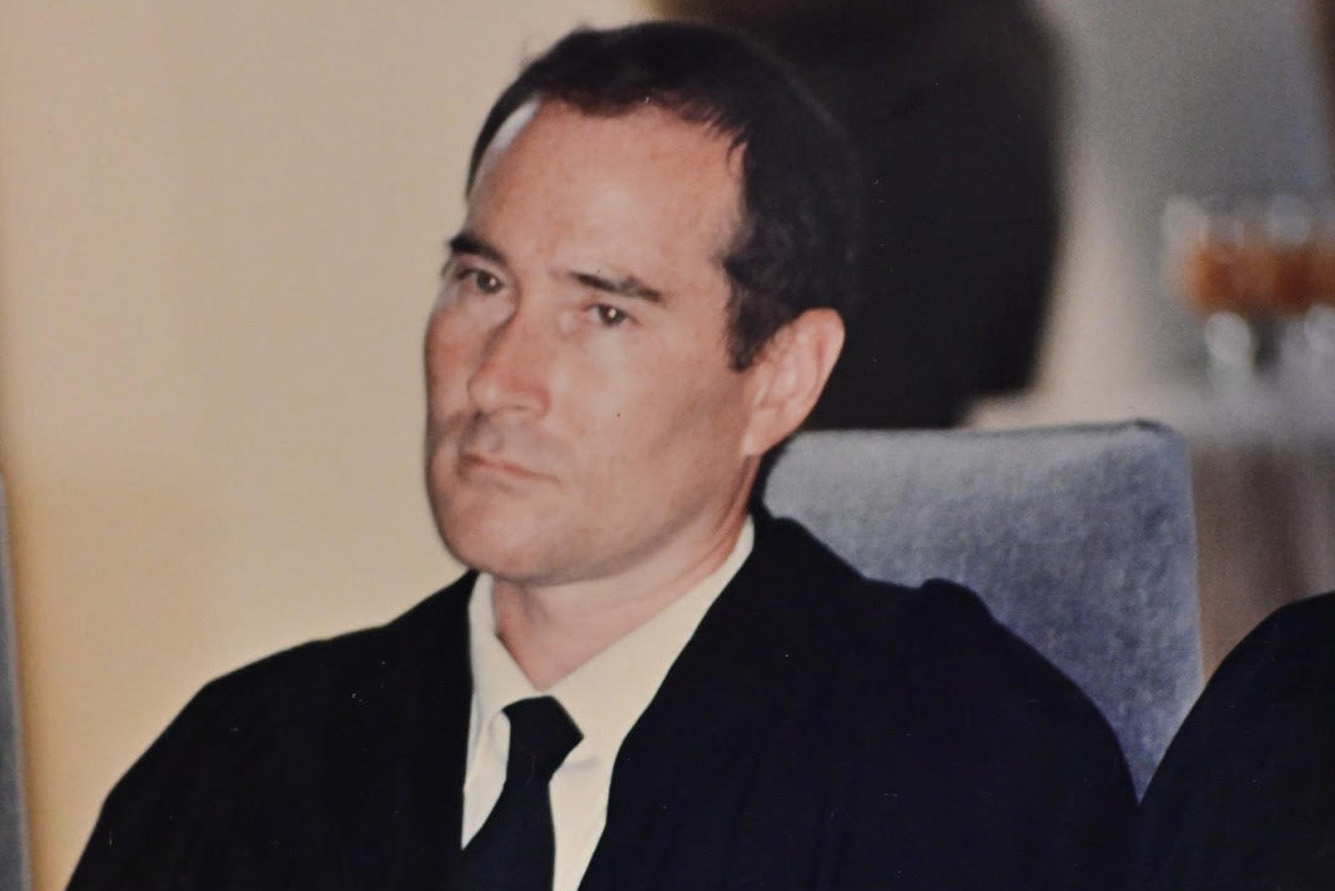 Shimon Feinberg as a judge
Were there particular types of cases you usually handled?
“I had the opportunity to deal with almost every kind of law imaginable,” he says. “It would probably be easier to ask what I did not deal with. The Magistrate’s Court handles the largest volume of cases in the country, so I encountered an enormous variety. The one thing they all had in common was my desire to reach a just outcome.”
The Road Back to Judaism
During those years, Feinberg was married to his wife, Devorah, and was the father of twin boys and a younger daughter.
“We had a good life,” he says. “We lived in the community of Nili, enjoyed a high standard of living, and overall we were very satisfied.
“Judaism was almost completely absent from our home. Although I had experienced a powerful spiritual awakening during high school that brought me closer to religion, I stopped putting on tefillin during my army service and decided to devote my time to other things.”
When Feinberg was 36, his twin sons celebrated their bar mitzvah. Despite the demands of his judicial work, he decided to teach them the Torah reading and cantillation himself, drawing on what he remembered from his own bar mitzvah before immigrating to Israel.
“Thank God, it went especially well,” he says. “Not long afterward, I received a phone call from another resident of the community asking if I could teach his son to read the Torah portion for his bar mitzvah.
“Then more and more requests started coming in. Because Nili’s population was growing rapidly at the time, I would return home after an exhausting day in court and begin teaching one lesson after another, from the afternoon late into the night.
“That is how I had the privilege of teaching the boys of Nili for twelve consecutive years.”
And yet, throughout those twelve years, Feinberg remained distant from Torah observance, although he retained a warm place in his heart for Judaism.
“One of my twins, like several other boys in Nili at the time, was drawn to Judaism and the experience of synagogue life. Because of him, I began joining the Friday night prayers.
“Looking back, I can say that this definitely affected me and brought me closer to Judaism.”
The major turning point came about two years later, when Feinberg accompanied his wife to the hospital for the birth of their fourth child.
“The delivery initially progressed normally,” he recalls. “Then suddenly the monitor changed and the lines dropped. Immediately they began rushing my wife’s bed toward the operating room. There was not even time to explain what was happening.
“I was left alone in the waiting room with no information, overwhelmed by terrible fear.
“At midnight, I turned to Hashem from the depths of my heart and made a commitment. I said that if my wife came safely through the operation and we were blessed with a healthy baby, I would begin putting on tefillin again, as I had when I was younger.
“The surgery was extremely complicated, but thank God it succeeded. Our fourth son, Daniel David, was born.”
How do you explain the fact that you became more religious when many people in similar circumstances do not?
“Looking back, I don’t think it is really surprising,” he says. “I was always searching for truth in general, and especially for the meaning that truth had for me personally.
“At a certain point, I simply understood that I had to decide who and what I was. I owed that to myself, but also to my family and children. I needed to know what path I wanted our family to follow.
“I decided to take a step that was not easy. I realized that I could not keep waiting. That realization led me to make a decision I have never regretted for even a moment.”
The Judge’s Son
Feinberg kept his promise and began putting on tefillin regularly. Over time, this led to keeping Shabbat, then to wearing a kippah and tzitzit, and eventually to observing additional mitzvot.
“I was 45 when I began outwardly looking like a religious Jew,” he says. “It was not an easy decision because I was deeply embarrassed by the idea of becoming ‘the religious judge.’
“I was afraid to leave the house looking that way. But eventually one thought settled the matter for me: ‘Whom are you more embarrassed before? The people who will see the respected judge dressed like a religious Jew, or God, who sees you dressed like everyone else while knowing what you really believe?’
“I decided that I was more ashamed before God, and I changed the way I dressed.
“Since then, I have come a very long way. When I first became observant, I did it largely out of respect for Judaism and a desire to present myself as a Jew, but I did not yet truly understand the meaning behind it.
“Today, as someone who devotes his time to Torah study and spends his days immersed in learning, I speak from a completely different place of understanding.
“I also have to mention my remarkable wife, who stood beside me throughout the entire process. When I first began becoming religious, she did not understand what was happening to me and did not identify with it at all. Nevertheless, she chose to join me in order to preserve the unity of our family.
“Thanks to her, today we have a large family of observant children and grandchildren who bring us tremendous joy.”
Standing Before the True Judge
As a former judge, do you still follow Israel’s judicial system today?
“Not very much,” he says candidly. “As a former journalist, I know the media from the inside, so I take what is written and said there with a certain degree of caution.
“I also find it difficult to see how far today’s courts are from ruling according to Torah law. That troubles me greatly.
“And I do not like seeing politics mixed into the judicial system. Court rules and legal principles have to be fair from the outset and must not be pulled in one political direction or another.”
He pauses for a moment and then adds: The times when my past as a judge comes back to me most strongly are during prayer, especially during the High Holidays, when I feel very vividly that every single day we stand before a King who loves righteousness and justice.
“We are all children of the true Judge. Judgment before Hashem is completely different from every other form of judgment we know. The climax comes on Yom Kippur, when Hashem does something that almost defies understanding. He sets aside the strict demands of the very laws He gave us in order to grant us atonement. The laws of the Creator come from tremendous kindness and tremendous love.
“I think that precisely because I served as a judge for so many years, I am able to appreciate that in a unique way.
“There are also times when I deliberately try to go beyond the strict letter of the law in my dealings with other people, with the hope that Hashem will see it.
“And I pray that He will do the same for us.”

