

Raising Children
How to Tell a Story Your Children Will Actually Listen To
A meaningful story can quickly lose a child’s attention when it is simply read from a book. Learn how eye contact, pacing, and natural storytelling can bring it to life.
- Rabbi David Fajerman
- | Updated
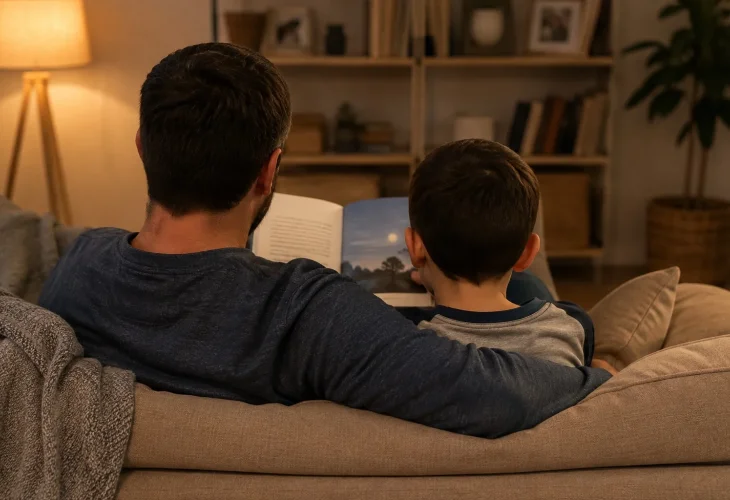
If you are ready to move from thought to action and tell your children a story, pause for a moment first. Take a friend’s advice and avoid one of the most common mistakes: simply reading the story aloud from a book.
Most people do not particularly enjoy listening to someone read from a book. The reader naturally follows a pace and tone that make sense to him because the words are right there in front of his eyes. But his listeners do not have that advantage.
At the same time, while the reader is focused on reading dramatically and accurately from the page, he often disconnects from his audience. He looks down at the book instead of at the people listening to him. Without eye contact and direct interaction, their attention begins to drift.
The unfortunate result is that despite the sincere effort invested in teaching and sharing something meaningful, much of the message can be lost.
Surprisingly, the person reading is often unaware of what is happening. From his perspective, reading directly from the book may seem like the most effective approach. It can even feel more authoritative or impressive because the words are being quoted directly from their source.
But if you want your children to listen and stay engaged, resist the temptation to simply read.
This applies whether you are telling a story at home, sharing an idea at the Shabbat table, speaking at a family gathering, or addressing a larger audience.
Use the Book Without Losing Your Audience
Sometimes it is important for listeners to know that the idea you are sharing comes directly from a particular book or Torah source. You want them to understand that these are not simply your own thoughts, but ideas grounded in a written source.
There is an effective way to accomplish this without losing their attention.
Say, “These ideas are written in the book...” As you say it, pick up the book and show it to your listeners. Open it and read no more than one or two lines directly from the text.
Then close or lower the book, look back at your listeners, and explain the essence of the idea in your own words and in simple, clear language: “What he is saying here is...”
This allows you to establish the source while still communicating directly with your audience.
Make Eye Contact and Slow Down
Remember to maintain eye contact with your listeners. Eye contact helps people stay focused and follow your train of thought. Without it, their attention can quickly wander to the many other thoughts competing for space in their minds.
Your speaking pace matters too.
The speed at which you think and express an idea does not necessarily match the speed at which your listeners can absorb it. You already know what you are trying to say. They are hearing it for the first time.
Slow down.
Watch your listeners as you speak. Are they following you? Do their expressions show that they are engaged, or are they staring into the distance?
Adjust your pace accordingly, especially when quoting directly from a book. The material is visually laid out before you, “arranged before you like a set table,” “black on white,” and “black fire upon white fire.” Your listeners, however, have only your voice to guide them. This makes it especially important to speak slowly and emphasize the key points.
For this reason, speakers giving lectures that contain many quotations sometimes distribute pages containing the passages they intend to cite. This allows the audience to see the material for themselves. Even then, however, lengthy reading aloud should be avoided.
When speaking to your children, the same principle applies. The goal is not simply to get through the words on the page. The goal is to connect with your children, capture their attention, and help the message reach their hearts.
So choose a good story, learn its main points, put down the book, look at your children, and tell it to them.
Good luck with your sweet kids!
Rabbi David Feirman is a lecturer on child education and the author of When Will My Children Listen to Me? and The Shabbat Table With Children.

