

Rosh Hashanah
Why Is the Shofar the Central Mitzvah of Rosh Hashanah?
Discover the deeper meaning of the shofar, its connection to the creation of man, accepting Hashem as King, the Giving of the Torah, and the hope for redemption
- Yonatan HaLevi
- | Updated
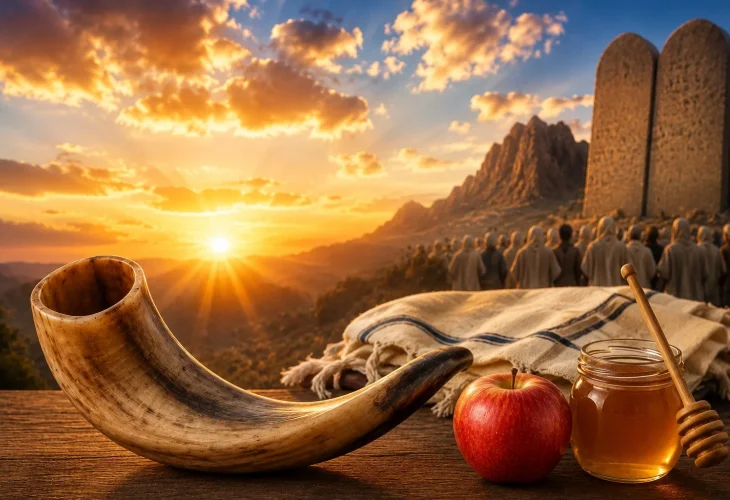
When the Torah speaks about Rosh Hashanah, we might expect it to mention that it is a Day of Judgment that determines the fate of each one of us. We might expect some reference to proclaiming Hashem as King or to the spiritual work required of us on this momentous day. Yet surprisingly, none of these themes are explicitly mentioned. The only subject the Torah mentions is the mitzvah of blowing the shofar.
In the Book of Numbers, the Torah commands: “And in the seventh month, on the first day of the month, you shall have a sacred occasion; you shall not perform any work of labor; it shall be a day of sounding the shofar for you” (Numbers 29:1).
Similarly, in Leviticus, regarding the first of Tishrei, the Torah states: “Speak to the Children of Israel, saying: In the seventh month, on the first day of the month, you shall have a day of rest, a remembrance through the sounding of the shofar, a sacred occasion” (Leviticus 23:24).
In other words, the Written Torah’s primary reference to Rosh Hashanah is the sounding of the shofar.
The Shofar and the Creation of Man
The mitzvah of hearing the shofar is the central mitzvah of Rosh Hashanah, and women also hear the shofar. Rabbi Moshe Schoenfeld explains that this is the only mitzvah performed through blowing, paralleling the creation of Adam on the first of Tishrei, when the Torah says, “And He breathed into his nostrils the breath of life” (Genesis 2:7).
Through blowing the shofar, we express the point of similarity between ourselves and our Creator, the Divine element within each of us. In this way, we proclaim Hashem as King.
At the moment the shofar is sounded, we recall that primordial moment in the creation of humanity, when Hashem breathed life into Adam. Adam opened his eyes and saw God, as it were, bending over him. Everything was completely clear. Adam stood on his feet and proclaimed, “Come, let us sing joyfully to Hashem,” and together with all of creation, he proclaimed Hashem as King.
Every year, on the anniversary of the creation of man, we recreate this experience of accepting Hashem’s sovereignty over ourselves and over all creation. We return to that first moment, to the deepest and most fundamental point of our identity and existence.
This is Rosh Hashanah.
Shofarot: Renewing Our Acceptance of the Torah
The Mussaf prayer of Rosh Hashanah contains a special section known as Shofarot. This section includes ten verses in which we recall, among other themes, the Giving of the Torah at Mount Sinai, which took place amid the sounds of the shofar and the dramatic revelation at Sinai.
By reciting these verses, we renew our acceptance of the Torah precisely on the day when we are in particular need of merit and Divine mercy.
It can be compared to a king who sees that the citizens of his country are prepared to accept his laws. Even if they have not carefully observed those laws until now, their willingness to recommit themselves awakens his compassion, and he is prepared to forgive them for their previous failures.
There is another request contained within Shofarot as well: that we merit very soon to hear the great shofar heralding the arrival of Mashiach, who will come and redeem us speedily.

