

Personal Stories
From France to Chassidut: A Lifelong Search for Meaning and Inner Change
Aaron Darmon shares his remarkable journey from a secular childhood in France to religious observance, a crisis of faith, life in Israel, and ultimately a career helping others find connection, commitment, and genuine personal growth
- Michal Arieli
- | Updated
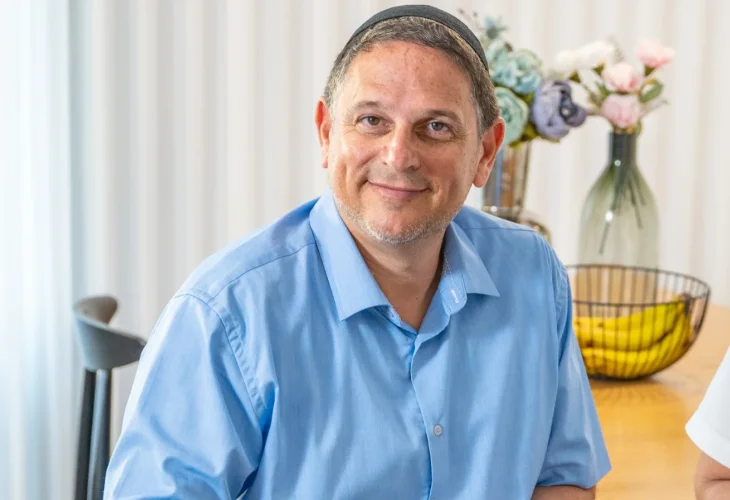 Aaron Darmon
The 54 years of Aaron Darmon’s life may, at first glance, appear to be a series of contradictions: a young boy wearing a kippah in the corridors of a tough secular school in France, a philosophy student who immigrated to an unfamiliar country in the middle of a war, an artist and spiritual seeker who left religious observance following a family tragedy, and today, a professional coach and therapist who has found himself immersed in the world of Chassidut.
But when Darmon tells his life story, he refuses to use the word “contradictions.” For him, every stage, every fall, and every upheaval has been part of a journey guided by precise Divine Providence.
“Hashem was always with me,” he says with complete faith. “Today, when I look back, I understand that He never left me for a moment.”
A Journey of Searching
“I grew up in Cannes, France, the city of festivals, red carpets, and glamour,” Darmon says, taking us back to his childhood. “The home I grew up in was barely traditional. We made Kiddush on Friday night with the television playing in the background. The only ‘custom’ I inherited from my father was to take the remote control and lower the volume a little during Kiddush. That was the atmosphere.”
The first turning point came when Darmon was about 11 years old.
“I was sent to a Chabad summer camp in Cannes,” he recalls. “There, for the first time in my life, I encountered Torah and Chassidut. I was a child who was always searching for meaning and interested in the big questions, such as the purpose of human beings and the meaning of life. This learning immediately captivated me.
“I opened the Tanya and suddenly understood that Judaism was not simply about prohibitions or technical restrictions. There was something profound here that explained how the soul works and what our mission is in this world. It simply spoke to me.”
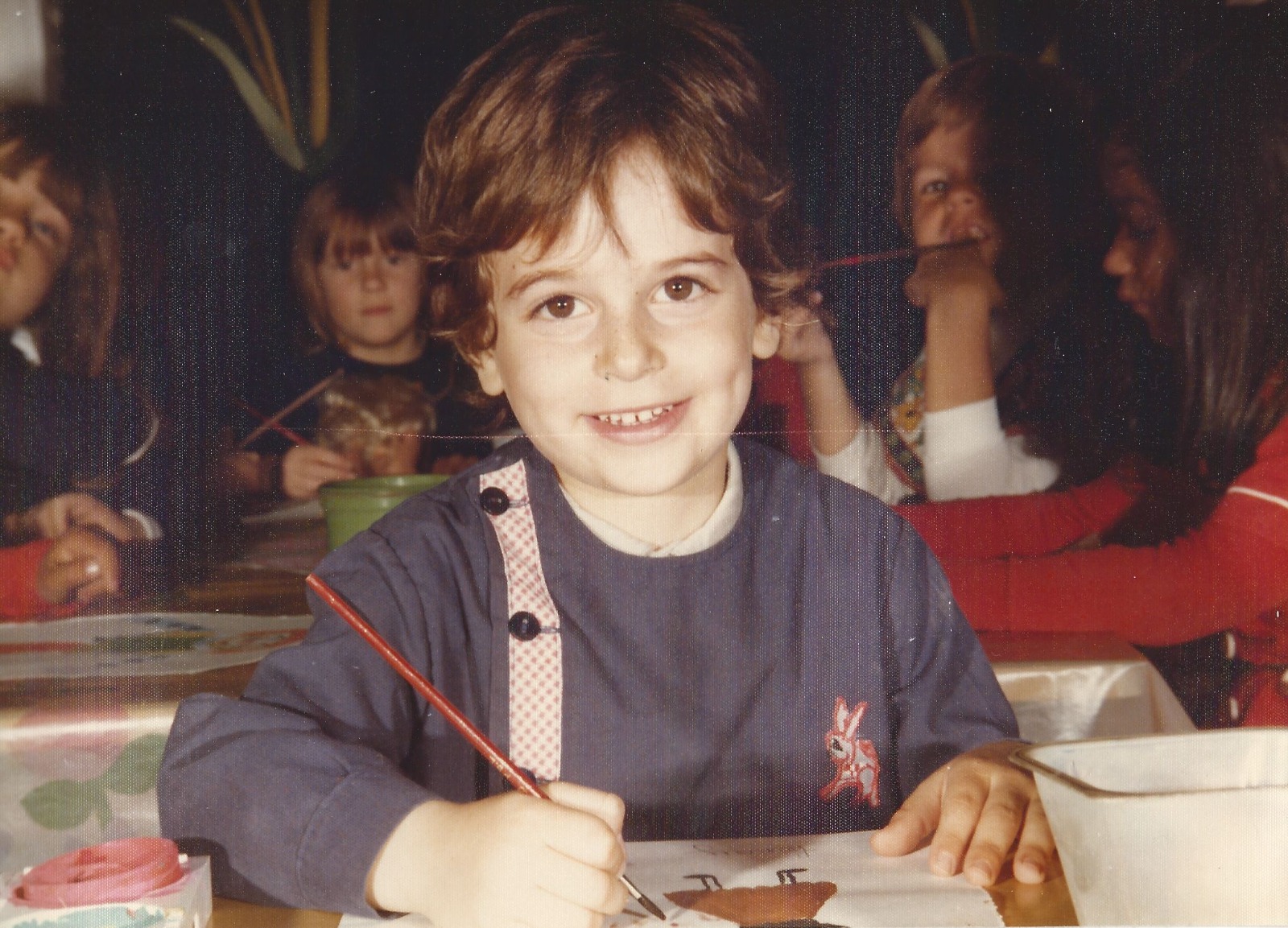 Aaron as a child
That experience did not remain merely a fond memory from summer camp. At the age of 13, the young Darmon made a courageous decision that demanded considerable determination: he became religiously observant and began wearing a kippah, despite living in a rigid and completely secular French environment.
He pauses to explain that in France at the time, religious symbols in educational institutions were restricted, making the sight of a kippah in his secular school highly unusual.
“The school administration didn’t know what to do with the only religious student walking through the halls,” he recalls. “They wanted to remove me and created enormous difficulties. For several weeks, there was a serious battle. They gave me an ultimatum, but I stood my ground until they finally gave in and had to accept me as I was.
“At home, they also didn’t know how to deal with the change that had suddenly landed on them, including the ‘kashrut revolution’ in the kitchen. At the same time, I sat and studied Chumash independently in Hebrew and French. I compared the two languages so I could decipher the words and verses.”
From France to Air-Raid Sirens
At 18, Darmon began studying at an institution of higher education specializing in philosophy. He was drawn to the depth of the subject, but because he continued to live a religious lifestyle, he once again found himself standing apart from those around him.
“And then, from the most unexpected source, came the sentence that shook me up and led me to move to Israel,” he says.
What do you mean?
“At the time, I had a teacher who wasn’t Jewish at all. One day he turned to me and said something that changed my life: ‘If you want to observe your religious laws and also receive a higher education, go to the Land of Israel. It’s a young country. There is something for you there.’
“Whenever I remember that conversation, I think of Rabbi Nachman of Breslov’s famous parable in which it is specifically the non-Jewish guard who directs the Jew back toward his treasure.”
Darmon packed his belongings and immigrated to Israel alone in the early 1990s. But his arrival in the Holy Land coincided with the Gulf War, presenting him with an entirely new challenge.
“All at once, I went from philosophy school straight into bomb shelters, gas masks, and air-raid sirens,” he recalls. “I had never experienced war in France, and it was extremely challenging and frightening.
“I was offered the opportunity to continue studying philosophy, but I discovered that the Hebrew I had learned from Chumash wasn’t enough. I didn’t know modern Israeli Hebrew, and that was another challenge that quickly made me realize I couldn’t study philosophy academically at that point.”
It did not, however, prevent him from building a life in Israel.
“I decided to study art, another field I loved, and I was even accepted to Bezalel. For me, that was a sign from Heaven that I was meant to remain in Israel.”
Darmon studied at Bezalel for three years. During that period, he experienced a devastating personal crisis when his mother died in France. The loss shook him deeply, including on a spiritual level.
“I had so many difficult religious questions,” he recalls. “There was no one to answer them. In the midst of tremendous emotional turmoil, I took off my kippah and left religious observance.”
Yet even during what he describes as a period of “letting go,” he did not find the inner peace he was searching for.
“After several years of feeling that I couldn’t find myself, I realized I didn’t want to continue living that way. This time, the decision came from within. I returned fully to religious observance, and very soon afterward, I was introduced to my wife and we married. We had the privilege of having Rabbi Pinchas Scheinberg officiate at our wedding, and it was an especially joyous occasion.”
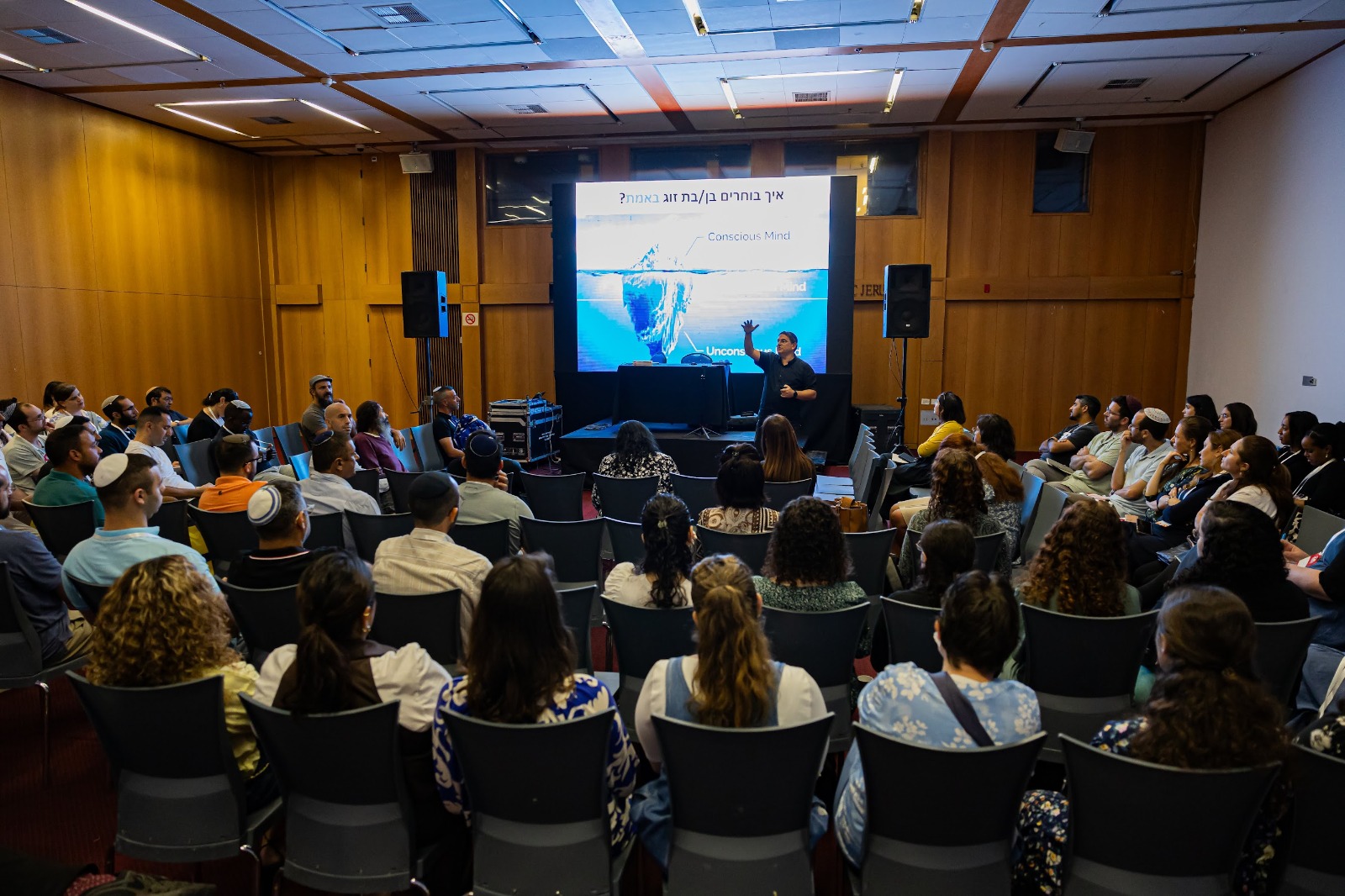
Searching for Genuine Inner Change
After his marriage, Darmon initially entered the worlds of design and graphic arts and later worked in project management. But something inside him continued searching and would not let him rest.
“I was constantly searching for my inner world. I wanted to understand what we are really doing here,” he explains. “I participated in a variety of courses, but I quickly came to an important realization: learning Torah and Chassidut is wonderful and essential, but learning alone does not always change me.
“I remained the same person, only with new thoughts that weren’t necessarily translating into a genuine shift in consciousness or improvement of my character traits. I was searching for a way to truly change.”
That search led him into the professional therapeutic world. He began studying various approaches, including Dimyon Novea (Flowing Imagination), and trained in advanced coaching and therapeutic methods. Later, together with Moshe Sharon, he founded the Tov U’Meitiv school for therapy and coaching in the spirit of Judaism. Hundreds of graduates have since been trained there in personal and couples coaching as well as post-trauma therapy.
In recent years, Darmon has focused extensively on couples therapy and guiding single men and women. His connection with this population began about 17 years ago, when he founded the Tiferet Yisrael synagogue in Jerusalem’s Nachlaot neighborhood. The synagogue became a magnet for hundreds of singles and young couples.
“Through them, I became closely acquainted with the challenges of prolonged singlehood and began specializing in the field,” he explains. “Again and again, I meet singles who have reached an older age without finding a match. Instead of asking themselves why, they assume it simply happened ‘by chance,’ or they blame the people around them.
“The deeper issue is that in recent years, people have lost some of their understanding of the commitment that marriage requires. They are afraid to commit and prefer to remain free. But this is where we need to understand that there is no true freedom without commitment.
“Specifically when we become more aware of the commitment inherent in married life, we can achieve a higher quality of life and genuine connection. This is something I tell both singles and married couples, because it is clear to me that this is one of the greatest gifts a person can give himself and his home.”

