

Sukkot
His Grandfather Left Him Everything: But There Was One Strange Condition
A grandson fulfills his grandfather’s strange final request and inherits a fortune. What happens next leads him on an unexpected journey back to Judaism.
- Naama Green
- | Updated
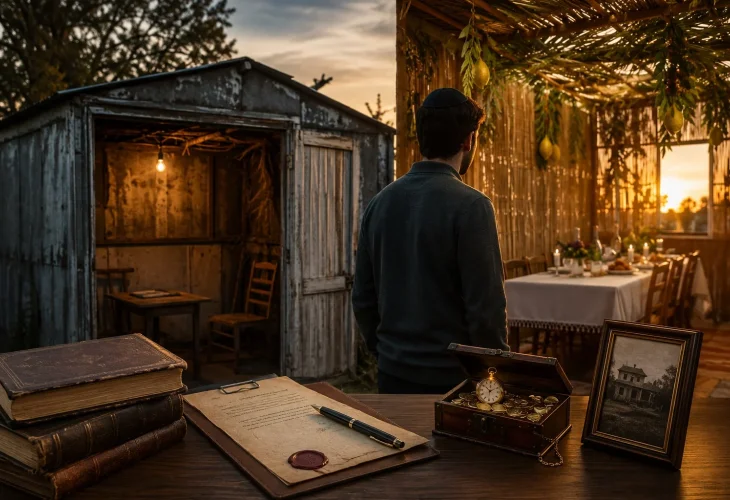
The Talna Rebbe once shared a remarkable story about the power of a mitzvah performed with sincerity and a warm Jewish heart. He told it in the name of a baal teshuvah who approached him and shared the following personal story:
“My grandfather lived in the United States. He was far from Torah and mitzvah observance, but because he knew he was Jewish, there was one mitzvah he observed with extraordinary devotion.
“For one week every year, he would leave his home, go out to the shed in his yard, and remain there day and night. In this way, my grandfather believed he was fulfilling the mitzvah of sukkah.
“In his old age, before he passed away, he left a will for his children and grandchildren. He wrote that whoever continued his legacy and fulfilled the mitzvah to which he had devoted himself by staying in the shed for seven days would inherit all of his assets.
“The children and grandchildren thought their father had lost his mind before his death. What was this strange custom that they were expected to continue observing for generations? Besides, as far as they knew, other than the modest apartment where he lived, he had no significant assets.
“So none of the grandchildren agreed to take on the strange obligation,” the grandson continued as the Rebbe listened attentively.
The Grandson Who Agreed
After some time, one of the grandchildren began thinking differently.
“This custom was obviously very important to Grandpa,” he thought. “The proof is that he was willing to leave his entire inheritance to whoever continued it. So I’m willing to do it. I’ll stay in the shed for seven days.”
After signing an agreement with his grandfather’s attorney, the grandson received documents confirming that all of his grandfather’s assets now belonged to him.
Then came an enormous surprise.
When he examined the inheritance, he discovered that his grandfather had owned far more than the family realized. In addition to his apartment, he had left behind numerous other assets and several bank accounts containing a substantial amount of money.
Almost overnight, the grandson became a wealthy man.
He had good character and decided not to tell the rest of the family about the extent of the inheritance, fearing that doing so might create unnecessary jealousy.
Eventually, the time came for him to fulfill the condition of his grandfather’s will.
He entered the shed and remained there for seven days.
It was not easy. Even more difficult was the fact that he had no idea what purpose the strange custom served. As far as he knew, he was sitting alone in a shed simply because doing so had entitled him to a large inheritance.
When the seven days ended, however, something continued to trouble him.
Surely his grandfather had not done this for no reason. There had to be some Jewish source behind it.
So he began searching for an explanation.
“Your Grandfather Was Trying to Observe Sukkot”
During his search, the grandson met a rabbi and told him about the unusual family custom.
The rabbi immediately understood.
His grandfather had been trying to fulfill the mitzvah of sukkah.
The rabbi began asking questions. What was the shed made from? How many walls did it have? What covered the roof?
The grandson did not understand the halachic concepts behind the questions, so he offered a simpler solution.
“Come and see it yourself.”
The rabbi went with him to examine the shed. It was made of tin and plastic, and its roof had no covering suitable for s’chach.
The rabbi was astonished.
Here was a Jew who had lived far from Torah and mitzvah observance, yet had devoted himself year after year to fulfilling one particular mitzvah. And despite all that devotion, he had not known how to fulfill it according to halacha.
The rabbi began explaining what the mitzvah of sukkah actually involved.
But the conversation did not stop there.
To explain the mitzvah properly, he spoke about the Exodus from Egypt and the Clouds of Glory. He told the grandson about the giving of the Torah, the mitzvot the Jewish people continue to observe, and the meaning behind the practice his grandfather had tried so devotedly to fulfill.
The grandson listened eagerly.
One question led to another. He wanted to know more about sukkah, then about other mitzvot, and eventually about Judaism itself.
The rabbi invited him to attend the Torah classes he taught, and the grandson began coming regularly.
Slowly, he grew closer to Torah and mitzvot. Eventually, he became fully observant and went on to build a beautiful Jewish family.
The Mitzvah That Reached the Next Generation
The story reveals something extraordinary about the power of sincere Jewish longing.
The grandfather had misunderstood the practical requirements of the mitzvah. His shed was not a valid sukkah, and his actions did not fulfill the mitzvah according to halacha.
But his desire to connect to a mitzvah was real.
Year after year, he left the comfort of his home and spent seven days in that shed because he sincerely believed he was doing what Hashem wanted from him.
And although he never knew how far that devotion would travel, it eventually became the doorway through which his grandson discovered Torah.
At the end of his story, the baal teshuvah revealed the final detail to the Talna Rebbe:
“I am that grandson.”
Because of his grandfather’s devotion to what he believed was the mitzvah of sukkah, he had begun asking questions. Those questions led him to Torah learning, then to mitzvah observance, and ultimately to a completely different Jewish life.
His grandfather had not known how to build a kosher sukkah.
But the sincere Jewish spark behind his actions helped build something else years later: a Jewish home in the next generation.

