

Personal Stories
Three Warm Pitas: The Childhood Sacrifice That Changed a Family’s Future
A hungry Jerusalem boy gave away his only meal to protect another Jewish child. Decades later, he wondered whether that selfless act had brought an extraordinary blessing into his family.
- Inbal Idan
- | Updated
There is something captivating about Jerusalem: the air that seems to blur the senses, the holiness that hovers over everything, the feeling that this city belongs to another dimension.
For me, Jerusalem has never been simply another tourist destination. It is something for the soul, a reminder that redemption is drawing closer, that Elijah the Prophet will yet come. Walking through its alleyways and absorbing the atmosphere, you encounter an extraordinary mosaic of people, colors, stories, and worlds that somehow come together as one.
An Elul Afternoon in Jerusalem
On one of those Elul days that was half cool and half warm, I set out to wander through Jerusalem’s ancient alleyways. At some point, I sat down on a bench and simply took in the beauty around me.
My attention was drawn to three elderly Jewish men sitting near the entrance of a house around a square metal table. Small glasses of tea were in their hands, and an open backgammon board sat between them, though it did not appear that anyone was actually playing. They were simply talking.
I don’t know how long I sat there. I wasn’t the only one captivated by the scene. Artists had set up their easels nearby, dipping their brushes into paint and trying to transfer the magic of Jerusalem onto canvas. Tourists from around the world passed reverently through the streets, taking in the scenery. I enjoyed every moment. In Jerusalem, each passing minute seems to reveal another story.
As the sun climbed toward midday, I got up and began looking for a minyan for Minchah. I approached the three men and apologized for interrupting them, then asked whether they knew where I could find a prayer service nearby.
One of them stood up and said that he, too, was on his way to pray. He joined me, or more accurately, I joined him, and together we made our way through the winding streets until we reached a synagogue.
We had a few minutes before the service began, and I tried to strike up a conversation. I have always enjoyed talking to older people. I like hearing what life has taught them, learning about the roads they have traveled and the wisdom they have accumulated. I almost always walk away with something valuable.
But this man motioned to me with his hand: later.
He wanted to recite the passages of the korbanot before the prayer service began, and once inside the synagogue, he would not utter an unnecessary word.
A simple Jerusalem Jew.
“That’s the Rabbi’s Father”
Outside, while the gabbai waited for a tenth man to complete the minyan, I chatted with some of the other worshippers. One of them proudly began telling me about the great rabbis and distinguished figures who had studied or prayed there over the years.
Then he pointed toward the man who had brought me to the synagogue.
“That’s the father of Rabbi X,” he said, naming one of the leading Torah scholars of our generation.
I was stunned.
I asked again to make sure I had understood correctly. He confirmed it.
I could hardly believe it. Somehow, I had imagined that this great Torah scholar had been born on a mountaintop, so to speak, with Torah and mitzvot placed into his mouth from infancy.
Now I was completely intrigued.
I waited until the prayer service ended.
Outside the synagogue, I caught up with the elderly man and warmly shook his hand.
“I heard that you are the father of the rabbi,” I said.
He smiled with obvious happiness.
“I was privileged,” he replied.
My curiosity immediately took over.
“How does a person merit a son who becomes such a Torah scholar?” I asked. “I want that too.”
He looked at me seriously.
“I’m a simple man,” he said. “I work in a carpentry shop. I don’t know very much. God gave me a gift.”
I continued asking, and eventually he said, “Sometimes I sit by myself and wonder what I did to deserve this and why it happened. When I search through my memories, there is one story from my childhood that comes to mind. I don’t know whether it is what you’re looking for, but it’s a long story. It can’t be told standing on one foot.”
My instincts told me not to let this opportunity pass.
“I have time,” I told him. “Plenty of time. I want to hear it.”
We sat down on a bench, and he began his story.
Growing Up Hungry in Jerusalem
“I grew up in Jerusalem, in one of the neighborhoods near the market. My family had very little, and the area was filled with poverty and crime. People struggled simply to survive the present. No one had the luxury of thinking about the future.
“There were new immigrants, survivors of wars, and families carrying all kinds of hardship. We were a large family, and from a young age we learned how to survive. We knew what hunger was. We knew and saw many things that children should never have to know or see. Everything existed openly in our neighborhood.
“And yet, somehow, we knew what to stay away from and whom to avoid. God watched over us.
“Every evening, as the day was ending, we would go to the market and search for whatever the stall owners had left behind. We gathered the leftovers and brought home whatever we could find. Every day was different. Every stall had different remnants.
“Sometimes you found a real treasure. If you were lucky enough to arrive at exactly the right moment and grab something before the other children did, you felt like the happiest person alive.
“The neighborhood children would spread out across different points in the market and begin searching. What we found became lunch and dinner. Sometimes it was the only meal we ate that day.”
Three Fresh Pitas
“One bitterly cold Jerusalem winter day, I went out on my usual end-of-day ‘raid’ of the market.
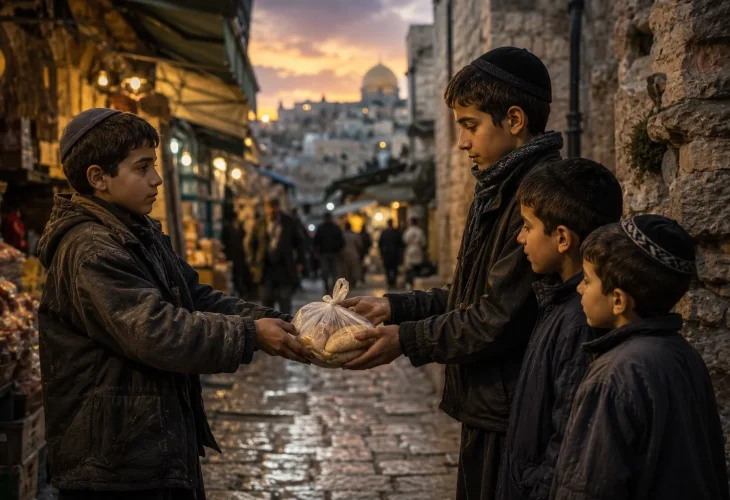
“I first reached a bakery stall. There I discovered a small bag containing three large pitas.
“They were fresh.
“They were warm.
“It was almost unheard of.
“Usually we found dried-out leftovers, spoiled food, or the lowest-quality products that no one wanted. But these pitas looked as though someone had deliberately placed the bag there waiting for me.
“I grabbed it quickly, hardly able to believe my good fortune. I kept looking around, afraid someone would notice and take my treasure away.
“I continued searching through the other stalls, hoping perhaps I might also find some vegetables or fruit.
“One of the other boys spotted my bag. I could see his eyes widen.
“When we returned to the neighborhood, we gathered together to eat whatever each of us had managed to find. Everyone envied my pitas, but this particular boy could not take his eyes off them. His two younger brothers were with him. They had found almost nothing, and what little they had found was barely edible.
“In those days, you thought about survival.
“Those pitas were going to be my only meal. I had not eaten anything since waking up that morning. And I had younger brothers at home who were hungry too.
“We were all fighting the same battle.”
The Man Who Came Offering Food
“Then Yoram appeared.
“Everyone in the neighborhood knew Yoram. He was a missionary. To this day, I don’t even know whether he was Jewish, but we had been taught to stay away from him and from the place he wanted us to visit.
“He tried to entice us with sweets, food, and other treats so that we would follow him there. But we knew that it was a place a Jew should not go.
“He never gave up.
“That day he approached us with his charming smile. He wore a thick, warm coat, tightly buttoned against the cold. The contrast between him and us was painful. We were a handful of skinny children wearing worn-out clothing.
“‘Cold today, isn’t it?’ he said, his breath visible in the winter air.
“‘Why should children be standing outside in weather like this, especially when there’s a place where you can get hot food for free?’
“I was a hotheaded boy. I understood immediately where this was going.
“‘Get out of here!’ I shouted.
“To this day, I don’t know where I found the courage. At that moment, I was ready to attack him if necessary. He must have sensed it because he backed off. He gave my friend and his younger brothers a sweet smile and continued on his way.
“But I knew something had happened.
“I could see that my friend had been caught by the temptation.
“I knew that the moment I left, and perhaps even if I stayed, he would go there.”
A Choice Between Hunger and a Soul
“I knew his life was different from mine. His father had died, and his home was filled with sadness. I, on the other hand, had grown up in a happy home. My mother had a remarkable ability to make the best of whatever life gave her.
“I had something to go home to.
“I wasn’t sure that he did.
“I looked at him. Then I looked at the bag in my hand, and I knew what I had to do.
“I handed him the bag of pitas.
“I asked him not to go there. I told him to go home and take care of his younger brothers.
“He was stunned by what I had done.
“He understood the sacrifice. Who better than he knew what gnawing hunger felt like? He understood exactly what those three warm pitas meant to me and what I was giving up for him.
“He thanked me with a nod, took the bag, and left with his younger brothers. They looked back at me with gratitude.
“I went home exhausted, tired, and above all, hungry.
“But I knew I had done what I needed to do.”
Years Later, a Knock at the Door
“I grew up and got married. I had no real education, of course. I worked in a carpentry shop, earning my living through physical labor, and as each child was born, I continued working to support my growing family.
“I had strong faith in the Creator. I wasn’t someone who went to synagogue regularly, but I knew Who was running the world.
“My oldest son grew up, and unlike me, he loved going to synagogue. He enjoyed the prayers and especially the bakashot, the traditional supplications and songs. I sometimes think the bakashot were simply the excuse that got him through the door. From there, everything developed.
“One day, a righteous man knocked on my door.
“He told me about my son, about how special he was and about his good heart. Then he suggested that we send him to a yeshiva in Bnei Brak. There was a good dormitory, he said, and he was certain my son would thrive there.
“I was frightened by the idea. Yeshiva wasn’t even part of my vocabulary at the time. The cost also worried me.
“The man told me he would take care of the expenses. He came twice and spoke to my wife as well.
“The third time, we said yes.”
“The rest is history.
“My son succeeded tremendously, and his growth influenced all of us. His brothers followed in his footsteps. My wife and I became much stronger in our religious observance.
“Today, beyond the spiritual value of everything that happened, I thank God when I look at what became of my children. Many young people from this neighborhood did not end up in good places. The environment was difficult.
“Every time I look at my son, I cannot stop thanking the Creator.
“And when I ask myself what I might have done to deserve such a gift, that childhood story is the only answer I have ever found.
“Of course, I am not God. I cannot know why things happen. But if you ask me, that is my answer.
“That cold evening, those three steaming pitas in a little bag, and the eyes of a hungry boy, when compassion overcame my own empty stomach, changed my life.
“They gave me a life of true, pure happiness. And that is what I am proud of.”
A Bag Full of Merit
He finished speaking.
I discovered that my own eyes were wet.
Sitting beside me was a rough, hardworking man filled with simple faith, an ordinary Jerusalem Jew who, as a hungry child, had given up his only food to protect three vulnerable souls.
He had given away a small bag containing three warm pitas.
And perhaps, in return, he had received an entire world.
A bag full of merit.

