

Magazine
Rabbi Yoram Abergel: A Life of Torah, Humility, and Love for Every Jew
Rabbi Yoram Abergel left an extraordinary legacy of devotion, perseverance, education, and unconditional love for the Jewish people
- Arik Navon
- | Updated
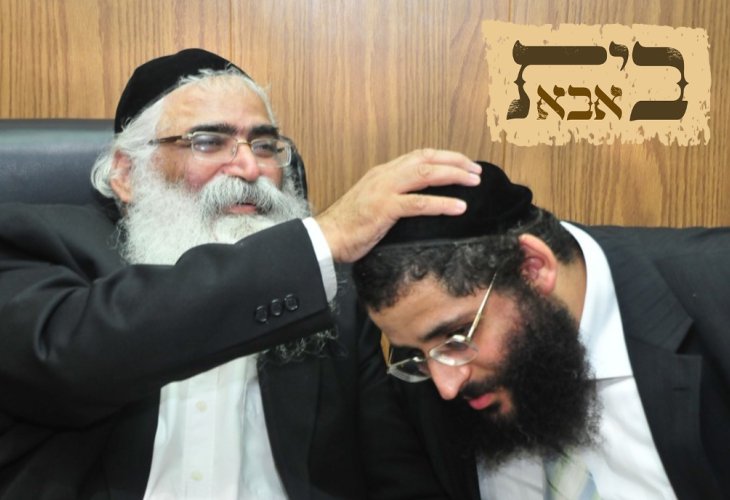 Rabbi Israel and his father, Rabbi Yoram Abergel
“I remember myself as a child falling asleep on the couch, with the sound of my father’s Gemara learning playing in my ears like the melodies of Gan Eden,” Rabbi Yisrael Abergel, head of the HaMeir LaAretz Beit Midrash and son and successor of the revered Rabbi Yoram Michael Abergel, recalls with longing.
“My father was a remarkably multifaceted person. He combined spiritual nobility with gracious humility, extraordinary brilliance with rare diligence, and simplicity and purity with an elevated holiness. At the same time, a passionate love for every Jew burned within him.”
Rabbi Yoram Michael Abergel was born on the 17th of Sivan 5717 (1957) to Rabbi Hanania and Rina Abergel, immigrants from Morocco who settled in Moshav Brosh in the northern Negev and raised a large family. As a child, he attended a religious state school and a Chabad Talmud Torah. He later studied at the Bnei Akiva Beit Yehuda Yeshiva in Kfar Maimon, Tiferet Tzvi Yeshiva in Jerusalem, and Yeshivat HaNegev in Netivot under Rabbi Yissachar Meir.
He married Rebbetzin Geula, and the couple had six children. After his marriage, he studied in a kollel for dayanus associated with Yeshivat HaNegev in Netivot. Later, at Rabbi Yissachar Meir’s direction, he transferred to a kollel for practical halachic studies in Sderot under the leadership of the city’s rabbi, Rabbi David Bar Chen. In time, Rabbi Abergel founded and developed the Kol Rina Rav Pe’alim institutions, headquartered in Netivot but extending throughout Israel and abroad. More than 2,000 men study in its network of kollelim.
What can you tell us about your childhood with your father?
“As a child, I don’t remember ever going to sleep while my father was home. Throughout the day he was occupied with Torah study, giving classes, and spreading Torah. He would come home at around eleven at night, when all of us were already asleep. My righteous mother would welcome him, and he would sit with her before going to sleep himself.
“But he did not sleep for long. By two in the morning, the light in the living room would already be on. My father would prepare a pitcher of tea, wrap it in two towels to keep it warm, and begin learning Gemara with tremendous diligence and an indescribable sweetness.
“Sometimes I would wake up in the middle of the night to the sound of his learning, which would draw me out of my warm bed. I would wash my hands using the cup that had been prepared beside my bed and curl up in the living room, listening to the sweet melody of his Gemara learning, filled with holiness. Those are memories I will never forget. It was like experiencing a taste of Gan Eden here in this world. The only day we saw our father in daylight rather than by moonlight was Shabbat.”
Rabbi Yisrael offers another story illustrating the extraordinary extent of his father’s diligence.
“When I was a young yeshiva student, I studied in Rabbi Yissachar Meir’s yeshiva ketana. In my first year we studied tractate Gittin. Once, while discussing one of its particularly difficult and complex passages with my father, he told me, ‘I first studied this sugya twenty-two years ago, and I couldn’t understand it. I studied here and there, but I could not reach its depths. Still, I refused to give up. I decided that I had to understand this sugya thoroughly and clearly, so I worked on it intensely and reviewed it many times. I remember there was one comment of Rashi whose sacred words I repeated 117 consecutive times. Only then did I understand it.’
“That statement reflected the limitless intensity of his diligence and his unique character. My father did not let go and did not make excuses for himself. He worked, persevered, and ultimately succeeded.
“Rabbi Yaakov Yankowitz, who was his teacher at the Oholei Yosef Yitzchak Talmud Torah in Moshav Brosh, once told me that when my father was in sixth grade, he tested him on the entire Mishnah, all 525 chapters, and my father could answer every question. Even as a child, he also knew the entire Tanach with its cantillation by heart.”
In Honor of the Ben Ish Chai
“Even as a young man, my father was already giving classes and spreading Torah,” Rabbi Yisrael continues. “The beginning of his vast Torah and chesed activities in honor of Hashem came on the 13th of Elul 5745 (1984), the yahrzeit of the Ben Ish Chai. On that day, he founded the Kol Rina Rav Pe’alim Kollel in Netivot, named for the Ben Ish Chai, author of Rav Pe’alim, and for my father’s mother, Rina.
“At first, the kollel operated out of a public bomb shelter. Over time, additional floors were constructed, including a beit midrash for 300 men and a synagogue for 250 worshippers.
“As the number of students in his kollelim grew and a community formed around him, he established the Be’er Mayim Chaim educational network in 2000. It included daycare centers, kindergartens, elementary schools for boys, an elementary school for girls, a girls’ high school, and a yeshiva ketana. Torah study throughout the kollel network continued around the clock, with daytime kollelim, midnight kollelim, and sunrise kollelim covering every area of Torah. The institutions also included the large Birkat Yosef U’Peulat Tzaddik chesed organization, which distributed food to needy families.”
What did your father’s weekday schedule look like?
“My father’s daily schedule was filled with Torah learning and spiritual activity on a scale that is almost impossible to comprehend. He studied during the predawn hours until it was time for Shacharit at sunrise. Beforehand, he would immerse in the mikveh and then go to the synagogue.
“After prayers he gave a series of classes: halacha from the Ben Ish Chai, Chok L’Yisrael, and one chapter of Mishnah each day with Rabbi Kehati’s commentary. The highlight was his class on the inner dimension of Torah through Tanya. These classes were eventually edited and published as the sacred series Betzur Yarum.
“At nine in the morning, the first stage of his day ended, and the working men went off to their jobs. My father then went to Yeshivat HaNegev and learned in its kollel until two in the afternoon. At two he returned home to gather strength for the second part of his day.
“At four in the afternoon he returned to the kollel for Mincha. Afterward, he began a class that continued for hours and covered virtually every area of Torah: Chumash with Rashi, a chapter of Navi, a page of Gemara, Shulchan Aruch, Mishnah Berurah, Kaf HaChaim, the Zohar with the Sulam commentary, and works of mussar.
“Maariv was at nine. But my father’s day was still not over. From there, he would travel to nearby communities to give additional classes and talks. He would return home at around eleven at night, exhausted but filled with satisfaction and joy.
“That was his schedule every single day of the year, without vacation.
After describing his father’s schedule, Rabbi Yisrael remarks, “You get tired just hearing about my father’s day. Now try imagining actually living it.”
What was Shabbat like with your father?
“Shabbat with my father was a true experience, a taste of the World to Come. Even on Shabbat, his schedule was demanding and packed with Torah classes.
“Shacharit took place at sunrise, attended by approximately 250 to 300 people, with even the aisles filled with plastic chairs. Afterward there was an elaborate Kiddush. While the Kiddush was being prepared, my father gave his first class, from the sacred work Tomer Devorah. He then gave a deep and unique class on the weekly Torah portion until ten-thirty.
“At one-thirty he gave another class in Likutei Moharan, followed by a wonderful class in Chassidic teachings that continued until Mincha near sunset. Before Maariv there was another short class in the Zohar. Immediately after Havdalah and Melaveh Malkah, my father traveled to Be’er Sheva to give a major lecture attended by 450 to 500 people.
“He would return home at midnight, and just a few hours later begin the new week with the sweet, yearning melody of Gemara learning.”
“It is important to emphasize how unique my father’s Torah teaching was. His words entered the hearts of everyone who heard him, even though his audiences were extraordinarily diverse. Rabbis and dayanim sat alongside intellectuals; Torah scholars, Chassidim, and Kabbalists alongside ordinary Jews. Everyone felt that my father was speaking directly to them.
“There was something remarkable about his classes. People would arrive carrying all sorts of questions, and during the lesson they would receive precise answers through his words. Each listener felt as though the rabbi were speaking specifically to him.”
What image of your father remains most deeply engraved in your memory?
“The image that remains with me tells the entire story of my father’s diligence. I remember seeing him extremely tired, yet he refused to abandon his learning schedule. To prevent himself from falling asleep, he would place a chair on top of the table and prop the Gemara against the back of the chair. Then he would stand and continue learning for hours.
“When I think about my father’s self-sacrifice for Torah, I understand how he acquired such enormous knowledge in every area of Torah. The foundations of his learning were simplicity, sincerity, humility, and tremendous purity.”
How did your father acquire such vast knowledge?
“My father’s secret was making use of every moment. Our friend Rabbi Aryeh Gamliel knew my father from their younger years, when they studied together in a kollel in Sderot. Every morning they traveled together from Netivot to Sderot and returned in the evening.
“My father had a special role during those trips. On the way there, he would teach the men an entire section of Shulchan Aruch, and on the return journey, another section. Remarkably, he knew everything by heart. He would quote the words of Maran, the Rema, and the other commentaries without opening a book.
“My father often said, ‘People think I have a special memory. They don’t realize that everything I learned, I reviewed dozens of times until Hashem enabled me to remember it well.’”
Alongside all that learning, he also managed to build remarkable institutions. What do you believe was the secret of their success?
“I’ll answer with a story. A Torah scholar once approached my father and asked how it was possible that kollelim around the country with barely a minyan of men sometimes struggled to pay salaries, while thousands studied under my father’s institutions and there were never excuses about recessions or financial crises.
“My father answered with a parable.
“Imagine a city bus traveling from stop to stop and picking up passengers. Does it make any difference to the driver whether there is one passenger aboard or fifty? Of course not. When does the number of passengers matter? When there is a small hole in one of the tires. At first the air escapes so slowly that it is barely noticeable. But as more passengers board and the weight increases, the air escapes faster until eventually the bus is forced to stop.
“‘The same is true here,’ my father explained. ‘When a person has even a small personal interest or ulterior motive, it is like a hole in the tire. At first it may not be noticeable. But as the enterprise grows, eventually everything comes to a halt, and there are unpaid salaries and endless excuses.
“‘But when a person works entirely leshem Shamayim, solely for the sake of the Divine Presence, without personal interests, then there is no hole in the tire. The bus continues traveling without interruption, whether it carries one passenger or fifty.’”
Rabbi Yoram Abergel drew inspiration from an unusually broad spectrum of Torah giants, including the Lubavitcher Rebbe, the Chazon Ish, the Baba Sali, Rabbi Ovadia Yosef, and Rabbi Yissachar Meir. It was a rare combination that reflected his deep love for the entire Jewish people.
“My father had an exceptionally close relationship with the Baba Sali, who trusted him greatly and called him ‘Rabbi Michael, master of the Mishnah.’ The Baba Sali had a practice of completing the entire Mishnah every month by reading eighteen chapters each day. In his old age, when reading became difficult, he asked my father to read the Mishnah to him each day.
“Once, while my father was sitting with the Baba Sali, a Torah scholar from Bnei Brak arrived and said that he wanted to establish a yeshiva named for the Ben Ish Chai. The Baba Sali told him that opening a yeshiva was wonderful, but that he should not name it after the Ben Ish Chai, because an institution bearing the Ben Ish Chai’s name had to be one hundred percent leshem Shamayim.
“When my father heard this, he made a decision in his heart: with Hashem’s help, he would one day establish institutions in the Ben Ish Chai’s name. And indeed, on the 13th of Elul 5745, my father founded Rav Pe’alim in honor of the Ben Ish Chai.”
Your father was also known for his distinctive approach to education.
“My father treated every child literally like a Sefer Torah. He showed every child the same respect and appreciation he would show an adult. My father did not see bodies. He saw souls.
“He always used to say, ‘Education is not training. Education is creating desire.’
“One of the central principles of education that my father lived by and instilled in everyone around him was personal example. When we were young, he trained us to get up for prayers at sunrise. You cannot imagine how difficult it is for children to wake up at that hour, but my father woke us with such sweetness and affection that it is difficult to describe. Sometimes he would sit beside us for forty minutes, joking with us while we were still half asleep, promising little surprises, all with endless patience.
“My oldest sister once told me that as a child she woke up one morning thinking, ‘My father is always rushing. He doesn’t have time to look at my notebooks.’ A few days later, she woke up and found a letter on the table.
“‘My dear and beloved Nechamaleh,’ he had written, ‘it gave me so much pleasure and happiness to open your schoolbag and look at your books, to see your beautiful handwriting and how organized your notebooks are. Well done.’
“Alongside the letter was a small treat. That was my father’s way of educating.”
A Burning Love for Every Jew
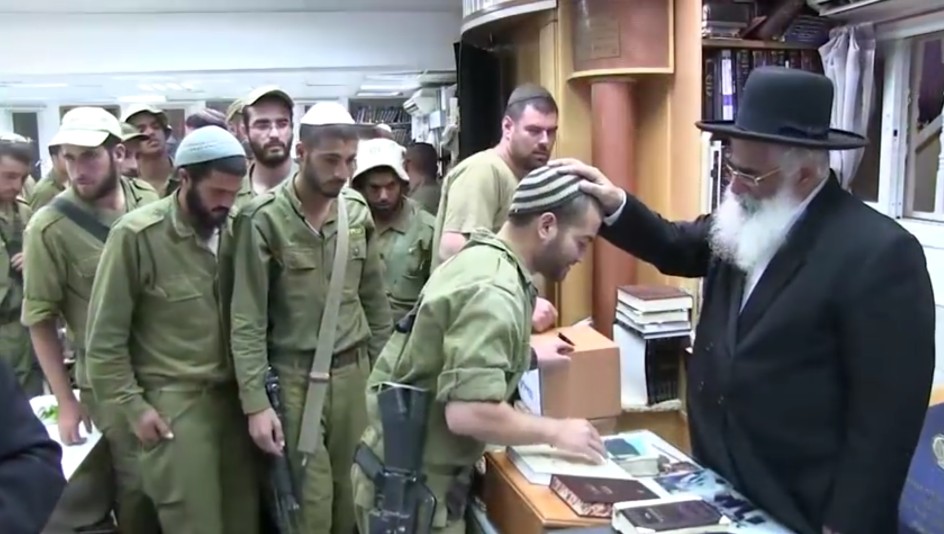
Alongside the Torah institutions he founded out of his passionate love for the Jewish people, Rabbi Abergel became widely known as a source of blessing and salvation. Tens of thousands of Jews came to his door seeking his blessing, guidance, and counsel.
Like a faithful shepherd caring for his flock, he greeted everyone warmly and gave each person the feeling that he or she was an only child and that he had all the time in the world. His love for others was also expressed through the Birkat Yosef U’Peulat Tzaddik charity organization and numerous nationwide chesed projects that distributed food and assistance to thousands of struggling families, regardless of ethnic or communal background.
Rabbi Yisrael recalls one incident that reveals the extraordinary sensitivity behind his father’s acts of kindness.
“Three years before my father passed away, he asked me to investigate the circumstances of a certain family whom he knew needed financial assistance. He wanted me to find their exact address.
“Two days passed. I called the family and asked for their address, explaining that I would be seeing the rabbi the next day and that he would give me an envelope containing a substantial amount of money for them.
“‘Forgive us, Rabbi,’ they replied, ‘but yesterday we already received an envelope from Rabbi Yoram with a generous sum of money for the holiday.’
“I was stunned.
“When I approached my father, he told me, ‘When I asked you to find out, I meant immediately, without delaying even for a moment. It took you two days. How can you leave a family in such a difficult situation for two whole days?’
“That was the sensitivity that characterized all of my father’s acts of kindness.”
His Torah Legacy Lives On
Rabbi Yoram Abergel became ill with cancer and, after battling the disease for several months, passed away on the night of Shabbat Parashat Bereishit, the 27th of Tishrei 5776 (October 2015). Approximately a quarter of a million people from across the Jewish spectrum in Israel and abroad attended his funeral.
He left behind numerous Torah works, including Betzur Yarum, Imrei Noam, Kol Rina V’Yeshua, and Yarum V’Nisa.
Following his passing, his sons Rabbi Chaim Yosef David and Rabbi Yisrael assumed leadership of the communities and continued his path. Rabbi Yisrael also took on the role of delivering Torah classes, teaching with clarity across the full spectrum of Torah subjects throughout Israel. His classes place particular emphasis on emotional and spiritual development, educating children, healthy marriage, and cultivating the different dimensions of a person’s character.
Continuing his father’s extraordinary life’s work, Rabbi Yisrael founded and developed the HaMeir LaAretz Beit Midrash, where accomplished Torah scholars, among the leading students of Rabbi Yoram, labor to prepare and publish his Torah teachings.
Rabbi Yoram himself once said of these teachings that they have “the power to purify the entire world and prepare it for the Redemption with kindness and mercy.”

