

Magazine
A Rabbi's Miraculous Journey: From Darkness to Sight
After a year of failed treatments for a hole in his cornea, Rabbi Aharon Ben Adiva was preparing for a painful biopsy. Then, just one day after making a powerful spiritual commitment, doctors discovered that the hole had inexplicably closed and his vision had returned.
- Miriam Solomon
- | Updated
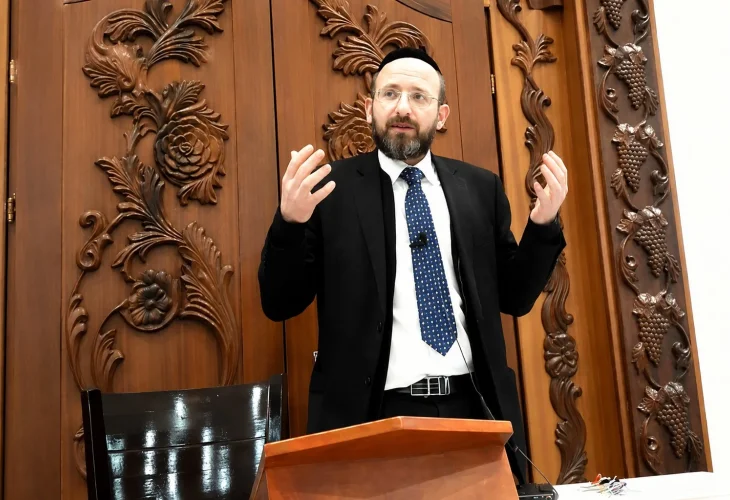
“One clear morning in the month of Kislev, I woke up, washed my hands, and rubbed my eyes in disbelief,” begins Rabbi Aharon Ben Adiva. “A dark, blurry screen seemed to cover my right eye, preventing me from seeing properly. It was as though cobwebs had spread across my entire field of vision on the right side. I blinked, rubbed my eyes, washed them, and blinked again, but the dark web remained, obscuring my vision in a frightening haze.
“‘I don’t know what’s happening to me,’ I told my wife in alarm. ‘I can barely see anything out of my right eye. Everything is blurry! Yesterday my vision was perfectly normal, and now I feel almost blind in one eye.’”
There was no question that the situation was frightening.
“There had been absolutely no warning,” Rabbi Ben Adiva recalls. “The day before, I could see perfectly, and suddenly that morning there was a blurry screen over my vision. My wife was extremely concerned and suggested that I see an eye specialist. It was obvious that this was not simply a question of needing glasses or having an eye infection, and we felt it was important to consult a specialist immediately.
“I called my health fund and asked for an urgent appointment with one of the well-known specialists, Dr. Chaim Cohen. The office staff told me that because of his heavy workload, he was not accepting any new patients in the near future. But when they heard our pleas and our explanation of the urgency of the situation, the doctor agreed to see me for an examination.
“That same morning, we arrived at the clinic. The journey there felt extremely strange. I had to concentrate intensely because I could see only part of my surroundings and had to rely heavily on my left eye to compensate.
“At the end of the examination, the doctor was stunned. He said, ‘I’ve been treating patients for 35 years, and I have never seen anything like this. You have a three-millimeter hole in your cornea. I’m giving you an immediate referral to Shaare Zedek Medical Center, and I’m marking it “urgent.” They’ll know how to treat you there. Go to the hospital right now.’
“My wife and I hurried to Shaare Zedek. When the emergency room staff saw the referral, they bypassed the usual procedures and admitted me quickly to the ophthalmology department. I was examined by some of the hospital’s leading doctors, but they were all baffled by the unusual condition. They searched for a natural explanation for the sudden hole in my cornea. Could it have been an infection that had suddenly developed in the eye? How could that have happened? They didn’t know.
“Eventually, the doctors decided to try an experimental medication. They warned me in advance that the process would probably not be short. Since they could not identify the underlying problem, they also could not know immediately what treatment might help.”
Medical treatment without a diagnosis? You were essentially being used as a test case?
“Exactly. I didn’t have a better option, so I agreed. The doctors instructed me to apply a particular ointment three times a day. After 24 hours in the hospital, during which nothing changed or improved, they had no choice but to discharge me with no real answers and a list of instructions to continue using the ointment.
“At home, I applied it every morning, afternoon, and evening, but I saw no improvement, literally and figuratively.
“I returned to the hospital for a follow-up three weeks later, and even the doctors had to admit that nothing had changed. They switched treatments and prescribed another ointment. Once again, I faithfully applied it every day. I returned a month later, and just as I could see with my own eyes, there was still no improvement.
“After more deliberations and consultations, they recommended special eye drops. I returned home with instructions to put the drops into the affected eye three times a day. I used them and waited, but the dark screen covering my right eye did not clear. There was no improvement whatsoever.
“I returned for another follow-up. The best doctors examined me repeatedly, but no one could arrive at a clear diagnosis. They recommended another medication, and when that failed, they tried yet another. For more than five months, I went from doctor to doctor and treatment to treatment.
“When I realized that the doctors at Shaare Zedek had exhausted their options and had nothing else to offer me, I consulted Rabbi Elimelech Firer, the renowned medical adviser and chesed activist. He listened to the details of my case and sent me to another specialist. That doctor did not know how to treat the problem either, but recommended that I transfer my care to Hadassah Ein Kerem Medical Center. ‘They will surely know what to do and how to treat you there,’ he told me.”
Did Shaare Zedek agree to transfer your medical records?
“Usually, moving from one hospital to another is not so simple. The procedures can be exhausting, and doctors are not always eager to cooperate with a transfer. But in my case, thank God, once Rabbi Firer became involved, there were no objections. The doctors readily released my medical file and all the necessary documents, and I transferred to Hadassah Ein Kerem.
“The ophthalmology department received me with great interest. One after another, senior doctors came to examine the ‘interesting case.’ But I didn’t feel like an ‘intriguing case’ or a ‘fascinating medical file.’ I hadn’t come to entertain them or provide material for new research. I was simply a suffering patient who wanted medical answers and the ability to return to his normal life.
“But the doctors at Ein Kerem had no clear answer either. They tried new ointments and various drops and instructed me to come for follow-up appointments four times a week. I followed every instruction, but nothing helped. The doctors gave me various injections around the eye under local anesthesia, but the dark, blurry screen continued to obscure my vision.
“Later, they asked me to try a therapeutic contact lens. It looked almost like a regular contact lens. I had to insert it every morning and remove it before going to sleep. In addition, I had to place a special plastic shield over the eye, secured with a large medical dressing. It was certainly not pleasant to walk around with all of this on my eye, but I had no choice.”
How long were you treated at Ein Kerem?
“For more than six months, and I didn’t see even the slightest change. With each new treatment, my hopes faded further. I would receive a new ointment and become hopeful that perhaps this time something would change. I would try it again and again, only to be disappointed.
“I was exhausted from changing dressings and applying ointments. I had no patience left for all the experiments. But I also knew that I could not disregard any treatment as long as there was a chance that it might help me recover. Every morning, afternoon, and evening, I had to use drops, apply ointments, bandage the eye, and attach the shield. So much effort centered around one eye, and absolutely nothing changed.
“Then came the frightening thoughts. What would happen to my vision? How would this end? Could the condition of my eye deteriorate further? Would I ever find the right solution? How much longer would I have to endure all these treatments?”
How did you cope? What did you do throughout those painful months?
“Throughout that period, I tried to maintain as normal a life as possible. My vision was more difficult than ever. Walking with only a partial field of vision became stressful and slow. Studying texts required tremendous effort, and reading and writing became far more complicated. In fact, almost every ordinary activity became slower and more difficult. I had never realized just how essential each eye is to normal functioning.
“Despite everything, I refused to surrender to the difficulty or put my normal life on hold. It was important to me to maintain my regular schedule. I made every effort to continue learning and teaching as though I could still see clearly with both eyes. I prepared classes, studied, and taught. Even when it was difficult and unpleasant, I thanked Hashem that I was still able to function.
“I have a principle that guides me throughout life, based on what the angel told Lot: ‘Do not look behind you.’ A person has to keep moving forward with the abilities and possibilities available to him at that moment, without constantly thinking about what could have been or what used to be. Whatever I am capable of doing now, with Hashem’s help, that is what I want to do.”
How could you maintain such a demanding schedule while studying to become a dayan and also delivering classes?
“Hashem helped me in an extraordinary way, beyond anything I could have imagined. At the beginning of that year, the program in the kollel where I had been studying halachah and dayanus came to an end. Until then, I had studied at Darchei David, close to my home, and I was very disappointed that I would no longer be able to continue there after 16 consecutive years.
“With no alternative, I searched for another kollel studying the subject we were learning. The only place I found was in Jerusalem’s Bayit Vegan neighborhood, far from my home in Bucharim.
“At the time, I had no idea that Hashem had actually hidden the solution to my problem within the closing of my old kollel. One month after the new zman began, my eye condition appeared, and suddenly I had to travel repeatedly to hospitals in the Bayit Vegan area, first Shaare Zedek and later Ein Kerem.
“Now the distance actually worked in my favor. Every morning I would hurry to the bus, travel to the hospital for my medical follow-up, and from there continue directly to the nearby kollel. I was grateful to be able to forget the troubles and frightening medical predictions and find comfort in Torah study. It was my only consolation during those painful days.
“My wife was the one who noticed this remarkable Divine Providence. She pointed out that even amid the darkness surrounding me, Hashem had arranged for me to have a kollel nearby so that the Torah study I loved would never have to stop. Despite all the examinations, experiments, and inconclusive theories of the doctors, I was able to maintain an almost normal daily schedule.”
After all that time, did the doctors still have no answer?
“No. They were groping in the dark almost as much as I was. After another six months of unsuccessful treatments, the doctors realized that even the therapeutic lens had accomplished nothing. They decided to use the final option they had left: a biopsy of my eye.
“Rabbi Firer’s assistant patiently explained the procedure. They would scrape the cornea and remove a tiny sample, which would then undergo extensive laboratory testing. He did not hide the truth from me. He explained that the procedure could be extremely painful and that some side effects, including an intense burning sensation where the cornea had been scraped, could persist for as long as six months. Nevertheless, considering my condition, he felt there was no alternative.
“The medical team held a meeting, examined my right eye, and confirmed that the hole in my cornea remained exactly as it had been, with absolutely no improvement. They scheduled the biopsy for two days later, Tuesday at eight in the morning. I was sent home for 24 hours without ointments, creams, or drops, and with a great deal of fear in my heart.”
A Resolution Before the Biopsy
For Rabbi Ben Adiva, that Monday was not simply a day of rest. It became a day of spiritual preparation.
“I prayed and begged Hashem for salvation. I asked kabbalists to perform a pidyon nefesh on my behalf. Since I was studying halachah near the home of Rabbi Azriel Auerbach in Bayit Vegan, I also went to him and asked for his blessing.
“The rabbi warmly held my hand and blessed me with ayin tovah and nehora ma’alya, good and abundant light. Then he said something to me that I will never forget: ‘You want to receive a gift from Hashem. What are you giving Him?’
“The question surprised me. I thought for a moment and answered, ‘I accept upon myself to strengthen my shemirat einayim, guarding my eyes.’
“In truth, I had never planned to say such a thing. The words simply came out of my mouth. The rabbi was pleased and said, ‘That is a wonderful commitment, especially in our generation.’
“I left his home feeling much stronger and more encouraged, and from that moment I resolved to be especially careful about guarding my eyes.”
“The Hole Has Closed!”
The following morning, Rabbi Ben Adiva arrived at Hadassah Ein Kerem with his wife for the biopsy.
“When I entered the examination room, they seated me in a special chair and firmly secured my head so that I would not move even slightly during the delicate procedure. They placed special adhesive strips on my eyelids so that I would not instinctively close my eyes during the biopsy, and the doctor injected a local anesthetic around the eye.
“As we waited for the anesthesia to take effect, I sat there unable to move and heard the doctor behind me ask her assistant to bring 15 test tubes for the corneal samples. Fifteen test tubes! My wife nearly fainted when she saw them, and inside I was trembling with fear. Those endless minutes of waiting remain the most frightening experience I have ever had.
“Then the anesthesia took effect. The doctor sat down in front of me and positioned the examination equipment for one final look before beginning the procedure.
“Suddenly, she pulled back in astonishment.
“‘Something is wrong here!’ she exclaimed. ‘I’m going to call Dr. Mendelson to come and give his assessment.’
“We were terrified. We had no idea what had happened.
“The doctor responded to her urgent call and interrupted his scheduled laser procedures to come examine me. He looked through the equipment and announced loudly:
“‘The hole has closed!’
“The doctors were stunned. How could such a dramatic change have occurred within a single day? A hole that had not responded to any ointment or treatment had suddenly closed on its own.”
That sounds extraordinary. How did it happen?
“We have no answer. To me, it was a genuine miracle. The doctor was astonished and began offering various possible explanations. Perhaps it had happened because we had stopped treatment? Maybe giving the eye 24 hours without ointments and drops had somehow allowed the hole to close?
“But if that was the reason, why hadn’t the eye healed during previous breaks in treatment throughout the past year?
“The doctor could not think of a more logical explanation. But I know what I believe caused the sudden change. I had accepted upon myself to guard my eyes from forbidden sights, and Hashem guarded my own eye from damage.
“And this was no illusion. For six months afterward, I had to return for weekly medical follow-ups so that the doctors could photograph my eye and verify that the hole had truly closed and had not reopened.
“Thank God, the recovery was real. The cornea closed, the blurry screen disappeared from my field of vision, and my sight became clear again. The weekly follow-ups eventually became unnecessary, and thank God, the hole has never returned.
“I was able to return to issuing halachic rulings, studying, teaching, and dealing with matters of taharot, which require sharp, clear eyesight, without any lasting effect from the terrible condition I had suffered.
“Even more remarkably, at my most recent follow-up, the doctor was delighted to tell me that even the scar on my cornea had disappeared. Were it not for all the photographs and medical records I have kept, there would be no way to see even a trace of everything my eye and I went through.”
How do you maintain your commitment to guarding your eyes in everyday life?
“I try to protect the precious eyes Hashem has given me wherever I go. When I walk in the street, I try not to look where I do not need to look. When I teach women in seminaries in Jerusalem, I remove my glasses and see only blurred silhouettes. The students have already heard my story and understand why I remove my glasses during class.
“I generally prepare my classes in advance and teach orally, so I do not need to read during the lesson, and taking off my glasses does not interfere with my teaching.
“I once tried taking my glasses off on the way to a class as well, but I fell down a dark staircase in the seminary. That taught me that even while guarding one’s eyes, a person is obligated to protect his body and not harm himself. Since then, I remove my glasses only during the class itself. At other times, I simply try to be careful not to look unnecessarily.
“My feeling now is much more comfortable and pure, and the positive influence of guarding my eyes illuminates my entire day. I tell everyone: Hashem has an abundance of blessing to give. Give something to Hashem as well, and you may merit to receive from Him measure for measure. If you begin and make the effort, you can only gain, and you may open a great door to salvation.”
At the end of that same year, another remarkable piece of the story fell into place.
“Just when the miracle occurred and I was finally able to stop making daily trips to the hospital, the head of my former kollel suddenly called me. He told me that a new group of students was beginning and invited me to return and take responsibility for the group.
“I was deeply moved to see the hand of Hashem. When I needed to be in the Bayit Vegan area, Hashem moved my kollel there. The moment the ordeal ended and I no longer needed the constant hospital visits, my former kollel reopened, allowing me to study near home once again.
“My mission in that area had ended. I had learned my lesson, and what remained was an overwhelming sense of gratitude to the Creator of the world: gratitude for the ability and privilege to see, and gratitude for the privilege of not seeing what I should not see.”

