

Parashat Ki Tavo
The Secret to True Happiness: A Powerful Lesson from Parashat Ki Tavo
From the first fruits to the blessings and curses, Parashat Ki Tavo reveals how gratitude and generosity lead to joy, while entitlement can set us on a very different path
- Rabbi Moshe Sheinfeld
- | Updated
Parashat Ki Tavo addresses several major themes. It begins with the mitzvah of bikkurim, bringing the first fruits to the Temple, followed by the declaration concerning the tithes. The parasha then describes the dramatic ceremony of blessings and curses at Mount Gerizim and Mount Ebal, where the entire nation accepts its covenant with God. Finally, the Torah describes the rewards of faithfulness to that covenant, including abundance, prosperity, security, and success, alongside severe warnings of destruction, exile, and suffering if the covenant is abandoned.
At first glance, these subjects may appear unrelated. What does a farmer bringing his first fruits have to do with the blessings and curses proclaimed on two mountains? Perhaps they are actually telling one continuous story, a story about success, gratitude, entitlement, and the choices that can ultimately lead a person either toward happiness or toward failure.
The Farmer Who Remembers Where His Success Came From
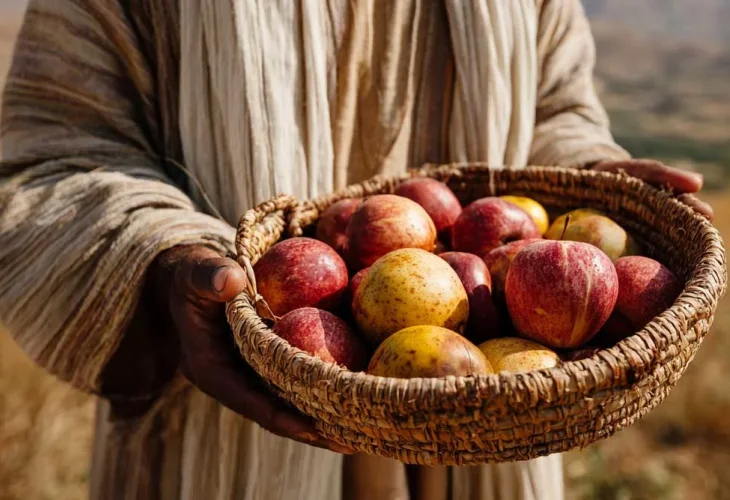
The mitzvah of bikkurim applies when a farmer in the Land of Israel sees the first fruits of the seven species for which the land is praised: wheat, barley, grapes, figs, pomegranates, olives, and dates. He takes the first fruits of his field, places them in a special basket, and brings them to Jerusalem and the Temple. There, he presents the basket to the kohen and makes a declaration recalling the extraordinary journey of the Jewish people, from Yaakov and Lavan through the slavery and Exodus from Egypt, and finally to the privilege of cultivating the soil of the Land of Israel.
The farmer is standing before the fruits of his own labor, yet he refuses to forget where his success ultimately came from. The land, the sunshine, the rain, and even the strength to work are all gifts from God. His harvest is not simply the product of his own power and skill. Instead of declaring, "My strength and the power of my hand produced this wealth for me," the farmer acknowledges his dependence upon God and expresses gratitude for His kindness.
The mitzvah of bikkurim therefore teaches humility. We are expected to work and make every reasonable effort to earn a livelihood, but success should never cause us to forget its ultimate Source. Whatever we achieve, we should remain aware of the blessings that made that achievement possible and be filled with gratitude for them.
The Mitzvah of the Tithes
The second mitzvah discussed is the declaration concerning the tithes. The Torah requires portions of agricultural produce to be separated for different purposes. Some are given to the Levi, who has no agricultural inheritance of his own. Maaser sheni, the second tithe, is brought to Jerusalem and eaten there in a spirit of joy before God. In certain years, maaser ani, the poor man's tithe, is distributed to those in need.
These tithes cannot simply remain indefinitely in a person's home. At designated points in the agricultural cycle, the Torah requires a process known as biur maasrot, the removal of the tithes. A person must make sure that everything has been distributed or dealt with according to Torah law.
He then makes a formal declaration before God: "I have removed the sacred portion from the house, and I have also given it to the Levi, the stranger, the orphan, and the widow, according to all Your commandment that You commanded me. I have not transgressed any of Your commandments, and I have not forgotten" (Deuteronomy 26:13).
With this declaration, the individual affirms that he has faithfully fulfilled his responsibilities and completed the cycle of giving. This concludes the first major section of the parasha.
From First Fruits to Mount Ebal
The second half of Ki Tavo shifts dramatically to blessings and curses. Moshe commands that after the Jewish people enter the Land of Israel, half the tribes are to stand on Mount Gerizim and half on Mount Ebal. The Levites are to stand between them and proclaim the blessings and curses, while the nation responds together, "Amen."
What connects these two halves of the parasha? Perhaps Ki Tavo is describing three stages in the development of a single person: first success, then a struggle over how to respond to that success, and finally the possibility of moral failure.
It begins with the farmer. His year has been successful. His fields have produced a beautiful harvest, and now he is carrying his first fruits to the Temple. But this is more than one farmer celebrating a particularly good season. His prosperity represents an extraordinary moment in Jewish history.
Only generations earlier, his ancestors wandered through the desert for forty years. Before that came centuries of slavery and suffering. Generation after generation experienced insecurity, hardship, and deprivation. And now this farmer is standing on his own land with a basket overflowing with fruit.
The Torah teaches him how to respond: when you receive goodness that cannot be taken for granted, recognize it as a gift and share it with others.
Gratitude Makes Joy Possible
The farmer's declaration deliberately retells Jewish history. Life was not always like this. His ancestors were wanderers and slaves. Jewish history was filled with hardship. It was only through God's kindness that they were redeemed, and it is through God's kindness that this farmer can now stand in the Land of Israel holding the fruits of his own field.
Once he acknowledges that truth, the Torah tells him, "You shall rejoice in all the good" (Deuteronomy 26:11). This may reveal something essential about happiness. When we understand that what we have is a gift rather than something we were automatically entitled to receive, we can finally appreciate it.
The Torah goes one step further and tells us not to celebrate alone. Share your blessing with the Levi who owns no land, with the stranger, and with those who have less. Gratitude and generosity belong together. When we recognize our blessings as gifts, it becomes easier to open our hands and share them. And when we share our blessings, our own joy becomes deeper and more complete.
When the Flow of Giving Stops
What happens when a person does not respond this way? What happens when he stops expressing gratitude and refuses to share? This brings us to the second figure in the story: the person who keeps the tithes in his home rather than distributing them as required.
What has gone wrong? He has blocked the two essential forces represented by the mitzvah of tithing: gratitude and giving.
The tithes are designed to benefit the Levi, support the poor, or bring the owner and his family to Jerusalem to rejoice before God. Every form of tithing directs a person's prosperity beyond himself. It reminds him that his possessions carry responsibilities and that his blessings are intended to create connection, gratitude, holiness, and generosity.
But the second person who stops that flow, and holds on to everything for himself, is where failure begins.
How Entitlement Changes a Person
If the second person represents the beginning of failure, the third represents its culmination. He is the person associated with the sins condemned at Mount Ebal. How does someone reach that point?
Perhaps his inner message has become: "I deserve everything. Life has not given me what I am entitled to, so I will take what I believe should be mine."
Once that mindset takes hold, moral boundaries can begin to blur. A person may gradually lose the ability to distinguish between what is genuinely his and what he merely feels entitled to possess.
The Torah's message is that this deterioration does not necessarily happen overnight. The third person is simply the final link in a chain that began much earlier. It began with a successful farmer standing before his abundance.
At that moment, he had a choice. He could look at his harvest and say, "Look what I accomplished. This belongs to me. I deserve it." Or he could say, "Look what I have been given. How fortunate I am. How can I express my gratitude, and how can I share this blessing?"
Those two responses may eventually lead in very different directions.
The Hidden Thread Connecting the Parasha
This perspective may help explain one of the most striking verses near the end of the Torah's warnings: "Because you did not serve the Lord your God with joy and gladness of heart, from an abundance of everything" (Deuteronomy 28:47).
The problem was not simply a lack of happiness, but an inability to respond properly to abundance. You had "an abundance of everything," yet somehow the abundance did not produce gratitude, joy, or generosity.
This is not a new idea introduced at the end of the parasha. It is the thread running through the entire narrative. The first fruits, the tithes, the blessings, and the curses are all parts of the same story. They ask one fundamental question: What will you do with the good that enters your life? Will abundance make you more grateful or more entitled? Will success make you more generous or more possessive? Will you see your blessings as gifts or as proof that everything belongs to you?
The Torah's answer begins with the farmer carrying his basket of first fruits. Look at what you have. Remember that it was never guaranteed, recognize the many gifts that made it possible, thank the Creator who gave them to you, and then open your hand and share your blessings with someone who has less.
Perhaps that is one of the Torah's most enduring formulas for genuine happiness: the ability to recognize the gifts we could easily take for granted, the humility to thank God for them, and the generosity to share them with others.

