

Magazine
A Life of Faith, Courage and Love: Dafna Levanon’s Inspiring Legacy
After losing her husband to a terror attack and later battling cancer, Dafna Levanon chose faith, generosity and joy, leaving behind a powerful legacy of resilience, family devotion and unconditional love
- Michal Arieli
- | Updated
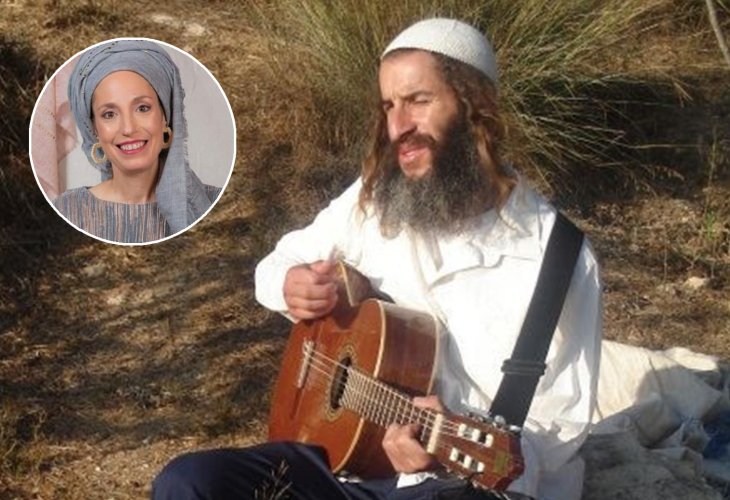 (Inset: Dafna Levon. She never stopped shining, even during her illness)
When Dafna Levanon and her three children traveled to Mount Hermon, to an outside observer, they might have looked like any other family enjoying the magnificent blanket of snow. Dafna was sitting in a wheelchair, but little suggested that this was no ordinary family outing. Dafna herself called it a “farewell trip,” held in honor of what she knew would be her final birthday, her 52nd.
Not long afterward, Dafna passed away. In a chilling coincidence, her death came exactly three days after she and her children marked 15 years since the murder of her husband, their father, Erez Levanon, who was killed while in hitbodedut, personal secluded prayer and meditation, as he prepared for a Torah class.
“Dafna’s extraordinary life story is much more than a story of coping and courage,” says her sister, Noga Levy-Hayardeni. “No matter which way you look at it, there is so much to learn from her. The truth is that although Dafna and I were very different, both religiously and politically, I learned more from her than from anyone else.”
Different Paths, One Family
“We were three siblings raised in a traditional religious home,” Noga recalls. “We had the same childhood and attended religious state schools, but my sister Dafna became much more religious than the rest of us. She continued on to a religious high school and chose not to serve in the army. I think that from the age of 20 onward, she never wore pants. As time went on, her religious outlook became stronger and stronger.”
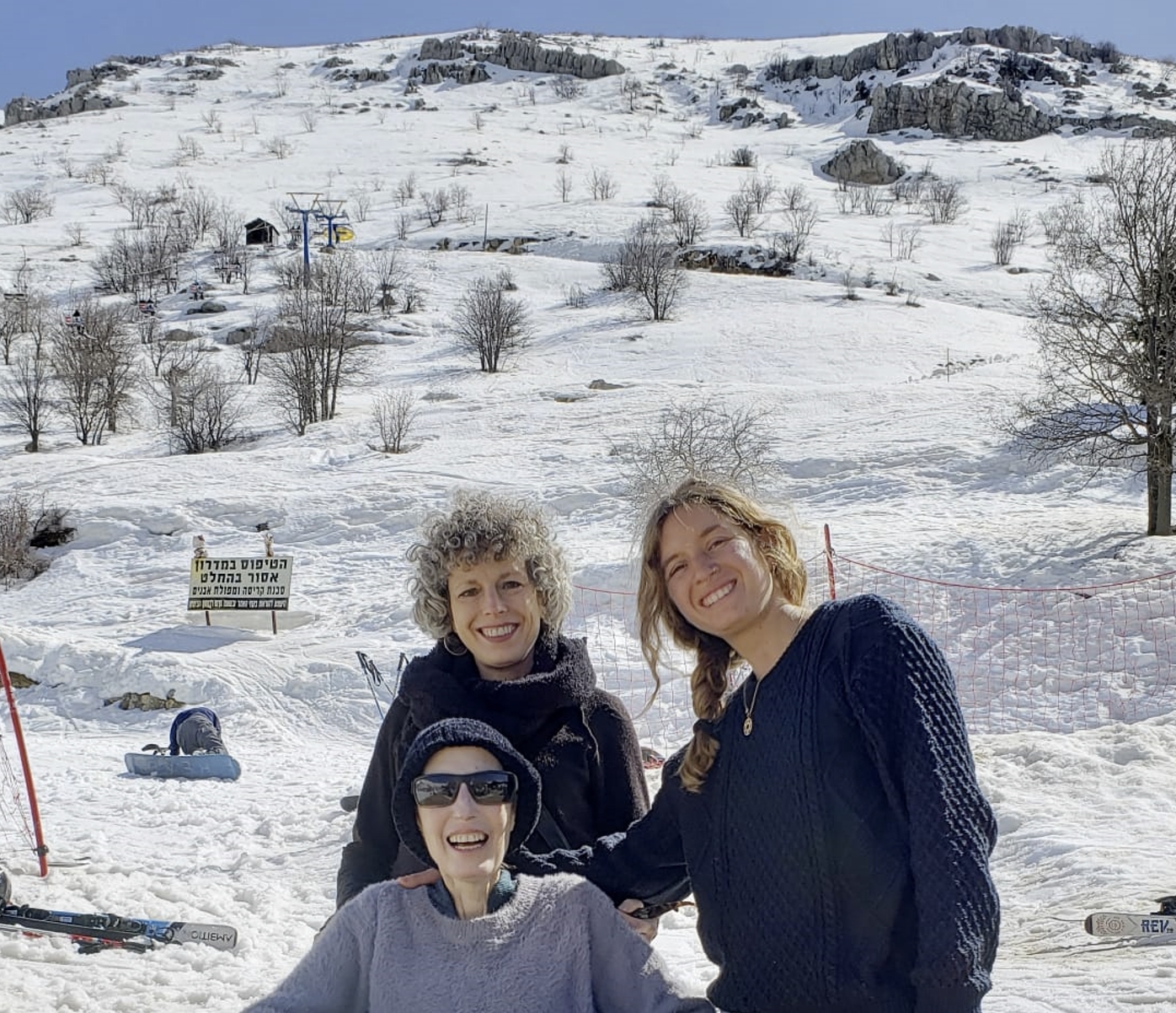 On the farewell trip to Mount Hermon
How did the family respond?
“One of the most important things in our family, ever since we were young, was that our parents accepted everyone. They always taught us tolerance and that there is room in the world for many different opinions. That foundation helped us later, when we encountered the real challenges of life. It influenced all of us and preserved our relationship throughout the years.
“Dafna was extremely talented,” Noga continues. “She had the soul of an artist. She was very sensitive and painted beautifully. We weren’t surprised when she chose to study at Emunah College, specializing in art and Jewish studies. During that period she became even more religious, and that was also when she met Erez. Within two weeks, they decided to get married.
“When she told me, I thought someone had gone crazy. How do you decide to marry someone so quickly? But apparently they shared an exceptionally deep spiritual connection.”
After their wedding, Dafna and Erez lived in Jerusalem. Then they surprised the family once again by deciding to move to Bat Ayin.
“My parents and I were shocked,” Noga recalls. “Bat Ayin represented not only a religious direction but a political one as well. I said to Dafna, ‘My dear sister, how are we ever going to see each other if you don’t drive on Shabbat and you live somewhere where we can’t drive in on Shabbat?’ I also admitted that I was personally afraid to travel there.
“Dafna gave me a short answer: ‘With God’s help, it will be all right.’ And it was. I rarely visited her there, especially because she absolutely refused to allow us to violate Shabbat on her behalf. Instead, we met at our parents’ home in Jerusalem and at our brother’s house.”
A Murder That Changed Everything
Over the following years, Dafna and Erez had three children. It had taken time and had not come easily, but they were deeply happy. They continued growing spiritually, attending Jewish studies classes and studying the Yemima method directly with Yemima Avital while she was still alive.
Both were highly creative. Erez had played music and written songs from a young age, while Dafna also loved writing. Over the years, they wrote songs together, which Erez set to music.
Their home became known for extraordinary hospitality. “Anyone who came to Bat Ayin knew that if they had nowhere to spend Shabbat or wanted an interesting place to stay, they could always go to Erez and Dafna,” says Noga.
Above all, their home was filled with joy. Erez was a Breslov Hasid, and the concept of “Serve Hashem with joy” was central to his life, even during difficult periods when maintaining that joy required tremendous effort.
“During Kiddush on Friday night, Erez would take the children and dance with them, singing Shalom Aleichem and the Shabbat songs. The children joined him wholeheartedly. On weekdays, he would wake them to the sound of his guitar, playing songs he had composed.”
Then, in a single horrifying moment, everything changed.
Erez went out for hitbodedut in preparation for a class he was scheduled to give, and he never returned. After an extensive search, it was discovered that two Palestinians from the nearby village of Surif had encountered him and murdered him with knives.
“I will never forget the phone call when my mother told me,” Noga says. “I simply couldn’t process it. How could something like this be real?”
Choosing Growth After Tragedy
Many years later, the pain remains palpable.
“Dafna’s life before and after the murder were completely different,” Noga says. “She and the children went through terrible trauma, and it was unquestionably a turning point. But what was remarkable was what Dafna did with it. She never allowed herself to sink.”
After Dafna’s death, the family found among her belongings a project she had created about growth after crisis. Yet Noga says she did not need to find the project to understand what Dafna had accomplished internally; it had been visible in the way she lived.
After Erez’s murder, Dafna became determined to publish both his creative work and her own in his memory. On the first anniversary of his murder, she arranged for a Torah scroll to be dedicated in his memory, raising the enormous sum required with the help of her family and the Bat Ayin community, all while raising three young children.
Every subsequent anniversary brought another project. One year, she took children’s songs Erez had written and composed but never had the opportunity to publish, arranged them, and released an album.
She also wrote two books in his memory, one for adults and one for children. The children’s book, Abba Erez’s Seeds, told in rhyme, sought to make the family’s terrible loss accessible to children while conveying faith and hope. Dafna hoped it could also strengthen families affected by terrorism and provide their children with a form of emotional support. She not only wrote the book but illustrated it herself.
“It was truly the work of her life,” says Noga. “Everything was for Erez and for preserving his memory.”
Facing Illness Without Looking Away
Two years after Erez’s murder, Dafna was diagnosed with cancer.
“It was trauma on top of trauma,” says Noga. “I remember how shaken all of us were. Yet even in the midst of that unimaginable difficulty, Dafna continued with all her energy and her famous radiant expression.”
Her home remained open to guests throughout the week. She volunteered wherever she could, became especially known for providing event decorations through a charitable lending service, arranged matches, and taught classes in Judaism, Hasidic thought and Jewish philosophy.
“I would ask her, ‘When do you ever have time for yourself when you’re constantly taking care of and volunteering for everyone else?’ Dafna would dismiss the question and say, ‘What have I really done?’”
Noga and Dafna did not always agree. For a period, Dafna tried to encourage her sister to become more religious. Noga made it clear that this was not the direction she wanted to take, and Dafna respected that.
“We were as different as two sisters could possibly be,” says Noga. “And yet she was truly my soulmate. I could talk to her about so many things, and she listened and understood so deeply.”
Dafna eventually recovered from cancer, but several years later it returned. From then on, her condition steadily deteriorated.
As her health worsened, something remarkable happened: all the love Dafna had given others began flowing back toward her. Friends she had helped over the years competed for the privilege of caring for her at home and in the hospital. At times, the family actually had to limit visitors so that she could rest.
Her daughter Levana put her own life aside to care for her mother day and night, learning to administer intravenous nutrition and medication and communicate with doctors. She slept on hospital floors and cared for her mother with extraordinary devotion.
Yet even while gravely ill, Dafna continued thinking about other people. She welcomed guests into her Bat Ayin home and even received visitors in the hospital. She listened to her friends’ troubles, offered advice and smiled despite nausea, weakness and pain.
“She simply could not close the door to her home,” Noga says, “and especially not the door to her heart.”
Always With a Smile
As Dafna’s condition deteriorated, she lost weight and eventually became unable to walk. Still, Noga says, her smile never disappeared, and the family never heard her complain.
For the final 11 months of her life, Dafna received nutrition intravenously and was unable to eat because she was constantly vomiting. Yet she continued inviting people for Shabbat and made sure that meals were prepared according to each guest’s preferences.
She would sit to the side, unable to eat, listening to the Shabbat songs and watching the guests around her table with genuine happiness.
“One Shabbat I came to stay,” Noga recalls. “I wondered how I could possibly eat while someone sitting next to me couldn’t taste anything. But Dafna completely surprised me. Not for a moment did she act as though she was unfortunate. Just the opposite. She was so happy with the guests and with Shabbat.”
And she refused to lower her standards of hospitality: not five salads, but ten; not two guests, but at least a minyan.
Even during her illness, Dafna continued creating art. Among other projects, she painted images of the Seven Species on benches in Bat Ayin and incorporated short lines from songs she and Erez had written together.
Conversations About Life and Death
Noga and Dafna had always spoken deeply about life. Their conversations took on an additional dimension because Noga herself had been diagnosed with cancer several years before her sister, at age 37. The cancer had a hereditary component.
In their later years, their conversations increasingly centered on life and death: how to live fully and rejoice in what one has, while at the same time preparing to say goodbye. Although Noga is not religious, she describes herself as a believer and spiritual in her own way. She was deeply moved by Dafna’s openness about preparing to leave this world.
Dafna prepared on every level, from practical matters such as a power of attorney and a will to deeply spiritual preparation. The family’s farewell trip to Mount Hermon was part of that process.
“At first it seemed impossible,” Noga recalls. “Who goes to Mount Hermon in a condition like hers? But eventually we all went with her, and it was the most enjoyable trip imaginable.”
Afterward, Dafna collapsed and was hospitalized at Ziv Medical Center. Realizing that her final days had arrived, she asked the entire family to come and say goodbye.
“We all came and gathered around her bed. Dafna said she had something she wanted to say to each of us. And then we discovered that the first thing she wanted to do was ask each one of us for forgiveness.”
Noga struggles to hold back her tears as she remembers it. “This righteous woman was asking forgiveness. For what? She had never hurt a fly.”
Dafna then spoke individually to each family member, telling them what she saw in them, what potential she believed they possessed, and what she wished for their future.
After saying goodbye, she asked to be discharged from the hospital and returned home. Three days later came the 15th anniversary of Erez’s death, on the seventh of Adar. It was the only anniversary on which Dafna was unable to visit his grave because she could no longer get out of bed.
Three days after that, on the tenth of Adar, she passed away.
Dafna died on Saturday night. The day before, she had still participated in the Shabbat meal, singing the Kabbalat Shabbat songs and later the traditional zemirot. On Shabbat morning, she awoke in severe pain. Around midday, the family called a nurse to administer morphine, and Dafna fell asleep. Forty minutes after midnight, she passed away.
Yet until that very morning, Noga recalls, Dafna had remained completely lucid, clear-minded and radiant.
Love Above Differences
Noga says she already misses her only sister deeply, especially Dafna’s extraordinary way of looking at life and the conversations they shared.
How, despite being so different, did you sisters manage to preserve such a close and mutually respectful relationship?
“First of all, there was love between us,” Noga explains. “We always loved one another, and I am certain that love is above everything else.
“Our opinions may have been different, but there was one fundamental principle we both always believed in: we are commanded, ‘Love your fellow as yourself.’ It doesn’t say that this applies only when the other person is like you or shares your opinions. You have to love them unconditionally.
“That is what both of us tried to live by.”

