

World News
Germany Plans Major Long-Range Weapons Buildup to Deter Russia
Germany is planning to invest nearly €12 billion in a long-range weapons network meant to deter Russia. The plan includes American Tomahawks, systems developed with Britain, and a cruise missile from an American-Israeli company being evaluated in Berlin.
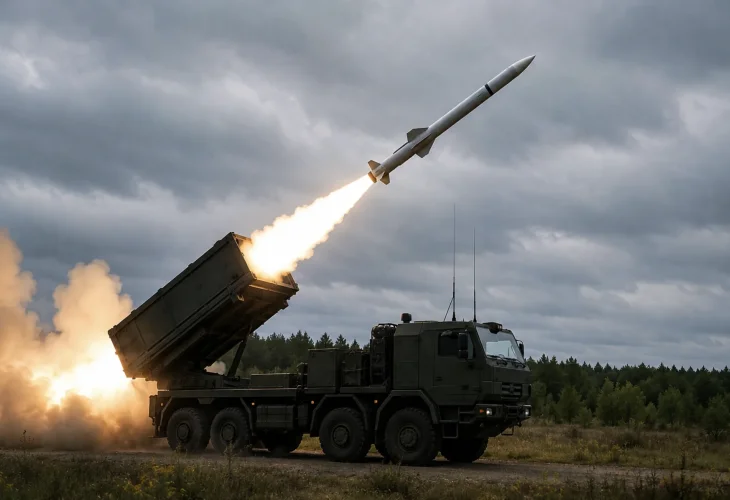
Germany is preparing for a major shift in its strike capabilities and plans to invest nearly €12 billion in building a new network of long-range weapons. According to internal German Defense Ministry documents obtained by Politico, the move is intended to strengthen deterrence against Russia. Among the candidates being considered for the network is a cruise missile made by an American-Israeli company.
The plan is meant to give Germany the ability to strike "deep inside enemy territory," including at command centers, airfields, missile launchers, and supply hubs. In Berlin, officials are seeking to establish a significant conventional response capability below the nuclear threshold, as part of a broader European military buildup in response to the growing threat from Russia.
The planned network consists of four different tiers, which are expected to enter service gradually. The first could become relevant as early as next year. At the same time, the most advanced systems, developed jointly with Britain, are expected to reach initial operational capability in the middle of the next decade.
One of the first elements of the plan is the procurement of a new, relatively inexpensive cruise missile that Germany hopes to begin operating as early as 2027. The emphasis is on a system that can be purchased and produced in large quantities and brought into service quickly.
As part of the search, the German Defense Ministry evaluated three missiles: Anthem, from the American-Israeli startup Covenant Industries; the BARS missile, offered by a Ukrainian company; and the Flamingo missile from the Ukrainian company Fire Point. The latter is already being used by Ukrainian forces and is striking targets in Russia's rear areas.
Germany is holding contract talks with two of the companies, aiming to receive missiles for certification and training purposes as early as next year. At the same time, Berlin is preparing framework contracts that would allow a transition to mass production later on. The documents describe the low-cost missile as "cost-effective and, above all, capable of mass production," with the intention of operating systems of this kind alongside more expensive and advanced munitions.
The approach relies heavily on lessons Germany is drawing from the war in Ukraine. According to the documents, Kyiv is making growing use of drones and missiles to strike military infrastructure and oil refineries inside Russia, while the use of fighter jets for strike missions remains relatively limited.
Alongside the development of these new capabilities, Germany also intends to rely in the coming years on American weapons already in service. German Chancellor Friedrich Merz told the Bundestag in early July that, during the NATO summit in Ankara, an agreement had been reached with the U.S. government to purchase Tomahawk cruise missiles and deploy them in Germany. Merz said, "We are closing an important strategic gap in our defense," and stressed that alongside the American procurement, Germany would also work to develop independent European systems.
The importance of Tomahawk missiles grew after the war in Iran, during which the U.S. military made extensive use of them. As a result, missile stockpiles were reduced by tens of percentage points, and the assessment is that additional years will be needed to replenish supplies and enable broad deliveries to U.S. allies.
The final two and most advanced components of the plan are being developed jointly with Britain. Under the Trinity House agreement, signed last year, Berlin and London are working on an advanced cruise missile and a hypersonic glide weapon. The goal is to reach initial operational capability in the middle of the next decade.
The two countries have already announced that the future weapons are expected to be capable of striking targets at distances exceeding 2,000 kilometers. The joint component with Britain is also expected to receive the largest share of the planned investment.
According to one of the documents, nearly €9 billion is designated for the development and procurement of these weapons, alongside €182 million to be allocated for their maintenance during service. In addition, €1.8 billion is designated for the development and procurement of cruise missiles, with another €97 million for maintenance. Together, the amounts total about €11 billion, while the Defense Ministry estimates that the overall funding required will reach "nearly €12 billion."

