

Torah Personalities
“Just Love Every Person”: The Remarkable Life of Rabbi Mordechai Auerbach, zt”l
Rabbi Mordechai Auerbach, zt”l, passed away on the eve of Yom Kippur. His students share moving memories of his love, wisdom, humility, and extraordinary legacy.
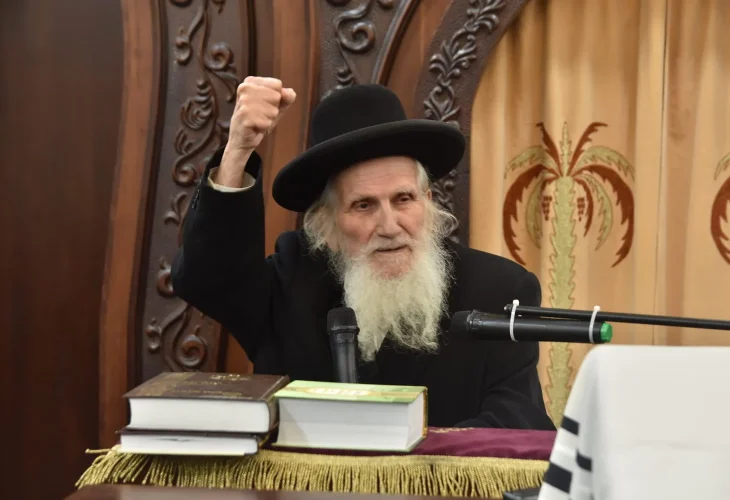 Rabbi Mordechai Auerbach, zt”l
Every year during Sukkot, thousands of people visit the sukkah of Rabbi Mordechai Auerbach in Tel Aviv to receive his blessing. This year, everything will feel different.
The sukkah will still be there, and the rabbanit’s warm, heartfelt welcome will be waiting for visitors as always. But the towering figure who accompanied so many people through every stage of their lives, Rabbi Mordechai Auerbach, zt”l, will no longer be there.
Sukkot was always a particularly special time in Rabbi Auerbach’s home. He served as rabbi of the Avir Yaakov congregation, head of the Halichot Shlomo yeshivah in Tel Aviv, and president of the National Center for Family Purity. Over the years, a large community of Jews returning to observance formed around him in central Tel Aviv. About 100 families live nearby, another 150 somewhat farther away, and thousands across Israel consider themselves his students.
During Chol Hamoed, visitors streamed into his sukkah. They watched him fulfill the mitzvah of dwelling in the sukkah, take the Four Species, and recite the blessing. He would sit with his guests, speak with them, sing, share Torah insights, and then sing some more.
This year, those who arrive will instead be welcomed by Rabbi Aharon Auerbach, Rabbi Mordechai’s son. Since news of Rabbi Auerbach’s passing arrived on Saturday night, on the eve of Yom Kippur, his family and students have struggled to comprehend that he is gone.
A Rabbi of Uncompromising Truth and Unconditional Love
One of Rabbi Auerbach’s longtime aides recalls growing up beside him.
“I had the privilege of growing up close to the rabbi throughout my life. My parents became religious when they were single. My father grew closer to Judaism through the rabbi, and my mother through the rabbanit. They built their home after someone from the community introduced them, and the rabbi officiated at their wedding.
“After they married, I was born as their first son, and I had the privilege of having the rabbi serve as my sandek. He gave me my name, after the Sadigura Rebbe, whose niece is the rabbanit. So I grew up at the rabbi’s feet in every sense of the phrase, and at age 14 I began serving him and taking part in the community’s activities.”
But why did Rabbi Auerbach establish such a significant community specifically in Tel Aviv?
The answer goes back decades.
Sixty six years ago, the Sadigura Rebbe known as the Avir Yaakov passed away. After moving to the Holy Land, he had become a prominent leader, but he left no children. Rabbi Auerbach’s wife was his niece, and following the Rebbe’s passing, Rabbi Auerbach was asked, on the advice of the admorim of the Ruzhin dynasty, to take his place as rabbi of the Avir Yaakov synagogue.
Over the years, a large community of Jews returning to observance gathered around him.
People often asked how he managed to reach so many different kinds of Jews.
“There is no method or way to do it,” he would answer. “Just love every person as they need to be loved.”
His aide believes that this combination of love and uncompromising truth was the secret of his influence.
“There are people who go through the world believing that a pleasant expression comes before everything else, but sometimes they have to lie to please people or ignore the truth. Others follow the truth all the way, but as a result sometimes cannot be warm toward others.
“With the rabbi, both qualities came together in an incomparable wholeness. The rabbi was a man of truth. I say this as someone who had the privilege of being with him behind closed doors for about 13 years, and never once did a false word leave his mouth.
“But his devotion to truth never caused him to lash out at others or be unpleasant toward them. He had immense love for everyone. Even when he corrected us, and that happened sometimes, we knew that he loved us with a deep, unconditional love. He rebuked us like a father educating his children.”
His unusual qualities were recognized by prominent Torah leaders as well. Rabbi David Abuchatzeira, the Makova Rebbe, and many others saw something exceptional in him. The Amshinov Rebbe reportedly referred to Rabbi Auerbach as “the rebbe of the rebbes,” reflecting the fact that admorim themselves came to consult with him.
“I never heard the conversations in full, because the rabbi maintained discretion,” his aide recalls. “But it was clear that they had not come simply to offer compliments or hear a Torah thought. Above all, the rabbi was extraordinarily wise, and they consulted him often.”
That wisdom was equally available to ordinary people.
“I saw with my own eyes, again and again, how people arrived with broken faces and left encouraged, with renewed strength.”
His sincerity could even be seen in the way he prayed.
“When he prayed as the shaliach tzibbur, he did not try to introduce special melodies or changes. He simply prayed exactly as he spoke to everyone, at eye level. It was his most direct prayer to Hashem, like a son speaking freely before his father.”
The same was true whether he stood before thousands or a small gathering.
His aide recalls accompanying Rabbi Auerbach to the enormous wedding of the Ger Rebbe, where he had been invited to read the ketubah.
“People might have thought that the rabbi would surely make a special effort for such an event, but he read the ketubah exactly as he would at the wedding of someone from the community who had returned to Jewish observance. That was simply his reality: the same truth, the same precision, the same love and embrace for every single person.”
That respect extended even to those whose beliefs differed greatly from his own. During disputes between religious and secular residents in the neighborhood, his aide once asked him, “How can we respect them?”
Rabbi Auerbach answered:
“We do not need to agree with everyone’s opinion. We have our opinion, which is the Torah’s view, and we know the truth. We do not need to agree with them, but we are obligated to respect them.”
The result was mutual respect. His secular neighbors respected him deeply because they knew that he genuinely respected them.
“You Never Lose by Yielding”
Roni Ayalon, director of the Shamayim Center in Tel Aviv, first met Rabbi Auerbach when he and his wife, Nurit, were beginning their journey toward Jewish observance.
“When we were looking for a place to pray, all the religious people in the area directed us to Rabbi Auerbach’s community, which was already a major beacon for people returning to Judaism. We spent the first three years of our journey within the rabbi’s community.
“There, we found his majestic presence, which knew how to appreciate and welcome with a good eye and a broad heart every person who came to him, from every background and style.”
Ayalon remembers a combination that seemed almost contradictory: uncompromising truth alongside humor, warmth, and tremendous sensitivity.
“People returning to observance were of course looking for a great Torah figure, but beyond that, they were looking for a person with a soul who would understand them. And that is exactly what they found in the rabbi.”
He also fled from honor. Whenever someone tried to speak about his greatness, he would respond with a joke and quickly change the subject.
Another defining characteristic was his ability to make peace.
“He made peace between husbands and wives, and one could see how quite a few couples came as enemies and left as lovers,” his aide recalls. “Stories came to him that seemed hopeless. I saw things with my own eyes that cannot be described.”
His approach was not weakness or an attempt to please everyone. Rather, he knew how to identify the good in each person and use it to bring people together.
That ability was closely connected to another principle Rabbi Auerbach lived by: the power of yielding.
“The rabbi gave up many things throughout his life, always emphasizing to me that ‘you never lose by yielding.’”
Once, while sitting in the community’s enormous beit midrash in the heart of Tel Aviv, Rabbi Auerbach pointed around the building and told his aide that he had never paid a shekel to acquire the space.
“All of this is because I yielded,” he said.
Decades earlier, the community had been asked to leave the building associated with the Sadigura Avir Yaakov because they had received it only under a protected tenancy arrangement. Rabbi Auerbach consulted his father, Rabbi Shlomo Zalman Auerbach, zt”l.
His father told him, “You have no halachic right to remain there.”
That was enough.
“We are leaving,” Rabbi Auerbach immediately announced.
Others wanted to search for leniencies or compromises, but Rabbi Auerbach refused.
“Because of that,” he later told his aide, “we received the large building where we are today. See how much power there is in yielding.”
His daily life reflected the same sense of complete dedication.
“Learning, learning, and more learning,” his aide says. “From morning until night, he only learned and taught.”
Yet somehow, he remained fully available to everyone around him. No visitor was made to feel that he was interrupting the rabbi’s learning or wasting his time.
“Be Who You Are”
Perhaps one of Rabbi Auerbach’s most remarkable qualities was his ability to guide people without trying to turn them into copies of himself.
Roni Ayalon worked closely with him while establishing Shoreshim, and later Ashira and Shamayim, centers dedicated to bringing Jews closer to Judaism in Tel Aviv.
“It was remarkable to see the rabbi’s boundless love for the Jewish people,” Ayalon says. “He had his own personal outlook, but he set it aside, and it never interfered with his ability to look at the person in front of him and guide that person on the path that suited them.”
This was especially important for Jews beginning to observe Torah and mitzvot.
“Rabbi Auerbach knew how to serve as a shock absorber, greatly softening the transition. He knew exactly how to guide people returning to Judaism so that they would not abandon their path because of the difficulties.”
His Shabbat table reflected that philosophy.
Students from dramatically different backgrounds sat side by side. Some wore shtreimels, others hats or knitted kippot, and some still had ponytails.
When someone objected to a guest’s appearance, Rabbi Auerbach would silence the criticism and ask simply, “What is the problem?”
He allowed people to progress at their own pace. Sometimes, when newly observant students wanted to adopt a hat or shtreimel immediately, he stopped them.
“Be who you are,” he told them.
When people newly returning to Judaism wanted to begin correcting their parents’ level of observance, he redirected them.
“The greatest mitzvah you can fulfill in your reality right now is honoring your parents,” he told them. “Do not let other things confuse you.”
He gave similar advice to students and professionals who wanted to abandon their education or careers immediately in order to devote themselves entirely to Torah study.
When one law student begged to leave his studies, Rabbi Auerbach reminded him how painful that would be for his mother.
“Continue studying, for your mother’s sake,” he told him.
His home embodied the same openness.
“Anyone who has not experienced it simply cannot understand,” a community member recalls. “Shabbatot at the rabbi’s home were always a pouring out of the soul and a special closeness to the Creator.”
After prayers, Rabbi Auerbach sometimes returned home with hundreds of guests. The rabbanit prepared food for everyone, and no one was ever told there was not enough room.
“There is no one in the community who did not visit the rabbi personally or stay in his home,” his aide says. “Everyone has their own story, and that is also why his passing is now so difficult. We all feel that we lost a father.”
Thousands attended his funeral, including Torah leaders, rabbis, and admorim representing a remarkably wide range of Jewish communities.
The Strength to Continue
Michal Yisraeli, a member of Rabbi Auerbach’s community, remembers another seemingly contradictory quality.
“On one hand, he was such a great person that you felt small and transparent beside him, with a real awe of him. And on the other hand, there was the ability and accessibility to ask him any question and speak with him about absolutely anything.”
As a mother raising her children alone for years, she frequently sought his guidance and spent Shabbat meals with him.
“The home was an open home, and the rabbi and rabbanit were like a mother and father to us, or perhaps a grandfather and grandmother.”
Once, she consulted him about her 11 year old son, Yehonatan.
“The child is connected to Rabbi Nachman,” Rabbi Auerbach told her. “That is how his mother raised him, and he needs to travel to Uman.”
She was astonished. Although she had become religious through Breslov Hasidism, she had never told Rabbi Auerbach.
“This is not how my father educated me,” he told her, “but what can we do? There are different kinds of souls.”
He even helped arrange for a young man from the community to accompany Yehonatan to Uman for Rosh Hashanah. From age 11 until today, at 28, Yehonatan has traveled there each year.
Her children remained deeply connected to Rabbi Auerbach.
As a boy growing up without a father figure at home, Yehonatan would approach the rabbi every Shabbat after prayers to wish him Shabbat shalom. Rabbi Auerbach would gently and humorously offer the child his pinky finger.
“They received so much personal example and tradition from him, in the synagogue, in prayer, and at the Shabbat table,” Yisraeli says.
“They saw how he welcomed every person with a smile and joy, how he never got angry and would not allow people to become angry with children, even if they were loud or disruptive. That example, in my opinion, is far beyond any lesson in parenting.”
Idit Lichtenfeld, an actress, creator, and director, remembers how Rabbi Auerbach gave Jews returning to observance something many desperately needed: a place to belong.
“The first thing the rabbi did for us was give us that place, first of all in his heart and home, but in every other sense as well. He never tried to reshape us.”
Instead, he encouraged them to remain close to their parents and, where appropriate, continue in their professions.
As an actress, this guidance was particularly meaningful to Lichtenfeld. During her journey toward observance, she asked Rabbi Auerbach what to do about the many performances in which she was involved.
He examined each one individually, telling her which she needed to leave and which she could continue.
“I was so moved when the rabbi always told us: ‘Stay connected to who you are.’ Thanks to the rabbi, I understood that I was not a ‘Princess of Babylon,’ as I appeared in a play, but a princess of the King of Kings.”
The rabbanit stood beside him throughout those years, welcoming people with the same extraordinary warmth.
When Lichtenfeld came to offer condolences before Yom Kippur, she found nearly all the women of the community gathered there.
“We all feel that we are in real mourning, unable to breathe from the pain, and at the same time encouraged and healed simply by being in that large home, which remains open, just as it always was.”
Rabbi Auerbach’s passing leaves his family and students with an enormous question: What happens now?
“That is exactly the question I have been asking myself in recent days,” his aide says.
“And it was as if I heard the rabbi giving me his obvious answer: ‘We continue.’
“I asked back: ‘But how?’
“He did not answer me, as was his way, leaving me with the task of trying to think through how to move forward.”
For the thousands of people who found a father, teacher, guide, and source of strength in Rabbi Mordechai Auerbach, zt”l, perhaps that simple message is itself part of his legacy:
“We continue.”
May the strength and wisdom he gave his students throughout his life continue to accompany them for many years to come.

