

Wonders of Creation
The “Useless” Organ That Turned Out to Be Vital: Meet the Thymus
Doctors once believed the thymus was unnecessary—and even tried to shrink it. Then one experiment revealed its crucial role in the immune system.
- Yehosef Yavetz
- | Updated
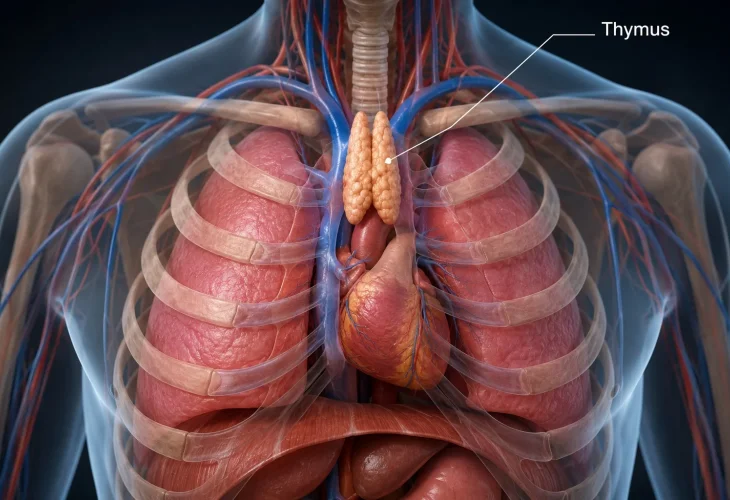
The thymus is one of the immune system’s most important organs, yet for much of medical history, doctors had little idea what it actually did. Hidden deep inside the chest, this soft, two-lobed organ sits behind the breastbone, above the heart and between the lungs.
Its existence was known even to ancient physicians, but its purpose remained a mystery. Other organs seemed easier to understand from their connections: the heart has blood vessels, the lungs have airways, and the kidneys produce urine. The thymus offered few obvious clues.
Its changing appearance made the mystery even greater. The thymus is relatively large and active in children, but after puberty it gradually shrinks, with much of its tissue replaced by fat. For years, this led doctors to assume that it was important only during growth and eventually became unnecessary.
That misunderstanding would have serious consequences.
When Doctors Tried to Shrink a Healthy Organ
At the beginning of the 20th century, dangerous confusion arose around the thymus. Autopsies of children who had died from severe illnesses sometimes revealed surprisingly small thymus glands. Doctors did not yet understand that acute illness, starvation, and severe physical stress can cause the thymus to shrink rapidly.
As a result, they came to regard a small thymus as normal. When a child who had died suddenly was found to have a larger thymus, doctors sometimes interpreted it as a dangerous abnormality.
An “enlarged thymus” became associated with suffocation, sudden death, and deaths during anesthesia. Rather than recognizing the risks associated with early anesthetic practices, some physicians blamed the thymus, believing it could press against the airway.
During the first decades of the 20th century, thousands of children underwent radiation treatments intended to shrink the organ. Because the treatment reduced the thymus shadow visible on chest X-rays, the apparent success seemed to reinforce the diagnosis.
Only years later did the consequences become clear. Long-term studies of children who had received radiation to the thymus area found increased rates of thyroid tumors and other cancers. A 1989 study found a dose-dependent association between thymus irradiation during infancy and an increased risk of cancer later in life.
The irony was profound: Doctors were irradiating a normal organ because they believed it was dangerously large, while scientists still had not discovered that this same organ played a crucial role in building the immune system.
The Experiment That Changed Everything
Even among immunologists, the thymus was long considered relatively unimportant. Cells taken from it did not produce antibodies, and removing the thymus from adult animals generally caused no obvious immediate harm. At a major international immunology conference in 1960, the organ was barely discussed.
The reasoning seemed straightforward. Remove the thymus from an adult mouse, and the animal still has large numbers of lymphocytes. Nothing dramatic happens immediately, so why assume the organ is essential?
What researchers had not adequately investigated was what would happen if the thymus were removed immediately after birth, before it had time to help establish the immune system.
In the late 1950s, a young researcher named Jacques Miller was working at London’s Institute of Cancer Research. His original question had little to do with discovering the function of the thymus. He was investigating how a particular virus caused leukemia in mice, a disease that first appeared in the thymus.
Miller removed the thymus from newborn mice to see whether doing so would prevent the virus from causing leukemia. The experiment affected the development of the cancer, but something even more important caught his attention.
Mice without a thymus developed a severe shortage of lymphocytes. They struggled to fight infections and were unable to reject skin grafts from unrelated mice.
In 1961, Miller published findings that transformed scientists’ understanding of the organ. The thymus went from being considered by many researchers a largely useless remnant to being recognized as a central part of the immune system.
The findings were initially met with skepticism. Some researchers argued that Miller’s mice were already sick or that the results were specific to a particular strain. But other laboratories eventually reproduced the findings.
Scientists discovered an entire family of immune cells associated with the thymus: T cells, with the “T” standing for thymus.
The Thymus Is Both a Factory and a Training Ground
The thymus does far more than simply produce large numbers of cells. Young immune cells originating from the bone marrow enter the thymus and undergo an extraordinary selection process.
Their ability to recognize the signals necessary for immune function is tested. Cells that cannot function properly are eliminated. Cells that react too strongly against the body’s own proteins are also removed.
Only a small proportion successfully pass these tests and leave the thymus for the bloodstream.
Those surviving T cells become part of the body’s defense against viruses, bacteria, and malignant cells while normally avoiding attacks against the body's own tissues. In this sense, the thymus functions as both a factory and a training ground: It helps develop an enormous variety of immune cells, tests them, and allows only suitable cells to continue.
Later research identified different types of T cells, including helper T cells, cells capable of killing infected cells, and regulatory T cells that help restrain excessive immune responses. Scientists also came to understand that the selection process occurring inside the thymus plays an important role in preventing the immune system from attacking the body itself.
Does the Thymus Still Matter in Adulthood?
Miller’s discovery helped explain why the thymus is so important early in life, but another question remained. If the organ gradually shrinks after puberty, does it still matter in adulthood?
For years, scientists believed adults depended largely on T cells created earlier in life and on the ability of those existing cells to multiply outside the thymus. But later research revealed a more complicated picture.
In 1998, Douglas Douek and his colleagues introduced a way of measuring thymic activity in humans using circular pieces of DNA known as T-cell receptor excision circles, or TRECs. These fragments are produced during T-cell development and can help researchers identify cells that have recently emerged from the thymus.
The research demonstrated that the human thymus continues producing new T cells during adulthood. Subsequent studies reinforced the finding: The aging thymus does not simply disappear or become completely inactive. Its activity declines substantially, but some T-cell production can continue, with considerable variation between individuals.
The question therefore changed. Scientists were no longer asking whether the adult thymus functions at all, but how its declining activity—and differences between individuals—might influence health and immunity as people age.
More recent research has continued to explore the relationship between thymus function, aging, immune health, and long-term health outcomes, highlighting how much scientists still have to learn about an organ that medicine once dismissed as unnecessary.
The history of the thymus is a remarkable reminder of how scientific understanding evolves. An organ once blamed for childhood deaths and deliberately exposed to radiation eventually proved to be one of the immune system’s essential training centers.
Hidden behind the breastbone, the thymus may become smaller with age, but its discovery fundamentally changed our understanding of how the body learns to defend itself.

