

Raising Children
The Gift That Never Came: A Lesson Every Parent Should Read
A childhood wish that seemed small left an impression that lasted a lifetime. This moving story reveals how deeply children can experience the simplest gestures.
- Nechama Frilich
- | Updated
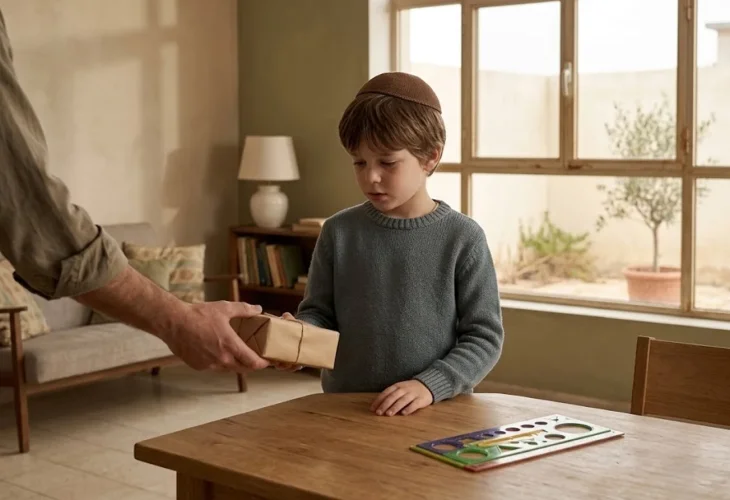
Some childhood memories fade with time. Others remain vivid for decades—not because of the object involved, but because of what that object represented. This is the story of Eyal, a valued donor involved in Jewish outreach, and the simple childhood wish that taught him a powerful lesson about what children sometimes need most from their parents.
Ten-year-old Eyal leaned against the window of his room, as he did every day, watching his friends kick a ball around in the street. It was meant for cars, of course, but in those days, it doubled as a playground.
His friend Yossi eventually announced that he was going upstairs. Eyal knew what that meant: Yossi was going home, where he could continue playing with the new game he had proudly been showing everyone for the past month.
Eyal could still remember the first time he had seen it.
He lived in Tirat Carmel, in one of the less affluent neighborhoods of northern Israel in the 1960s. Toys and games were luxuries. Money spent on a child's toy was money that could have gone toward something the family actually needed. So when a child did receive something new, it was special—and naturally, he proudly showed it to his friends.
One day, Yossi brought out a shape-drawing set, something that seemed cutting-edge at the time. Eyal watched with undisguised envy as his friend demonstrated the different shapes and designs it could create.
Before long, a dream took hold of him.
He wanted one too.
But reality quickly brought him back down to earth. His parents would never buy him something like that. As far back as he could remember, they had never bought him a gift that was simply for him, apart from one occasion when an uncle had surprised him with a new book.
Still, perhaps this time would be different.
That evening, Eyal enthusiastically told his father about the wonderful drawings the set could make and described all its different parts. In the days that followed, he mentioned it again and again, asking in different ways and dropping increasingly obvious hints.
It is difficult for an adult to fully understand the longing of a 10-year-old who has never been given something that belonged only to him.
Eyal was not angry with his parents. He understood that earning a living was difficult and that his father worked hard to support the family. He had already learned that money was not something to waste.
His mother's words were deeply ingrained in him: Thank Hashem that nobody is hungry and that you have clothes to wear.
She often told him about her own childhood in Jerusalem before the War of Independence.
“There was terrible hunger—may you never know such troubles,” she would tell him. “We had to save every penny. Who was ever full? We were always hungry, waiting for more.”
Eyal had grown up hearing those stories. He understood.
But understanding did not make his little wish disappear.
The Package in His Father’s Hands
Eyal had suffered from shortness of breath since he was a year old. Countless nights were spent awake with his parents in the early hours of the morning, every window open and the shutters raised, hoping the breeze coming down from the nearby mountains would help him breathe.
He spent plenty of time in doctors' offices and clinic hallways. This was the 1960s, when medications were not always made particularly child-friendly, and unpleasant pills and syrups were simply another part of being sick.
From his bed, Eyal sometimes overheard his parents discussing his condition. Recently, he had heard his father talking about new medications that might become available. A professor had said they could help, and his father was determined to obtain them—even if they were expensive.
Then, one day, his father surprised him.
Eyal was in the middle of an exciting game with his friends when his father approached, carrying a bag.
“Here,” his father said happily. “I bought this for you.”
Eyal froze.
“Dad?”
He could barely believe it.
“Dad, you bought something for me?”
His heart overflowed. His father was smiling, and Eyal was certain he understood the wonderful secret hidden inside the package.
Tomorrow, he would finally have something to show his classmates.
He would finally be able to say the words he had heard so many other children say:
“Look what my dad bought me.”
Maybe it was the shape-drawing ruler. Maybe, at last, his father had bought something just for him.
Then his father handed him the package.
“Yes, sweet Eyal. I got you the medication.”
His father had no idea what had just happened inside his son.
He did not see the dream shatter. He did not realize that the package Eyal had imagined containing the object he had wanted for so long instead contained another reminder of his illness.
Eyal lowered his hands and looked at the floor.
The joy disappeared in an instant.
He could barely remember how he dragged himself upstairs. His parents saw the disappointment on his face, but they assumed he would get over it.
And Eyal knew his father loved him.
His father took time to explain how electrical appliances worked and allowed Eyal to help him with tools around the house. Every Saturday night, he would take out his old violin, and together they would sing the melodies Eyal's grandfather had sung.
Those moments meant a great deal to him.
But his father could not have known about another need growing quietly inside his son—the longing to receive something unnecessary, something chosen simply to make him happy.
That night, Eyal fought back tears.
I will never receive something that is mine. Something meant just for me.
He wanted to experience what other children seemed to experience so naturally: the excitement of holding up a small gift and saying, “Look what Dad bought me.”
The medicine could never satisfy that need.
And as he fell asleep, one question continued to trouble him:
Why?
Decades Later, the Ruler Still Means Something
Today, Eyal is old enough to be marrying off his grandchildren.
The years have passed, but that childhood memory never completely disappeared.
Sometimes, when his wife gathers the games, crayons, rulers, and papers their grandchildren leave scattered around the house, Eyal notices a shape-drawing ruler.
And suddenly, he is 10 years old again.
“Maybe you will never know what that simple ruler meant to me,” he tells his wife. “You will not understand that, as a child, it was the desire of my life. I did not have big wishes. Just one longing: that my father would buy me that ruler. It seems so simple to you, but it was enormous in my eyes.”
“It is time for you to let it go,” she tells him.
“I knew you would not understand.”
“All because of a ruler?”
And then Eyal explains what it took him years to understand himself.
“Today I understand that it was not the ruler.”
“Then what was it?”
“No one ever bought me something personal, something of my own. I did have devoted and caring parents. They made sure I had food. I had neat, clean clothes, handed down from my siblings. I had books because I exchanged books at the public library.
“I longed for my mother or father to hand me a small bag and say, ‘Eyal, here. I bought this especially for you—for you, because you matter to me.’”
Sometimes the Smallest Things Say the Most
Eyal's story is not really about a ruler, nor is it about parents who did not love their child. His parents clearly cared for him, sacrificed for him, tended to his health, and worked hard to give him what he needed.
But children do not always measure love by sacrifice in the way adults do.
Sometimes, what stays with a child is something seemingly insignificant: a small gift chosen especially for them, a few uninterrupted minutes together, a favorite snack brought home unexpectedly, or the feeling that a parent noticed what mattered to them.
The object itself may eventually be lost, broken, or forgotten.
But the message behind it—I thought of you. I know what makes you happy. You matter to me—can remain for a lifetime.

