

Sukkot
The Sukkah That Brought an Entire Building Together
He moved into a building filled with feuds and resentment. Then one sukkah gave the neighbors a reason to sit, eat, sing, and celebrate together.
- Inbal Idan
- | Updated
 (Photo: shutterstock)
When the real estate agent showed me the apartment, he described it as peaceful, in a well-kept building with a great view and excellent exposure—and, above all, easygoing neighbors. I had been looking for an apartment in the area for a long time, but I didn’t know this building yet. Compared with the other buildings, it had relatively few residents, which was another major advantage for me.
After my wife and I saw the apartment, we came away impressed. I even tried knocking on one or two neighbors’ doors. Unfortunately, no one answered. The building was quiet and well maintained, exactly as I had been told. Everything looked perfect.
We signed the deal.
Welcome to the Neighborhood
A month later, we were fortunate enough to move in. I’m a very social person, and connecting with people is a core part of who I am, so on the very first day, I went around to the neighbors with boxes of chocolate and candy, offering treats to everyone. Almost all of them opened their doors with a bit of hesitation, their eyes widening when I offered them something. I didn’t really pay attention to their expressions. To me, it felt natural—I was new to the building, right?
But those were the good days.
Right afterward, the flood began. One of my children left his bicycle in the entrance. We had made it clear to the kids again and again that bikes should be locked outside, but he had rushed upstairs to grab something from the apartment, and just then a neighbor arrived.
He immediately came up to our home, furious. He gave an angry lecture about the bike being left there in such an unsafe manner, and then continued: If we intended to join forces with family X, he would make sure we understood who was in charge here.
I honestly didn’t understand him. There is no question that a bike left at the building entrance is a safety and sanitation problem, and it absolutely called for a conversation and clarification with my son. But I couldn’t understand what it had to do with family X.
There was no such family in the building.
I gently asked what he meant. Eventually, I understood that it was a family that had moved away long ago. They were gone—but the resentment remained, and now I was supposed to fix it.
I calmly explained that I didn’t know what had happened with the former neighbor, but I did know that, it would not happen with me. I would speak with my son. He immediately stressed that we should be careful not to end up like them, because he was going to “make the direction clear right away,” in his words.
That was my introduction.
Within two weeks, I understood that I had moved into a buzzing hive of anger, manipulation, and intrigue. It wasn’t just that neighbor. Later, I learned from him that the son of the downstairs neighbors deliberately threw down his bike as part of their ongoing battle with one another.
But that was only the small story. Everything was wrapped in revenge, rivalries, and petty calculations. For a moment, I felt like I was inside palace corridors, surrounded by all the politics and schemes swirling there. It became a real burden. I’m not someone who can absorb things like that. I can’t bear to hear, see, and understand that this is how people treat one another, no matter how right one person or another may be.
Even before Rosh Hashanah, I tried to persuade people—maybe someone would soften, forgive, rise above it, and take responsibility for what was happening here. But there was no one to talk to.
It was painful and unbelievable.
The Sukkah No One Thought Could Happen
My apartment didn’t have a balcony suitable for a sukkah, and since we are observant, I now had a new problem: Where would I build the sukkah that year?
I asked one of the neighbors, a religious man, where he built his sukkah. He sighed and told me that every year he traveled elsewhere to celebrate the holiday because here, there was no chance the neighbors would allow it.
I was completely stunned. Was it really that bad?
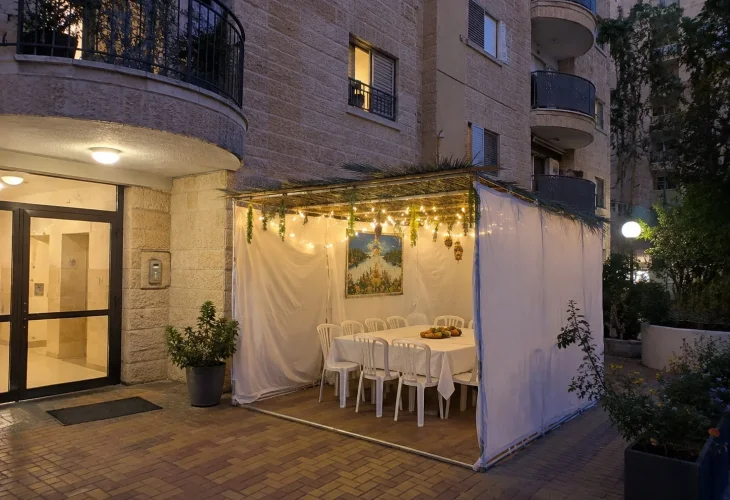
I wasn’t discouraged, but at least I knew what to expect. I went knocking on neighbors’ doors, asking whether I could build a sukkah at the building entrance, where there was a large enough open area that people could still pass through easily and the sukkah would not inconvenience anyone.
I won’t say it went smoothly, but aside from two neighbors who had trouble giving their consent, I managed to persuade everyone to agree. Of course, I promised that immediately after the holiday, I would take down the sukkah and leave no trace behind.
The night after Yom Kippur, I began putting up the sukkah, as prescribed. With every nail, I prayed to Hashem to help me get through this holiday with great joy, because the whole situation in the building and its sour atmosphere were very difficult for me.
The neighbors came and went, and it seemed that they were even happy to see a lovely sukkah at their entrance.
Then the religious neighbor arrived. He looked at the sukkah and was very surprised that I had received everyone’s approval. I immediately told him he was welcome to celebrate the holiday with us. There was a big sukkah, and we love guests.
“It’ll be joyful,” I promised him. “Give it a try.”
He smiled and thanked me but said he had already made plans with someone else. The next day, he came back, somewhat embarrassed, and asked whether it would be all right if he and his family came to our sukkah after all, because the place he was supposed to go had canceled for some reason.
I jumped for joy and started dancing with him. Guests on a holiday—what a joy! He was so moved; he could see firsthand how much I wanted him close.
An Invitation for Everyone
On the eve of the holiday, I went up to all the neighbors, knocking door to door.
First, I went to Mazal, a widowed neighbor and a kindhearted woman. She was very happy to see me and said she was excited to see a sukkah in the courtyard. She hadn’t seen one in years; it truly took her back to her childhood and her parents’ home.
She had grown up in a home that observed Torah and mitzvot, and she had continued to observe as much as she could after getting married. Even today, she is careful about all the laws of kashrut, and her kitchen is strictly kosher, she noted excitedly.
I told her that I was truly excited to invite her to join us for the holiday meals. She was a little embarrassed and said she hoped she would feel up to it.
From there, I continued to the older neighbor—the one who had been angry about the bicycle. I invited him too, to come and be with us for the holiday. He smiled, appreciated the gesture, and thanked me.
There was no answer at the final two apartments.
The Sukkah Begins to Work Its Magic
Holiday eve arrived. I made Kiddush over wine, happy and thrilled to see my family and the neighbors together.
Before we went out to wash our hands, my wife noticed Mazal near the sukkah. She urged her to come in. It seemed Mazal was debating with herself about whether to enter; she was probably embarrassed.
No one can say no to my wife.
Mazal told her that she had cooked for the holiday and had large pots of food at home. We told her not to worry—we would bring everything down. I immediately went upstairs to her apartment with my sons.
What I saw there... food of every kind, enough for an army battalion. Nothing like it.
We brought it all down to the sukkah in several trips. She had set a table fit for a king. Everything was there. Mazal is blessed with talented hands, and her food was so delicious.
She told us that for years she had longed to cook for a family. Sadly, she had never had the opportunity, and now, with the sukkah and the invitation, it all burst out of her.
It was so moving.
I was happy that we had been able to give her a family and a holiday atmosphere. We complimented her on the excellent food, and as we enjoyed ourselves and tried to figure out who could possibly finish these quantities, the older neighbor stood at the entrance, a little embarrassed, with a young man beside him.
I immediately got up and shook his hand.
“I came with my grandson, so he could see a sukkah for the first time in his life,” he said, half embarrassed.
We immediately arranged chairs for them. They had no choice—they joined us. There was certainly no shortage of food.
At first, I was worried and a little frightened. Here the neighbors were meeting in my sukkah, and perhaps emotions would erupt and get out of control.
But Hashem heard my prayer and brought peace among us.
I decided to go over to the neighbors who had not opened their doors for me that afternoon. I thought: If I’m doing this, I’m doing it all the way.
A student couple lived in one apartment. I told them about the sukkah and invited them to come down, even just for a few minutes.
“There’s excellent food,” I promised.
They said they would come down for a short visit.
From there, I went to the last door, where a not-young couple from Eastern Europe lived. They didn’t really understand what I wanted; a sukkah was not something they truly knew about. They looked at me strangely, but as you may have gathered by now, I’m not fazed by reactions like that. I kept talking and talking until they got tired of it and said they were coming down.
I returned to the sukkah. Two minutes later, the students arrived and settled in. It wasn’t long before I saw them emptying and refilling their plates. The older neighbors came down carrying a bouquet of flowers they apparently had at home.
Everyone praised Mazal; perhaps for the first time, they discovered the chef they had in the building. It gave her so much—she blossomed and was happy. Everything she had prepared suddenly had such deep meaning.
We began to sing, singing every style—Israeli folk songs, Mizrahi music, Israeli songs, and Hasidic songs, from every corner of the spectrum. The joy was indescribable.
Time passed, and we were still singing. I shared a few brief words of Torah, focusing mainly on the essence of the days of Sukkot. I told them about Simchat Beit Hashoevah. For some of them, it was the first time they had ever heard of it.
Then we went back to singing, because there is nothing like song to bring worlds closer and open gates.
The meal ended close to midnight. We left the sukkah as though we had been torn out of a magical world and brought back into present-day reality.
What Happened After the Holiday
I wondered whether any of this would help the overall atmosphere. After all, life goes on, and feelings follow laws beyond nature.
After the holiday, I got my answer.
The student couple came down with musical instruments, one carrying an oud and the other a clarinet. The European couple arrived with an accordion and a violin.
They had agreed among themselves: Simchat Beit Hashoevah.
I was stunned.
They had joined together to surprise me.
Naturally, everyone joined in again. This time, there was dancing and singing with musical instruments—a perfect symphony.
What can I say?
That year, I had ushpizin ila'in kedishin...

