

Sukkot
What Is the Meaning of Life? 10 Essential Insights From Ecclesiastes
Discover the wisdom of King Solomon, why Ecclesiastes is read on Sukkot, and what Kohelet ultimately teaches about happiness, wealth, purpose, and our relationship with God
- Naama Green
- | Updated
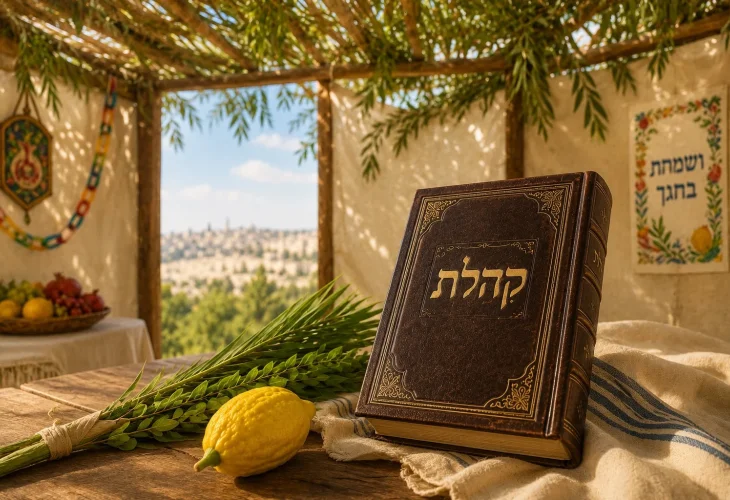
The Book of Ecclesiastes, Kohelet, confronts some of life’s most profound questions: What gives life meaning? Can wealth, wisdom, success, or pleasure bring lasting happiness? Traditionally attributed to King Solomon, the wisest of all men, Ecclesiastes examines these questions with striking honesty before arriving at its ultimate conclusion.
Following are ten fascinating facts about Ecclesiastes, the biblical book traditionally read during Sukkot.
1. The Name “Kohelet” Appears Only in Ecclesiastes
The name Kohelet does not appear anywhere else in the Bible. Within the Book of Ecclesiastes itself, however, it appears seven times.
The book opens with the words: “The words of Kohelet, son of David, king in Jerusalem. Vanity of vanities, said Kohelet…” Later, Kohelet declares: “I, Kohelet, was king over Israel in Jerusalem” (Ecclesiastes 1:12).
2. Jewish Tradition Identifies Kohelet as King Solomon
According to the Sages, Kohelet is another name for King Solomon. Kohelet Rabbah and Shir HaShirim Rabbah teach that Solomon was known by three names: Yedidiah, Solomon, and Kohelet.
3. The Book Itself Points to King Solomon
Numerous verses in Ecclesiastes support the traditional identification of Kohelet with Solomon.
Kohelet says, “I, Kohelet, was king over Israel in Jerusalem.” He also describes his extraordinary wealth and accomplishments: “I made myself gardens and orchards… pools of water… I acquired male and female servants… I also amassed silver and gold” (Ecclesiastes 2:4–8).
His exceptional wisdom is also emphasized: “And besides being wise, Kohelet also taught the people knowledge; he weighed, investigated, and composed many proverbs” (Ecclesiastes 12:9).
These descriptions are consistent with the biblical portrayal of King Solomon, renowned for both extraordinary wealth and unparalleled wisdom.
4. Solomon Composed Three Biblical Books
Seder Olam Rabbah, a Midrashic work traditionally attributed to Rabbi Yose ben Halafta, a student of Rabbi Akiva, relates that toward the end of Solomon’s life, Divine inspiration rested upon him and he composed three books: Proverbs, Song of Songs, and Ecclesiastes.
5. Why Was Solomon Called “Kohelet”?
Rashi offers two explanations for the name.
According to one explanation, Solomon was called Kohelet because he gathered together great wisdom. Rashi connects this with another name associated with Solomon, Agur ben Yakeh (Proverbs 30:1), explaining that he “gathered” wisdom.
Another explanation is that he was called Kohelet because he delivered his teachings before an assembled audience.
6. Ecclesiastes Was Edited in the Time of King Hezekiah
According to Jewish tradition, the Book of Ecclesiastes was edited by King Hezekiah and his court.
7. Why Is Ecclesiastes Read on Sukkot?
In most Jewish communities, Ecclesiastes is read on Shabbat Chol HaMoed Sukkot. Several explanations are offered for the connection.
One is the verse, “Give a portion to seven, and also to eight” (Ecclesiastes 11:2), which is understood as alluding to the seven days of Sukkot followed by Shemini Atzeret.
Another explanation connects the reading with the mitzvah of Hakhel, the national gathering that took place during Sukkot.
There is also a deeper thematic connection. Sukkot is known as zman simchateinu, “the season of our rejoicing,” while Ecclesiastes challenges us to distinguish between fleeting worldly pleasure and genuine, enduring joy.
Kohelet describes his pursuit of pleasure: “Whatever my eyes desired I did not withhold from them; I did not deny my heart any joy.” Yet the book ultimately teaches that worldly accomplishments and pleasures alone cannot provide the lasting fulfillment the human being seeks.
Customs regarding the public reading of Ecclesiastes differ. Some communities read it from a kosher parchment scroll and recite the blessings Al Mikra Megillah and Shehecheyanu, following the opinion of the Vilna Gaon. Other communities, including many Chassidic communities, read it from a printed text without reciting a blessing.
8. Ecclesiastes Is a Book of Wisdom
Ecclesiastes belongs to what is commonly called biblical wisdom literature. It grapples with universal questions about human existence, Divine providence, justice, happiness, and the purpose of life.
Kohelet conducts what might be described as a philosophical investigation into the human search for fulfillment. Throughout much of the book, he examines the things people commonly believe will make them happy: wisdom, justice, relationships, family, wealth, achievement, and fame.
Again and again, he demonstrates that none of them, by themselves, can provide the absolute happiness and inner peace for which the human soul longs.
9. Kohelet Tests the Things We Believe Will Make Us Happy
A recurring pattern runs throughout Ecclesiastes. Kohelet introduces something that appears capable of giving life meaning, explores its advantages, and then reveals its limitations.
Wealth is one of the clearest examples. Kohelet describes the endless anxiety of a person consumed with accumulating possessions: “The eye is not satisfied with wealth” (Ecclesiastes 4:8), and, “One who loves money will never be satisfied with money” (Ecclesiastes 5:9).
Wealth itself can even become destructive: “There is wealth preserved for its owner to his detriment” (Ecclesiastes 5:12).
Ultimately, no amount of material success can overcome human mortality. A person enters this world with nothing and eventually leaves it the same way: “As he came from his mother’s womb, naked shall he return… and he shall take nothing from his labor that he can carry in his hand” (Ecclesiastes 5:14).
The message is not necessarily that material possessions have no value. Rather, they cannot bear the weight of becoming the ultimate purpose of a human life.
10. So What Is the Meaning of Life?
After examining and rejecting nearly every conventional answer to the human search for lasting meaning, Kohelet finally reaches the climax of the book.
The reader who has traveled through all of its questions, contradictions, disappointments, and observations is given a final answer: “The sum of the matter, when all has been considered: Fear God and keep His commandments, for this is the whole of man.” — Ecclesiastes 12:13
This is the destination of Kohelet’s long investigation. Wealth is temporary. Pleasure fades. Accomplishments cannot defeat mortality, and even human wisdom has its limits.
The enduring purpose of life lies in a person’s relationship with God and in living according to His commandments.
Perhaps that is also why Ecclesiastes is so fitting for Sukkot. The sukkah itself reminds us that physical security is temporary. We leave our permanent homes and sit beneath a fragile roof, learning that what appears permanent may not be permanent at all.
Kohelet asks us to make the same discovery about life itself: once everything temporary has been stripped away, what remains?
For King Solomon, the answer is clear: “Fear God and keep His commandments, for this is the whole of man.”

