

World News
Nepal Disaster Worsens: Hundreds Dead, One Israeli Out of Contact
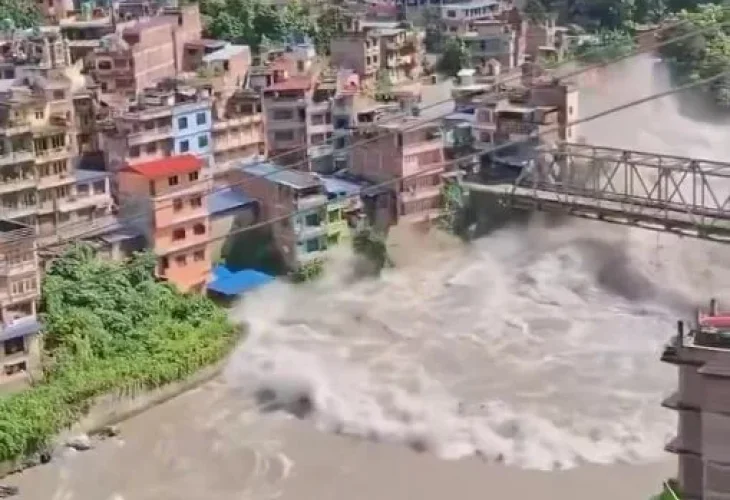
Nepalese authorities say about 200 people have been killed in massive flooding in the country’s north. Around 1,000 people are missing, including roughly 400 tourists and at least one Israeli. Israel’s Foreign Ministry warns travelers about flooding, landslides, and blocked roads.
 (Photo: Under Section 27A)
(Photo: Under Section 47A)
Nepalese authorities announced this morning (Thursday) that approximately 200 bodies have so far been recovered after the massive flood that struck the country’s north yesterday, near the border with Tibet. About 1,000 people have been reported missing, including some 400 tourists and 40 security personnel.
Israel’s Foreign Ministry in Jerusalem said that one Israeli is currently considered to be "out of contact." Israel’s consul in Beijing is in ongoing contact with the person’s family and is assisting in efforts to locate him.
In light of the extreme weather, flooding, and mudslides in Nepal and the border areas with Tibet, Israel’s Foreign Ministry in Jerusalem issued a warning to Israelis about flooding, landslides, and blocked roads. Travelers are asked to follow authorities’ instructions and avoid nonessential travel in high-risk areas and through flooded crossings.
According to the ministry’s announcement, Nepal has seen damage to infrastructure, blocked roads, and difficulty reaching certain areas. Israelis staying in areas at risk of flooding, landslides, or rising river levels are asked to follow local authorities’ instructions, stay away from rivers, waterways, and slopes, and avoid nonessential travel on roads at risk of being blocked or collapsing.
The ministry recommends that travelers monitor weather forecasts and official announcements, make sure family members or acquaintances in Israel know where they are and their travel route, and keep a charged cellphone and an additional charging method on hand. Travelers should also avoid attempting to cross flooded roads, bridges, or water crossings.
Israel’s Embassy in Nepal and the Foreign Ministry’s Consular Affairs Division are monitoring developments and are in contact with local authorities. In the event of distress or loss of contact with Israeli travelers, people may contact the situation room at 02-5303155 or the embassy in Nepal at 00-977-1-4434966 and 00-977-14290500. The Foreign Ministry said this is an evolving event and that its recommendations may be updated according to developments on the ground.
The Nepal-based newspaper "Kathmandu News" reported today that the sudden flood in the Bhotekoshi River caused destruction across three districts. According to the report, it is one of the country’s most severe disasters in recent years.
The flood was caused after an avalanche blocked the flow of a tributary of the Bhotekoshi River and first struck Timure, near Nepal’s border with China in Rasuwa District. Much of the settlement, home to hundreds of people, was swept away before the flood moved downstream. Since no rain had been reported in the area, residents received no warning of the disaster and continued their daily routines when the flood hit.
Rajendra Dhungana, the chief customs officer in Rasuwa, said he initially thought an earthquake had occurred when he felt the ground shake on Wednesday morning. When he ran outside, he saw a wall of water, dragging what appeared to be a cloud of smoke behind it, crashing down from upstream and heading toward Timure Bazaar.
"It was the flood, rising like a wave nearly 100 meters high and sweeping away the market," Dhungana told the Post. "Within moments, the market was gone." As the scale of the disaster became clear, Dhungana and dozens of others fled to the nearby forest. More than 300 vehicles and trucks waiting at the customs checkpoint were washed away.
The floods destroyed nine hydroelectric power projects and an equal number of commercial bank branches. An initial report shows that 19 movable bridges and 40 kilometers of highway were washed away by the flood.
Based on the still-undisclosed scale of the disaster, security officials and disaster experts say Wednesday’s flood may be among the deadliest in Nepal’s modern history, surpassing every disaster since the 1993 floods in Sarlahi, Rautahat, and Makwanpur, which killed 1,400 people and have long been considered the country’s deadliest disaster.

