

Parashat Ki Tavo
The Hidden Message of Bikkurim: Gratitude, Blessing, and Preparing for Rosh Hashanah
Parashat Ki Tavo teaches that recognizing Hashem’s kindness is more than gratitude. From the first fruits to our daily blessings, it is a path to closeness with Hashem and a meaningful preparation for the new year
- Rabbi Menachem Jacobson
- | Updated
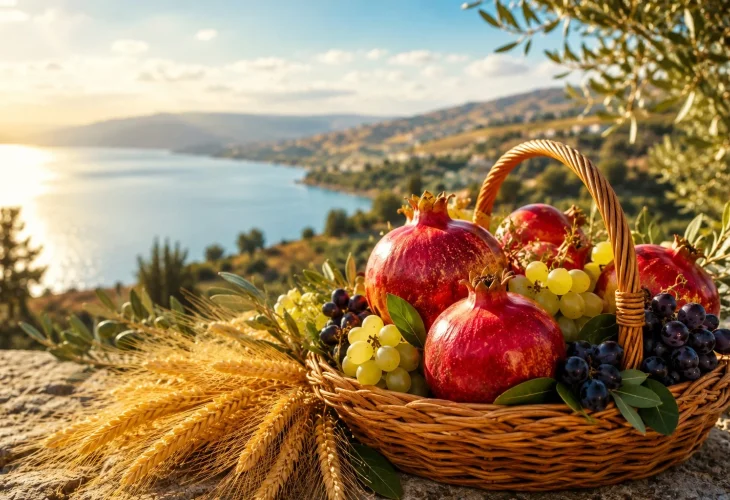
In Parashat Ki Tavo, we read of the declaration of gratitude recited by the person bringing the bikkurim, the first fruits.
A new fruit begins to emerge. The tree has not dried up. It has survived drought, frost, fires, and other threats. Here is the red pomegranate that will soon appear on the Rosh Hashanah table. And when it does, it can remind us of the gratitude we owe our Father in Heaven for the good land, for the rain, and for its fruits.
The First Fruits: Joy Joined With Gratitude
For many, the mitzvah of bikkurim symbolizes the beauty and joy of agricultural life in the Land of Israel. While it certainly expresses that beauty, its deeper message is the joining of two emotions: joy in the first fruits and gratitude to the Creator who made them possible.
Perhaps no one understands this more naturally than a farmer who looks heavenward, waiting for rain. A farmer knows that despite all human effort, no one can ultimately control the weather and all the forces upon which a successful harvest depends. This awareness creates a unique capacity for gratitude to the Creator.
Alongside that gratitude comes another recognition. More than almost any other area of life, agriculture in the Land of Israel is presented by the Torah as directly connected to the observance of Torah and mitzvot. We say this every day in the second paragraph of the Shema:
“And it shall be, if you diligently obey My commandments... I will provide the rain of your land in its proper time.”
The Torah elaborates on this connection:
“But the land to which you cross over to possess is a land of mountains and valleys; from the rain of heaven it drinks water. It is a land that Hashem your God seeks out; the eyes of Hashem your God are always upon it, from the beginning of the year to the end of the year.
“And it shall be, if you diligently obey My commandments that I command you today, to love Hashem your God and to serve Him with all your heart and with all your soul, then I will provide the rain of your land in its proper time, the early rain and the late rain, and you will gather in your grain, your wine, and your oil. I will provide grass in your field for your animals, and you will eat and be satisfied.” (Deuteronomy 11:11–15)
Water can perhaps be desalinated when rain is scarce, but throughout the long chain that leads from planting to harvest, countless obstacles can still arise. Fires and incendiary balloons can also prevent the fulfillment of the promise, “You will gather in your grain, your wine, and your oil.”
Yet this dependence should not necessarily be understood simply as punishment, but as a form of closeness.
The many mitzvot surrounding the Jewish farmer in the Land of Israel, from the mitzvot that apply specifically to the land to the agricultural meaning of the festivals, create an entire way of life centered on relationship with Hashem. The farmer experiences the Festival of the Harvest and the Festival of Ingathering not merely as historical commemorations, but as realities connected to his own field and produce. His dependence on the Creator becomes part of that relationship.
Ki Tavo as a Preparation for Rosh Hashanah
Perhaps this provides an additional reason why Parashat Ki Tavo is read before Rosh Hashanah, as discussed in the Talmud, Megillah 31b.
It is not only about the principle of “May the year and its curses come to an end.” Ki Tavo also prepares us for the new year by reminding us that blessing, abundance, crops, and fruit come from Hashem and remain under His providence.
The entire ceremony of bikkurim is an expression of gratitude to the Creator who grants the harvest and its abundance. The importance the Torah places on this mitzvah is reflected in the extraordinary celebration surrounding the bringing of the first fruits. Those bringing bikkurim were welcomed by the residents of Jerusalem and by the people of the cities through which they passed.
The ceremony demonstrates the centrality of appreciation, and of recognizing and expressing gratitude, to the Jewish way of life.
In his famous comments at the end of Parashat Bo, the Ramban presents this recognition as one of the fundamental purposes underlying the mitzvot. We are called upon to recognize the source of our blessings, to acknowledge that our success does not come merely from our own power and ability, and to express gratitude for what we have received.
That recognition itself becomes part of our relationship with the Creator.
The Key to Closeness Is in Our Hands
Rashi reveals a striking idea in his explanation of the verse near the end of Ki Tavo:
“But Hashem did not give you a heart to know, eyes to see, and ears to hear until this day.” (Deuteronomy 29:3)
Rashi explains “a heart to know” as the ability “to recognize the kindnesses of the Holy One, blessed is He, and to cleave to Him.”
Many people long for deveikut, a sense of closeness and connection with Hashem. During Elul, many try to live the message of Ani l’dodi v’dodi li — “I am to my Beloved and my Beloved is to me” — and to draw closer to the King.
Here Rashi gives us a remarkably direct path, to recognize Hashem’s kindnesses, and through that recognition, cleave to Him.
Is that really so difficult?
Are we unable to notice the kindness surrounding us each day — the conditions that make our lives possible, the opportunity to serve Hashem, and the countless personal blessings each of us receives?
Why, then, are our hearts not constantly overflowing with the gratitude described in the Nishmat prayer: “Even if our mouths were as full of song as the sea, and our tongues as full of joyful praise as the multitude of its waves, we could still not thank You sufficiently”?
Why We Stop Seeing the Blessings
Perhaps the verse itself contains the answer: “Hashem did not give you a heart to know, eyes to see, and ears to hear until this day.”
If, as Rashi explains, the verse refers to recognizing Hashem’s kindness, then we learn that gratitude requires a heart that notices, open eyes and open ears. These do not necessarily come naturally.
Nature, routine, and the relentless pace of life can obscure Hashem’s kindness. Nature conceals the miracle beneath the language of predictable laws. Routine dulls our amazement at the extraordinary machine called the human body, which is more sophisticated than the most advanced computer, with trillions of details and systems functioning together with astonishing precision.
The same is true of weather and rainfall. Despite all the advances of science and our ability to observe and forecast natural systems, human beings still do not control them.
And beyond all of this, the sheer pace of life often prevents us from stopping long enough to think.
Learning to See Before the New Year
As the year draws to a close, we prepare to ask the Creator for another year of life, livelihood, health, and blessing.
Perhaps we can prepare by training ourselves to notice the abundance we already possess. We can open our eyes to what is here rather than focusing exclusively on what is missing. We can learn to hear Hashem’s kindness in every ordinary moment of life, health, sustenance, family, and opportunity.
One practical way to do this is already built into the structure of the Jewish day. From the morning blessings to the blessings we recite over the small pleasures we enjoy throughout the day, every berachah can become a moment of awareness. When said with concentration, a blessing interrupts the rush for just a few seconds and asks us to notice. There is food in front of me. There is water to drink. My body is functioning. I have awakened to another day.
The message of bikkurim is therefore not limited to the farmer carrying his first fruits to Jerusalem. It speaks to every one of us.
Before asking for the blessings of the coming year, we can stop and recognize the blessings of the year that is ending. Before asking Hashem for more, we can notice what He has already given us.
And perhaps this is one of the simplest paths to the closeness we seek during Elul: to recognize His kindness — and through that recognition, to draw closer to Him.

