

Jewish Music
From the Desert to the Stage: Uriah Harush’s Journey of Music and Faith
Musician Uriah Harush shares how his childhood in Dimona, spiritual longing, family, and faith shaped his path from desert solitude and street performances to creating an album he describes as his personal dialogue with God
- Avner Shaki
- | Updated
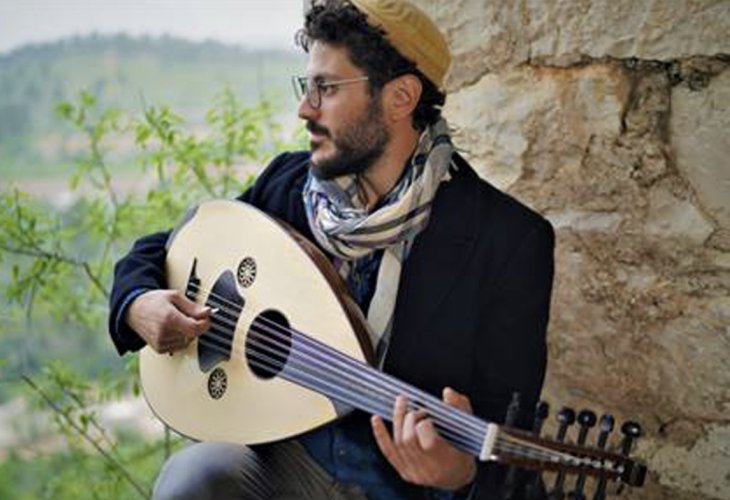 Uriah Harush (Photo: Yanai Yaacov Lein)
The sun was making one final appearance, emerging from between the clouds for a brief farewell, when I arrived at Moshav Beit Zayit in the Judean Hills, just outside Jerusalem.
The home of the young Harush family sits peacefully on one of the beautiful streets of this pastoral community known for its many artists, blending naturally into the surrounding landscape. Before I had even shifted the car into park, Uriah was already greeting me in the dirt parking area beside their home.
The attractive, rustic appearance of the house somehow brought Avraham Avinu, the great master of hospitality, to mind. In the end, and somewhat unexpectedly, I stayed with the Harush family longer than I had planned. The warmth of that first impression remained with me until I finally left their home and continued on my way.
Uriah Harush is married to Nili and a father. A prolific musician, songwriter, composer, and performer, his first single, "Bega'aguai" ("In My Longing"), received praise, radio airplay, and touched the hearts of many listeners. When performances were canceled because of the coronavirus pandemic, Harush used the unexpected break to record his debut album.
"I was born in Dimona," he begins. "I had a simple and special childhood in a wonderful, loving family. My father was born in Dimona. His family immigrated from Morocco a few years before he was born, and my mother immigrated from Morocco. There are four brothers in our family, and I'm the youngest. We were very close as children, and thank God, we still are today.
"It was important to my parents that we sleep together, two brothers in each room. Every so often, my father would even switch the room arrangements so that, at least for a certain period, each of us would have the experience of sharing a room with each of the others.
"My parents also wanted us to receive a musical education from an early age, so they sent my three brothers to the conservatory in Dimona. Avia, my oldest brother, played trumpet and today works in high tech. My brother Yagel, an accomplished musician from whom I've been privileged to learn a great deal, played clarinet. And my brother Oded, who works in education, culture, and communications and appears frequently on Hidabroot, learned guitar.
"To tell the truth, I was the kind of child who didn't stick with extracurricular activities for very long, so my parents didn't send me for formal music lessons the way they did with my older brothers.
"I may have given up on classes pretty quickly," Harush admits, "but the desert and its landscapes were something I remained deeply attached to. My parents' home is right on the edge of the desert, and I spent many hours there as a child. From about the age of six, I would often cross the road and head down into the desert, sometimes with friends, but most of the time alone.
"Dimona in general is a very special place. My grandmother would often pick me up from kindergarten, and on the way home we would encounter a herd of goats. She would casually start chatting in Arabic with the shepherdess.
"One of my companions in the desert was Akiva Turgeman, who remains a close friend to this day and is now a talented and successful artist. We would play in the desert for hours. We had our own cave where we would play, and when we were older, we would light bonfires and stay there playing music all night.
"Long before I learned what hitbodedut was, I was practicing it in the desert, spending hours alone and talking to God. There is something incredibly quiet and peaceful about the desert that makes that possible. Even today, when I visit my parents in Dimona, something happens to me. The desert speaks to me. There is tremendous humility in the desert."
When Music Became Serious
"There were always lots of musical instruments around our house," Harush continues, "and every so often I would experiment with one of them. The desire to make music burned inside me from a very young age, maybe five. But the real turning point came when I was twelve. I simply picked up one of the guitars in the house and never put it down. I still haven't.
"The connection was immediate and powerful. At first I taught myself. Three years later, I began studying with a private teacher. Today we're good friends, and we've also performed together many times. Later I studied with other teachers, some of whom lived in central Israel. I would travel several hours each way for a one hour lesson and then travel all the way back. By that stage, music had become very serious for me, and my parents gave me a tremendous amount of support and encouragement.
"They didn't believe this would eventually become my profession, but they supported me anyway. Officially, I attended high school, and eventually I even earned my matriculation certificate, but I didn't invest very much in school. There were plenty of times when I reached the school gate and thought, 'What, I'm going to spend the whole day here? No way,' and turned around. Usually I went straight to the desert. And through all of it, I never stopped playing music."
During those years, toward the end of high school, were you already thinking about taking your music to the next level?
"Absolutely. I was completely focused on it. During my army service, I really wanted to do something with music, but that obviously wasn't simple. So immediately after I was discharged, I took my discharge grant and used it to produce my first album.
"I enrolled at the Rimon music school's branch in Beersheba, and while studying there I began working on the album. The process took a long time, and I invested a tremendous amount in it. But just before the album was supposed to be released, I decided to shelve it.
"When I made the album, I wasn't religious. By the time it was ready to come out, I was observant again. Today, when I look back at those songs, I can see that some of them were actually very much about faith. Still, I decided not to release the album.
"When I produced it, I was a recently discharged soldier dreaming of moving to Tel Aviv and making it big, the typical dream of a young person from the periphery. By the time the album was ready, I was married and much more settled. In one of those songs, for example, I sang, 'God, just give me a reason to believe.' Today I wouldn't sing a line like that. I have more humility before God now. A considerable amount of time had passed between writing the songs and preparing to release them, and time had changed me."
Later, you also entered the academic world rather than limiting yourself to the practical side of music.
"Yes. It was important to me to become more professional in that area as well. Academic study can contribute tremendously to any artist. I enrolled at the Jerusalem Academy of Music and Dance, where I completed a bachelor's degree in Middle Eastern music and specialized in the oud. I then continued to a master's degree in contemporary improvisation.
"When I was accepted to the academy, my wife Nili had just been accepted to law school, and we were living in Nachlaot. I had no idea how we were going to support ourselves, but we had tremendous faith that, with God's help, we would manage.
"Not long after I began studying, I started working as a sound technician and production assistant. A few years earlier I had worked at the theater in Dimona, composing music for plays and dance performances, so I felt I had something to contribute.
"I had a wonderful experience at the theater, and this is a good opportunity to thank God for sending so many good people into my life along the way who were real angels.
"After several months at the theater, I began performing more frequently with my brother Yagel and David D'Or. From there, I began working with other artists. Over the years I've been privileged to play with Shuli Rand, Haim Louk, Amir Benayoun, Erez Lev Ari, and others. I was also the principal oud player for the Israeli Andalusian Orchestra.
"A few months after I began performing regularly, I left the theater because I realized I could actually make a living from music. I also played on the street quite a lot. A friend from school and I would take our instruments, find a place, and simply start playing. On pedestrian malls, in the market, wherever we could."
The Humility of a Street Musician
"Being a street musician is a very special experience. It's truly a lesson in humility. Often, you don't play what you want to play. You play what people ask you to play.
"Once, while we were performing, a drunk man approached and asked us to play a particular song. We continued playing other songs, but he kept insisting. Again and again, he came closer and asked us to play that song.
"After half an hour, I finally told my friend, 'Let's just play it for him so he'll leave us alone.' We started playing, and I watched him standing in front of us. He closed his eyes and began dancing by himself, completely absorbed in the music. He was simply savoring every moment.
"A few minutes after we finished, he came back with a 200 shekel bill and tucked it into my shirt. He had been so moved. Financially, street performance could actually be worthwhile. In a few hours of playing, we could earn anywhere from 300 to 1,200 shekels."
"My Song of Songs"
"God smiled on me in the world of live performance, and I saw that I could earn a respectable living from it," Harush says. "At one point I also began performing with the Israeli Andalusian Orchestra, where I stayed for three years. They had invited Yagel to collaborate with them, he brought me along, and afterward they asked me to stay.
"Around that time, I felt ready to begin teaching as well. I gave workshops, began teaching at the Musrara School of Music, and gave private lessons. But performing remained the main focus.
"Thank God, our musical field is very successful in Israel. At the academy, you meet musicians from many different genres, and you see that in other styles, jazz for example, it can be much harder for musicians to succeed and find performance opportunities.
"Sometimes one of my professors would cancel a lesson because he had gotten a performance. On the one hand, it was disappointing because the lesson was canceled. On the other, it gave me hope. It showed me that our music had a market and an audience.
"Early on, I was debating whether to study Western or Eastern music, and a friend gave me advice that helped tremendously. He said, 'If you want to study jazz, go study in New York. That's where the scene is. But if you want to study in Israel, learn what is happening here.'
"Israel has world class masters in the kind of music I play. This is also a wonderful opportunity for me to mention Elad Levi, a master of Andalusian music from whom I've learned an enormous amount. Ethnic music in general is very strong in Israel. In fact, I think we're currently learning the language of Israeli music itself. We're bringing Andalusian, North African, and Middle Eastern music together with jazz, blues, and rock, and from all of that we're creating new Israeli music."
When did you feel that the time had come to break through with original material of your own?
"Alongside all the performances and workshops, I was constantly writing and composing my own material, so over time I accumulated quite a collection. I had melodies without lyrics, lyrics without melodies, and several complete songs. Professionally, though, most of my time went into performances and rehearsals, which was another reason I wasn't releasing my own work.
"Then the coronavirus arrived and turned everything upside down. My entire schedule, booked for many months ahead, disappeared in a single day. There had been months when I performed more than 20 times. It was genuinely a life changing event for me.
"Because of my strong faith in God, I wasn't afraid. I trusted that He would continue to provide for us. Professionally, there was tremendous uncertainty, but I remembered that God is in the world and He runs everything.
"I quickly understood that the pandemic was going to be serious and that performers would be the first to stop working and the last to return. It didn't take long for me to realize that this was my opportunity to record an album.
"I knew exactly which musicians I wanted with me: Hillel Amsalem, a master percussionist and expert in Andalusian, African, and Cuban music, and Dror Tobol, who plays Middle Eastern double bass and specializes in North African and Middle Eastern music. We invested an enormous amount in this album, and we spent more than half a year just rehearsing. People don't really do things like that anymore. It was an incredible amount of work because we wanted to record the entire album live.
"Throughout the process, I felt that this was my own Song of Songs. It was, in essence, my dialogue with God."
You seem like a modest person, not someone who chases publicity. How do you handle that side of the music industry?
"It really is a challenge. But I can say that I'm glad this didn't happen too early in my life. Today I have the anchor of a home and a family, and that gives me tremendous calm and stability. If I had begun releasing music when I was younger, I imagine it would have been much more complicated.
"At the same time, I understand that I'll have to expose myself to some degree. There really isn't a way to release your music without playing the game. But within that, I have my boundaries.
"And if we're talking about beginning to release my own material, I definitely wanted my first calling card to be 'Bega'aguai.' That song expresses me. It expresses who I am. I create out of longing. Quite a few people told me there were stronger singles on the album, but I decided to begin specifically with this one. I wanted to express that longing for God.
"Another thing that made the process easier was sending the recordings to producer Udi Turgeman after we finished recording them. It gave me a tremendous sense of release and freedom. Of course, we worked on the production together, but I also gave him plenty of room.
"We're constantly influenced by other people, and when that happens in the right measure, it's a wonderful thing. Something beautiful happens when we absorb something deeply from another person and then manage to bring it out from within ourselves in the most authentic way possible."
You're beginning this journey with a label attached to you: "Yagel Harush's younger brother," especially since he makes music similar to yours. How does that feel?
"Yagel and I are a love story. I don't feel that I'm operating in his shadow, but he has certainly spread his good wings over me. We've been playing together professionally for more than a decade. I've learned so much from him: how to conduct yourself professionally, how to run a rehearsal, how to prepare for a performance, and much more.
"There are plenty of challenges in forging an independent path, even without the family connection. I was very nervous before releasing my first song. Sending your own songs out into the world is frightening. I'm glad that while we were creating, I wasn't thinking about any of that. The pandemic gave us a kind of bubble in which we could simply work.
"What ultimately helped me decide to release the songs was the extremely positive response we received. We realized we had something meaningful here. Thank God, we felt we had something to give the world."
There are four brothers in your family, and three of you chose artistic professions. Do you have an explanation for something so unusual?
"It's actually funny because that was the last thing my father wanted," Harush laughs. "My father raised us to find steady, stable jobs, eight to four in an office. That's also the life he chose for himself. He was a banker for 40 years. At one point, he even registered me for a job at the nuclear research facility in Dimona.
"My mother, however, is extremely creative, so perhaps we got it from her. She's also a wonderful singer. At the same time, my father was the one who played Middle Eastern and North African music at home, and that obviously had an enormous influence on us.
"One thing I definitely took from my parents' upbringing was the importance of home. Many people don't realize how difficult it can be to be a musician. I perform frequently as an instrumentalist, and you're always expected to be excellent. Naturally, that requires tremendous amounts of practice and rehearsal, and that time comes at the expense of being at home.
"Then there are the performances themselves, which usually take place in the evening, exactly when you would naturally expect to be home with your family. So within all of this, I try to maintain the right balance between work and home.
"Performances abroad complicate things even more. I've turned down overseas performance offers more than once. My wife and I have an agreement that I always accept performances in Morocco, but everything else needs to be considered individually. I'll travel to Europe only if the trip is no longer than two days. I still don't do the United States. Maybe that will change when our whole family can travel together. A few years ago, I flew to Warsaw for a performance with David D'Or and was back home in less than 36 hours."
Where do you hope this journey takes you?
"I want my songs to reach the hearts of the Jewish people, and the hearts of people throughout the world. I want my music to touch people. One of the most powerful things I've learned in this field is that you have no idea what something you've created can do for another person.
"We spoke earlier about publicity and promotion. If there's one reason I'm willing to enter that world, that's it: the possibility of having a positive impact on people. Beyond that, I want to continue working with people I love and respect and continue learning from them, both in playing and singing. Playing comes more naturally to me. Singing is something I have to work on more.
"Thank God, I've received very encouraging responses to the songs, and that gives me the strength and desire to continue creating.”

