

Israel News
Israel Moves Closer to Ending Its Electricity Isolation With Undersea Link to Europe
The planned cable through Cyprus and Greece would give Israel its first connection to a foreign electricity grid, providing an additional source of power during emergencies as the project gains new international backing.
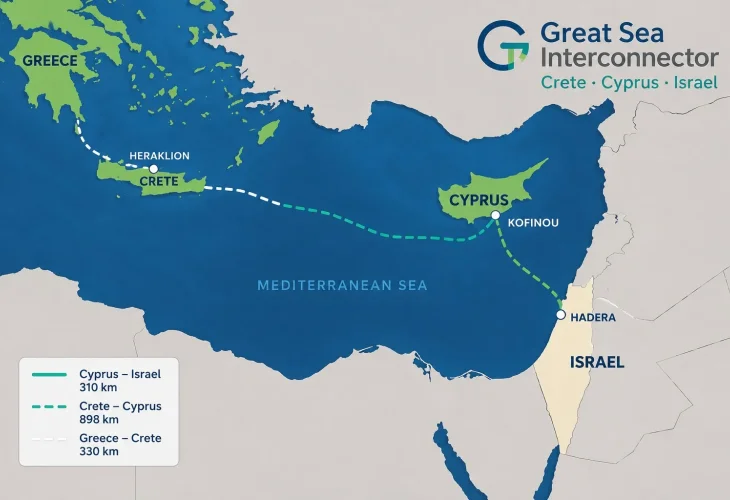
Israel is moving closer to connecting its electricity grid to Europe through a major undersea cable, a project that could give the country an additional source of power during wartime emergencies.
Israel currently operates as an “energy island,” with no electricity connections to neighboring countries. That means the country must generate all of its own electricity, leaving the system more exposed if power plants, natural gas facilities, or major transmission infrastructure are damaged during a war.
The Great Sea Interconnector is designed to change that. The project would connect Israel to Cyprus by an undersea electricity cable, continue from Cyprus to the Greek island of Crete, and ultimately connect Israel to the wider European electricity network. “The system would be bidirectional, allowing Israel to both import and export electricity depending on supply and demand.”
The project has gained renewed momentum in recent weeks after years of delays.
French infrastructure firm Meridiam recently became the majority shareholder in the company developing the interconnector, while French manufacturer Nexans is preparing to advance work on the cable. The project operator also submitted a formal investment request this month for the Israel-Cyprus section.
The United States has expressed support for the project as part of broader efforts to strengthen energy security and cooperation in the Eastern Mediterranean.
Israel relies heavily on domestic natural gas, while its electricity grid has no external connection. During conflict, offshore gas facilities and other energy infrastructure can be shut down or restricted because of security threats.
A connection to Europe would not eliminate those risks, but it would give Israel an external source of electricity during shortages or emergencies.
Israel’s Energy Ministry considers the project strategically important and is currently examining the economic feasibility of the Israel-Cyprus section. Israel and Cyprus are expected to negotiate how the costs will be divided and seek additional European funding. The current target is for electricity to begin flowing through the connection by 2034.
The project also faces geopolitical opposition.
Turkey has repeatedly objected to sections of the planned cable because of its maritime disputes with Greece and Cyprus in the eastern Mediterranean. Turkish pressure has previously delayed survey work connected to the project.
Greek officials have rejected Ankara’s objections, saying Turkey’s permission is not required for construction to continue.
The European Union has already committed hundreds of millions of euros toward the Greece-Cyprus section of the project.
If completed, the interconnector would end Israel’s long-standing electricity isolation and give the country access to the wider European power grid during both routine periods and emergencies.

