

Wonders of Creation
How Does the Amazon Stay So Green? The Answer Starts in the Sahara
One of the driest places on Earth helps supply nutrients to one of the wettest. Discover the remarkable journey of Sahara dust to the Amazon rainforest.
- Yehosef Yavetz
- | Updated
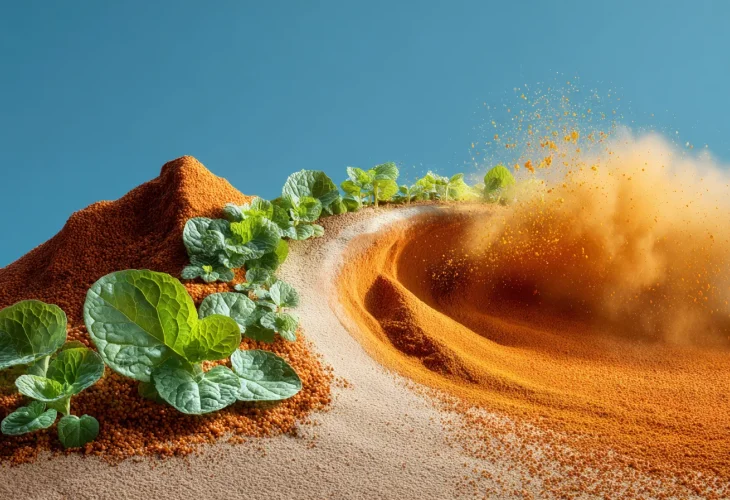
Plants need nutrients to grow. We know that from our own gardens, where fertilizer is often added to keep plants healthy. In city parks, gardeners regularly replenish the soil.
But who fertilizes the vast Amazon rainforest? With millions of acres of dense vegetation, where do all those plants get the nutrients they need?
The surprising answer is that some of those nutrients arrive from thousands of miles away.
In North Africa lies the Sahara Desert, an immense expanse of rock, gravel, bare earth, and dunes that receives very little rain. On the other side of the Atlantic Ocean, in northern South America, lies the Amazon Basin, home to hundreds of millions of acres of dense, humid tropical forest.
Every year, these two dramatically different regions become physically connected. Tiny particles of African dust rise into the atmosphere, travel thousands of miles across the Atlantic, and eventually settle over the Amazon. Along with them comes one of the nutrients the rainforest needs most: phosphorus.
Millions of Tons of Dust Cross the Atlantic
In 2015, a team of researchers led by scientist Hongbin Yu of the University of Maryland and NASA’s Goddard Space Flight Center used years of satellite measurements to quantify the enormous scale of this movement.
Their findings were remarkable: about 28 million tons of African dust settle over the Amazon Basin each year.
This is not the coarse sand we typically associate with the Sahara. What crosses the Atlantic is primarily extremely fine mineral dust, including particles of clay, silt, and other tiny minerals that winds can lift high into the atmosphere and keep airborne for days. At their peak, these dust clouds can be seen from space as a yellowish-brown layer stretching from the coast of West Africa deep into the Atlantic.
Measurements collected by the CALIPSO satellite allowed researchers to track the journey almost like a shipping ledger. On average, about 182 million tons of dust per year traveled westward past 15 degrees west longitude, near the African coast. By the time the dust reached around 35 degrees west longitude, closer to South America, approximately 132 million tons remained in the atmosphere.
Along the way, some of the dust settled into the ocean or was washed out of the atmosphere by rain. Of the remaining mass, about 27.7 million tons settled over the Amazon Basin, while another 43 million tons continued westward toward the Caribbean Sea.
Why Does the Amazon Need Help From the Sahara?
From the outside, a tropical rainforest may look like the last place on Earth that could be short of nutrients. There are towering trees, dense vegetation, and enormous quantities of leaves and organic matter.
Yet many soils in the Amazon Basin are actually poor in certain nutrients.
Heat, humidity, and enormous amounts of rainfall affect the soil over long periods of time. Minerals weather away, while soluble nutrients are carried by rainwater into streams and rivers. As a result, much of the rainforest’s nutritional wealth is stored not in the soil itself, but in its trees, leaves, and other living matter.
When a leaf falls and decomposes, its nutrients are quickly absorbed again by plant roots. It is an extraordinarily efficient recycling system, but it is not completely closed.
One of the important nutrients lost from this system is phosphorus. Plants need phosphorus for essential processes involved in growth and metabolism, and it can be a limiting nutrient in parts of the Amazon Basin. Every year, some phosphorus leaves the ecosystem through rivers and the gradual leaching of nutrients from the soil.
Researchers compare the process to a bathtub with a slow leak. Nutrients are recycled again and again within the forest, but a small amount continually escapes.
This is where African dust plays an important role.
Of the roughly 28 million tons of dust estimated to settle over the Amazon each year, Yu and his colleagues calculated that about 22,000 tons consist of phosphorus, averaging approximately 23 grams of phosphorus per hectare of forest.
That may sound tiny compared with millions of tons of dust, but for the Amazon’s phosphorus balance, it is significant. Researchers found that the amount arriving from African dust is comparable to the amount of phosphorus estimated to be lost from the Amazon through rainfall and rivers each year.
Where Does the Phosphorus Come From?
We tend to think of deserts as endless stretches of sand. So where does all this phosphorus come from?
One of North Africa’s best-known dust-producing regions is the Bodélé Depression in Chad. Today, it is one of the driest places on Earth, but in the distant past, the region was part of the vast Mega-Lake Chad system.
Over thousands of years, sediments accumulated on the ancient lakebed, including the remains of microscopic organisms such as diatoms, single-celled algae with mineral-rich structures.
As the lake shrank and the region dried, these ancient, powdery sediments were left exposed. Powerful winds sweeping through the depression can lift enormous quantities of this material into the atmosphere, including phosphorus-containing minerals.
The result is extraordinary: material from an ancient African lake can cross an entire ocean and contribute nutrients to living vegetation in South America.
How Scientists Followed the Dust
Researchers were able to measure this enormous journey largely thanks to an instrument aboard the CALIPSO satellite.
Launched in 2006, CALIPSO used lidar, a remote-sensing technology that uses laser light. The satellite sent pulses of light into the atmosphere and measured the signals reflected back by particles such as dust.
This allowed scientists to determine not only whether a dust cloud was present, but also how high it was, how thick it was, and how its concentration changed during its journey.
Instead of simply seeing a flat brown cloud over the ocean, researchers gained a three-dimensional, multi-year picture of the enormous atmospheric pathway connecting Africa and South America.
Scientists had already identified African dust in the Amazon decades earlier. The major advance of the 2015 research was the ability to quantify the phenomenon: how much dust leaves Africa, how much remains over the Atlantic, how much reaches the Amazon, and how much phosphorus arrives with it.
A Remarkable Connection Between Two Continents
The picture that emerges seems almost counterintuitive.
One of the driest regions on Earth contributes to the nutrient balance of one of the wettest.
Amazon rainfall, essential to the rainforest’s survival, also carries some phosphorus out of the ecosystem. Thousands of miles away, powerful winds lift mineral-rich dust from the exposed ground of North Africa. Atmospheric currents carry that dust across the Atlantic, and rain and gravity eventually bring some of it down onto the Amazon’s trees and soil, where its nutrients can enter the forest’s natural cycle.
The scientific answer to the question “Who fertilizes the Amazon rainforest?” therefore begins thousands of miles away, across the Atlantic Ocean.
But there is also a deeper message. The Creator designed a world in which places that appear completely disconnected can depend on one another in remarkable ways. A desert thousands of miles away can help supply nutrients to a tropical rainforest across an ocean.
Scientific research allows us to uncover just a small part of the extraordinary complexity built into creation, revealing connections that would otherwise have been almost impossible to imagine.

