

World News
Spain’s Ceuta Migration Crisis Deepens as Prime Minister Accuses Israel of Spreading Disinformation
Thousands of migrants remain in the Spanish enclave after roughly 70,000 people entered from Morocco, heightening tensions in the city. Spanish Prime Minister Pedro Sánchez says Israel and Russia exploited the crisis to spread false information.
 Illustration
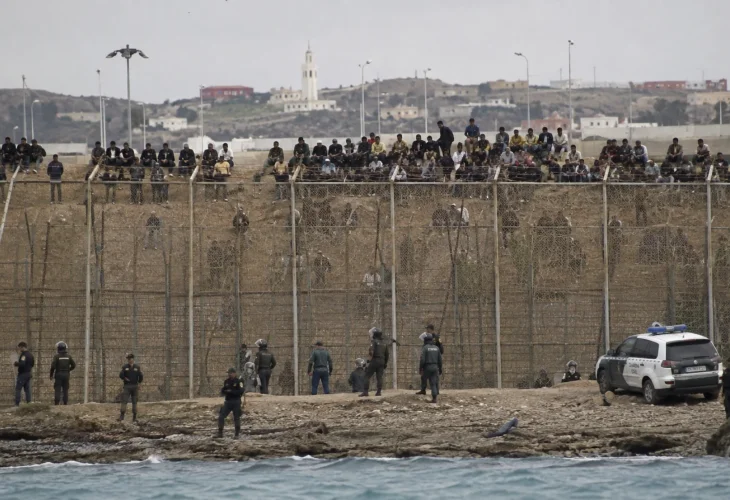
The migration crisis in the Spanish enclave of Ceuta continues to fuel intense tensions, with thousands of migrants still in the tiny North African territory weeks after roughly 70,000 people crossed into it from Morocco. Against the backdrop of clashes in the city, Spanish Prime Minister Pedro Sánchez today (Monday) accused Russia and Israel of spreading and amplifying false information related to the mass arrival of migrants at the end of July.
In an interview with Cadena SER radio, Sánchez said that "after July 30 and 31, rumors and false information spread through social media networks linked to both Russia and Israel, as well as from an international far-right organization that always uses migration not only to attack Spain, but also to attack Europe and divide it."
According to the Spanish prime minister, it is "clear" that Russia and Israel took advantage of the crisis to criticize his government, amid Madrid’s disagreements with both countries over its position on the wars in Ukraine and the Middle East.
At the same time, Sánchez rejected the possibility that Moroccan authorities were involved in the sudden flow of migrants toward the enclave: "No intelligence service with which the Spanish government normally cooperates has any doubt, or, more precisely, has suggested any doubt, regarding the involvement of Moroccan authorities in one way or another."
The overwhelming majority of the more than 70,000 people who entered Ceuta at the end of July, either by swimming or walking from the Moroccan side, returned to Morocco within hours or have since been sent back. Still, thousands remain in the enclave, which covers only 18 square kilometers, and their presence has become a crisis that Sánchez’s government is struggling to manage.
The size of the population remaining in the city is also disputed. Spain’s left-wing government estimates that between 3,500 and 7,000 migrants are currently in Ceuta, while the enclave’s leaders say the number is at least 10,000.
Alongside the migration crisis, security tensions have also escalated. On Saturday, four Moroccan migrants were arrested on suspicion of throwing stones at a patrol of Spanish soldiers. A police spokesperson told AFP that one soldier fell and was injured while chasing the suspects.
It was the second incident of its kind in just a few days. Early Thursday morning, a military vehicle carrying four soldiers was attacked after around 70 migrants ambushed it and threw stones and other objects at it. The soldiers managed to escape and call the police, while one was lightly injured after being hit by a stone. Following the incident, 12 migrants, all Moroccan citizens, were arrested, and 11 of them were deported back to Morocco, according to local reports.

