

Israel News
Givati Soldiers: “There Is a Deliberate Effort Here to Clash With Religious Soldiers”
Following the incident in which 16 religious soldiers were sent to military detention after refusing to ride in a Namer armored vehicle with a female paramedic, soldiers described clashes with commanders during the preceding Shabbat. “They asked us to conduct drills on Shabbat, with no operational need.”
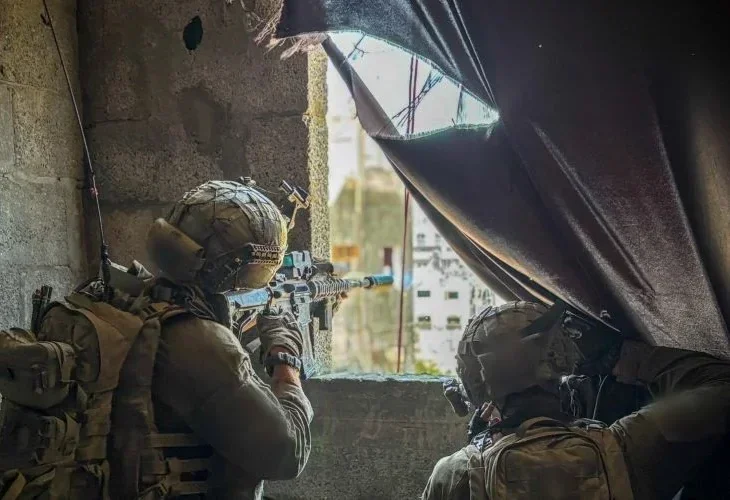 Activity in Gaza, archive (Photo: IDF Spokesperson)
The Council of the Union of Hesder Yeshivas responded this evening (Monday) to the incidents in a battalion of the Givati Brigade. A letter sent to the rabbis of the yeshivas and their students stated, among other things: “The recent incident in the Givati Brigade, in which soldiers refrained from going out with a female paramedic in a Namer armored vehicle for operational duty, is the kind of incident we have been trying to prevent for a long time. The ongoing reality, in which Torah-observant combat soldiers are forced to contend day after day with mixed male-female combat teams during their service, under conditions that are not compatible with halacha or their spiritual world, and that do not comply with the Joint Service Order, has led us to this unfortunate incident in the Givati Brigade.”
“The rabbis of the Hesder yeshivas have been warning for a long time about repeated violations of the Joint Service Order, and about the IDF’s personnel-building approach, which does not take the reality described above into account. The fact that soldiers are repeatedly forced to choose between their faith and their loyalty to the military places them in an impossible conflict that harms both the IDF and the soldiers themselves.”
“Such a complex reality requires the military and those issuing orders to build a system in which trust is a solid foundation, a system in which a commander understands his soldiers and presents the reality to them as it is; a system in which adherence to the Joint Service Order by IDF commanders, and the ability of a soldier who observes halacha to serve according to his faith, are given high and clear priority in guidelines, orders, and actions.”
“On the other hand, the soldier must trust his commanders, carry out his duties to the best of his ability, and obey his commanders’ orders in an operational situation in the field, provided those orders have been approved by operational authorities and the military rabbinate. The IDF’s ability to continue functioning rests on this trust.”
The letter continued: “In the current incident, an outstanding platoon that fought bravely, with some of its soldiers wounded in battle, and that also faced the complex reality of mixed male-female combat teams, was forced in a single moment to decide in such a conflict. Even if an error was made in that decision, it cannot be viewed as an isolated event disconnected from the broader challenging reality. A deep and thorough review shows that the current incident was preceded by a crisis of trust with the direct command, stemming from a failure to adhere to halacha and orders while presenting the soldiers with a false picture, and this made a significant contribution to their decision in this case. We call on the military to get to the bottom of the matter and address problems such as these with the necessary seriousness.”
“Given the complexity of the circumstances, the harsh punishment imposed on the soldiers does not, in our view, fit the broader picture that emerges from the review of the incident.”
It should be noted that yesterday, because they refused to board the Namer, five soldiers were sentenced to 10 days of military detention and 11 others to five days. The IDF Spokesperson claimed that the combat soldiers “refused to go out on an operational mission in the Gaza Strip, which ultimately was not carried out as planned.”
According to the report, the soldiers said that about a week and a half before the Namer affair, the company commander decided to hold a drill on Shabbat involving the evacuation of wounded soldiers and opening a vein. They said there was no operational urgency requiring the drill to take place on Shabbat, and they asked that it be postponed to another time. According to them, after Shabbat they approached the brigade rabbi, and after hearing the details of the incident, he replied that there was no reason to conduct such a drill on Shabbat when it did not stem from an operational need.
The soldiers added that regarding the Namer incident as well, “there was no operational activity at that time. The incident was presented to the brigade rabbi as operational activity, but it was routine activity.”
The soldiers claimed that “our feeling is that there is a deliberate effort here to clash with religious soldiers and students of the Hesder yeshivas. Instead of finding solutions and allowing shared service based on mutual respect, they repeatedly choose confrontation.”

